| Size in ft | Width: 9'8" x Length: 12'8" |
| Size in Inch | Width: 116" x Length: 152" |
| Size in meters | Width: 2.95 x Length: 3.86 m |
| Colors | Red, Burgundy, Black, Ivory, Brown, Rust |
| Shape | Rectangular |
| Woven | 100% Hand-knotted | Handmade |
| Pile | Wool |
| Age | 1980s |
| Design | Turkmen Bokhara | Rows of Guls and Cross Motifs | Wide Geometric Borders |
| Origin | Made in Iran | Turkmen |
| Condition | Excellent |
9'8" x 12'8" Persian Turkmen Bokhara Rug | Red Field, Rows of Guls | 1980s Wool
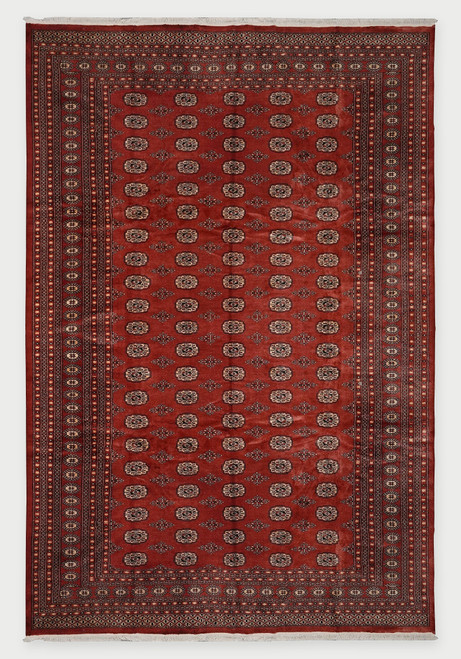
This 9'8" x 12'8" Persian Turkmen Bokhara rug lays rows of black, ivory and brown guls across a deep red field, the classic tribal pattern that has made Bokhara rugs a favourite for generations. Small cross-shaped motifs sit between the guls, and broad borders of zigzags and diamonds frame the whole piece in darker burgundy. It was hand-knotted in Iran by Turkmen weavers in the 1980s and is in excellent condition, with a soft, even wool pile. At this generous size it fills a large living room, a family room or a dining room with a table for eight, and its strong red brings warmth and character to wood floors, stone and neutral furniture.
Rows of Turkmen Guls and Cross Motifs
The field is built from a strict grid of guls, the octagonal emblems of Turkmen weaving, set in long rows from one end to the other. Each gul is divided into quarters filled with small hooked shapes in black, ivory, brown and rust, and the quarters alternate in colour, which gives the repeat a quiet rhythm. Between the guls stand smaller cross-shaped motifs drawn in black outline, linking the rows into a lattice. The borders are wide and layered: a main band of stepped diamonds and zigzag lines in burgundy and black, framed by narrow stripes of tiny triangles and dots. At each end a deeper panel, called an elem, carries large diamond shapes, a typical Turkmen finish. The close-up photos show the clean, sharp drawing of each gul and the dense, even knotting.
Deep Turkmen Red for a Warm Large Room
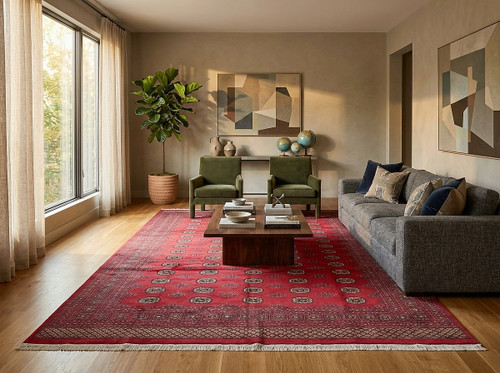
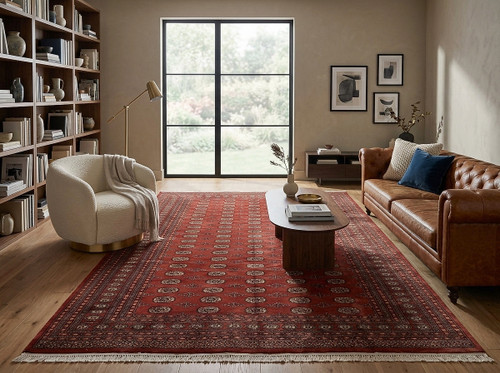
Red is the main colour, a deep, slightly cool Turkmen red that covers the field and glows in natural light. Burgundy fills the borders, and the guls bring black, ivory, chocolate brown and touches of rust. The effect is rich and saturated, yet the small repeating pattern keeps it orderly rather than busy, which is why Bokhara rugs sit so well in many styles of room. In a living room it pairs beautifully with charcoal or grey sofas, dark wood shelving and olive or green chairs, as the room photo shows. It also looks right with leather, brass and warm walnut, and against white walls the red becomes the room's main colour. Its size lets it anchor a full seating group or a long dining table, and the dark border hides everyday wear along the edges.
Turkmen Weaving in Iran and This Rug's Make
Turkmen tribes live across the borderlands of Iran, Turkmenistan and Afghanistan, and their weavers have used the gul for centuries as the mark of a tribe or family. The trade name Bokhara comes from the old market city where many of these rugs were sold. Turkmen weavers in northeast Iran still work in this tradition, with tight knotting, geometric drawing and a palette led by red. This rug was hand-knotted in the 1980s with a wool pile clipped short and even, so the small guls stay crisp, as the rolled and close-up photos show. The folded corner reveals the back, where the knots sit in fine, regular rows and the pattern reads clearly. Both ends finish in a pale fringe from the warp threads, and the long sides are bound by hand in dark wool.