Watch the film
| Size in ft: | Width: 10'3" x Length: 12'7" |
| Size in Inch: | Width: 123" x Length: 151" |
| Size in meters: | Length: 3.84 x Width: 3.12 m |
| Colors: | Navy Blue, Deep Red, Ivory, Green, Beige, Soft Gold |
| Shape: | Rectangular |
| Woven: | 100% Hand-knotted | Handmade |
| Foundation: | 100% Cotton |
| Pile: | |
| Age: | 1980's | Semi-Antique |
| Design: | Tabriz Medallion | Flowering Sprays | Corner Spandrels |
| Origin: | Persian Tabriz | Made in Persia |
| Condition: | Excellent | Full even pile |
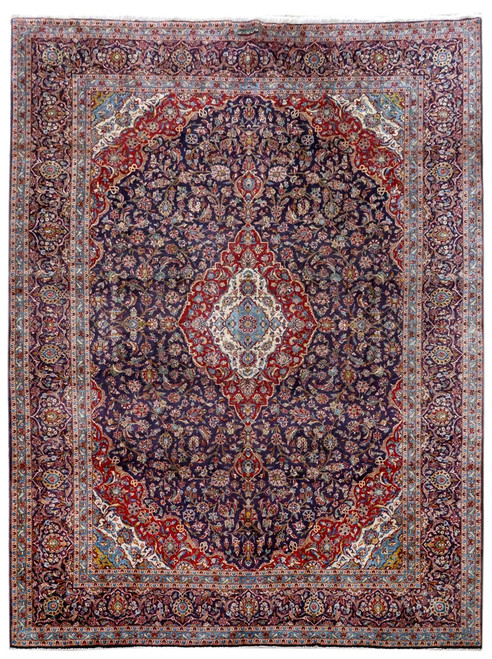
10'3" x 12'7" Persian Tabriz Rug | Navy Blue Field with Red Floral Medallion | 1980s
This is a room size piece from the workshop tradition of northwest Persia, woven in the 1980s and kept in excellent order, with a full even pile and clean, straight sides. The field reads as a deep midnight navy, almost unbroken at the outer corners, which is what gives the deep red medallion and the red corner spandrels their punch. It is a serious floor rug rather than a delicate one: heavy hand-knotted wool on a cotton foundation, the sort of weight that settles into a dining room or a formal sitting room and does not move for 40 years. Among Persian Tabriz rugs this is the classic drawing-room formula, and it sits comfortably with the rest of our large Persian rugs. Every rug we sell ships with a certificate of authenticity.
Please Note About the Photographs:
Some photos show soft pale lines and shadows running across the open navy field. Those are fold marks and pressure shadows from pallet storage, not wear, not fading and not damage. They relax once the rug is laid flat, and every rug is professionally steamed and pressed before it ships.
Design and Motifs
The layout is a single lobed medallion with slender pendants top and bottom, drawn in curved line rather than the angular village manner. Inside the red medallion sits an ivory cartouche filled with small roses, tulip forms and paired green leaves, with a pink rosette at the exact center. Out of the medallion tips run long flowering sprays, dozens of tiny blossoms on thin stems, that fan into the navy field like sprigs laid across water, and they are the detail that separates this drawing from a plain medallion rug. The 4 corners carry matching red spandrels packed with palmettes, cypress buds and scrolling vine. The main border is navy, alternating a large red palmette with turned leaves against a ground of small ivory and coral blossoms on a brown vine, and it is framed by ivory guard stripes carrying a repeating flower head and serrated leaf, with narrow olive and pale green outlines that keep the whole frame from reading heavy.
A Navy Field Lit by Red, Coral and Ivory
The ground is a saturated navy blue that shifts with the nap, closer to indigo where the pile leans away from the light and nearly black-blue where it leans into it. Against it the medallion and spandrels are a true deep red, warm rather than orange, and the ivory center reads as a soft cream tinged with pale pink. The floral work carries the rest of the palette: coral and blush pinks in the blossoms, olive and sea green in the leaves, soft gold and ochre in the vine work, small beige and ivory flower heads scattered through the field, and occasional rust and teal accents in the border palmettes. There is no white in the rug at all, which is why the contrast feels antique rather than graphic. Under lamplight the navy deepens and the coral notes come forward; in daylight the green and gold do more of the work.
Tabriz Weaving in Northwest Persia
Tabriz has been the commercial and design capital of Persian weaving for centuries, and its workshops are built around drawing: a curved line, a flowing vine and a medallion that resolves cleanly at the corners, all of which need a disciplined weave to hold together at this scale. Tabriz weavers count fineness in Raj, the knots across a gereh of roughly 2.75 inches, and a room size piece such as this one is woven on a taut cotton warp with the wool packed down hard so the pattern stays square across more than 12 feet of length. The wool here is dense and slightly lustrous, cut at a medium pile, with the tight selvedges and even fringe you expect from town work rather than village weaving. The 1980s date puts it in the semi-antique bracket, and if you want to understand how weavers, dealers and collectors read age from wool, dye and wear, our guide on how to date an Oriental rug walks through the same checks we ran on this piece.
10'3" x 12'7" Persian Tabriz Rug | Navy Blue Field with Red Floral Medallion | 1980s
Ask about this rug
This piece is the only one of it, so the things worth knowing about it are particular to it. If you want to talk through the size, the colour in your own light, or the weave, speak to someone here first.