Watch the film
| Size in ft: | Width: 10'5" x Length: 13'7" |
| Size in Inch: | Width: 125" x Length: 163" |
| Size in meters: | Length: 4.14 x Width: 3.18 m |
| Colors: | Light Green, Blue, Ivory |
| Shape: | Rectangular |
| Woven: | 100% Hand-knotted | Handmade |
| Foundation: | 100% Cotton |
| Pile: | |
| Design: | Sarouk | Saraband Mir Boteh | All-Over Repeat |
| Origin: | Persian Sarough | Made in Persia |
| Condition: | Excellent |
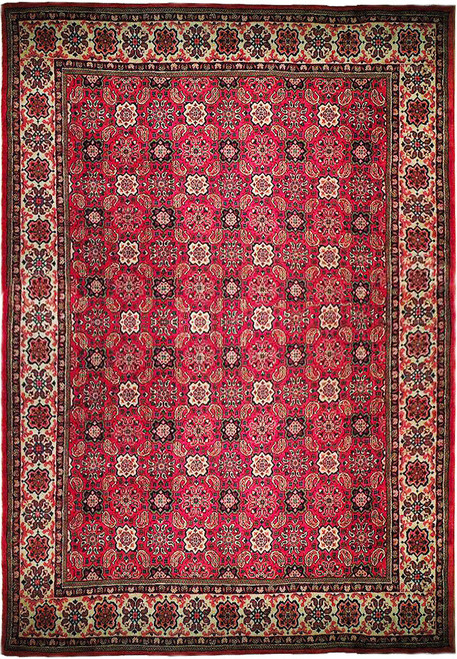
10'5" x 13'7" Persian Sarough Rug | Saraband Mir Boteh All-Over Design | Light Green Field, Multi-Border
This is a room-size piece from the Arak weaving belt of western Persia, where the Saraband villages and the Sarough workshops have shared drawing and technique for generations. The field is covered edge to edge with the small Mir boteh, thousands of tiny paisleys marching in disciplined diagonal rows across a light green ground, and the whole thing is framed by a stack of narrow guard stripes and one wide ivory main border. The pile is 3/8" wool on a cotton foundation, in excellent condition with even nap and sound, straight selvages, and at 10'5" x 13'7" it covers a full seating group without crowding the walls. If you want the background on the type before you commit, our guide to Persian Sarough rugs walks through the weave and the regional variations. Every rug we sell ships with a certificate of authenticity.
Please Note About the Photographs:
The full overhead photograph was shot under flat studio light, which mutes the field toward grey-green. The corner close-up is the truer reading: a soft, clear light green with warm red and navy botehs sitting on top of it. The color in person sits between the two images, closer to the detail shot.
Design and Motifs
The field is pure Mir-i-Boteh: a single small paisley, drawn with a hooked tip and a serrated body, repeated in staggered rows so the eye reads diagonal lattice lines running in both directions. Each boteh alternates in color from row to row, which is what keeps an all-over boteh repeat from going flat over 13 feet of length. There is no medallion and no open ground, by design; this pattern is meant to work as a continuous textile surface. The border system is the other half of the story. Counting outward from the field there are 9 concentric bands, alternating narrow reciprocal sawtooth and barber-pole stripes with two wider ivory bands carrying a stylized turtle-and-vine figure, each one outlined in dark navy so the stripes stay crisp. The corners are resolved cleanly, with the border drawing turning square rather than colliding, which is a good sign of a weaver working from a proper cartoon.
A Light Green Field With Blue and Ivory
Light green is uncommon as a field color in this family, and it is the reason to buy this particular piece. The ground is a soft sage that shifts toward celadon where the light catches the pile, and because the botehs are so small and so densely packed, the green reads as a textured wash rather than a solid block. Inside that field, each paisley is picked out in brick red, rust and deep indigo with small ivory outlines, so from standing height the surface looks warm pink-brown and from close up it separates into distinct colors. The main borders are ivory, almost bone white, which brightens the whole perimeter and pulls the green forward. Navy does the structural work throughout, edging every guard stripe and carrying the dark outer band, and touches of soft blue and pale gold appear in the reciprocal stripes. The plain green outer surround and the ivory fringe finish it. Practically speaking, this is a rug for a room with warm wood, cream walls or brass, where a red field would shout and this will not.
Saraband and Sarough Weaving
The Saraband district sits south of Arak in western Persia, in the same weaving region that produced the Sarough name, and the two traditions overlap in both drawing and construction. Saraband weavers built their reputation on one motif, the small repeating boteh, and on executing it with near mechanical consistency over very large formats. That is harder than it sounds: any drift in the count shows immediately when a motif repeats thousands of times, and here the rows hold true from end to end. Construction is the regional standard, an asymmetric knot on a cotton warp and weft with the wool clipped to 3/8", short enough to hold the fine boteh outlines but heavy enough to take decades of traffic. Wool from this part of Persia is springy and takes dye well, which is why the reds and indigos have stayed saturated while the green ground mellowed into its current tone. In a 10x14 Persian rug, a piece of this type is a real find in excellent, never-cut, never-repaired condition.
10'5" x 13'7" Persian Sarough Rug | Saraband Mir Boteh All-Over Design | Light Green Field, Multi-Border
Ask about this rug
This piece is the only one of it, so the things worth knowing about it are particular to it. If you want to talk through the size, the colour in your own light, or the weave, speak to someone here first.