Watch the film
| Size in ft: | Width: 10' x Length: 14'2" |
| Size in Inch: | Width: 120" x Length: 170" |
| Size in meters: | Length: 4.32 x Width: 3.05 m |
| Colors: | Red, Saffron Gold, Ivory, Sky Blue, Navy, Rose |
| Shape: | Rectangular |
| Woven: | 100% Hand-knotted | Handmade |
| Foundation: | Cotton |
| Pile: | |
| Age: | 1970's | Semi Antique |
| Design: | Kerman Medallion | Cartouche Border |
| Origin: | Persian Kerman | Made in Persia |
| Condition: | Perfect | Excellent throughout |
10' x 14'2" Persian Kerman Rug | Red Field Lobed Medallion | 1970s Semi Antique
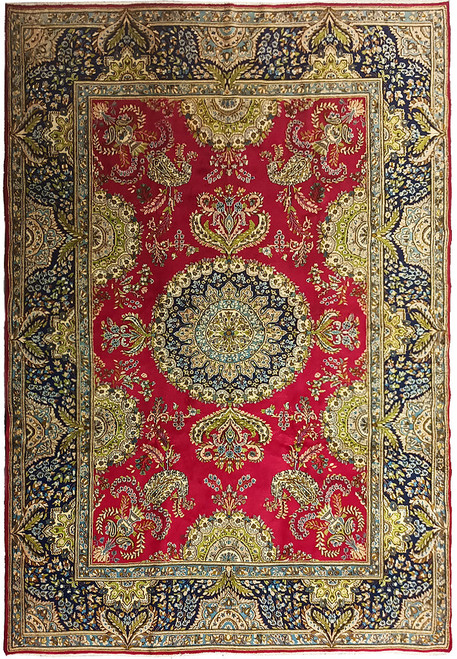
A 1970s Persian Kerman in the classic city format: a wide open tomato red field, a single ivory and navy lobed medallion, and a deep saffron border that does all of the talking. The pile is wool on a cotton foundation, clipped low enough that the drawing in the medallion and the border panels stays crisp, and the condition is genuinely perfect, with full even pile edge to edge and clean original ends and sides. At 10' x 14'2" it covers a full seating group or a 10 seat table without crowding, and it ships with a certificate of authenticity confirming origin, age, materials and hand-knotted construction. It sits naturally alongside our other 10 x 14 Persian rugs but the empty red field makes this one read far quieter in a room than most pieces its size.
Design and Motifs
The center holds a diamond medallion filled with dense ivory and navy scrollwork around a small gold cartouche, with a stepped finial at the top and a matching pendant dropping toward the bottom of the field. That medallion floats inside a large cusped red reserve whose shaped outline is drawn in gold, so the plain field is framed twice before it ever reaches the border. The four corners carry pale spandrels of ivory and sky blue packed with palmettes, 8 petal rosettes and thin curling vines, each anchored by a small rose colored blossom. The main border is the part a Kerman buyer looks at first: alternating navy and gold cartouche panels separated by slender columnar motifs, every panel filled with its own vine and rosette arrangement, then held in place by narrow reciprocal guard stripes in green, gold and ivory. The drawing is fully curvilinear, with no angular shortcuts anywhere in the field.
A Tomato Red Field Framed in Saffron Gold
The field reads as a warm tomato red with a slight coral lift where the light catches the pile, and because it is left almost entirely open it behaves like a color block rather than a pattern. Around it the palette turns soft: saffron and antique gold through the border ground and the medallion outline, ivory and buttery cream in the spandrels and guard stripes, and a cool sky blue that shows up in the palmettes and in the paler border panels. Deep navy supplies the contrast, filling alternate cartouches and the scrollwork inside the medallion, while small touches of rose, cherry red and sage green appear in the flower heads and the reciprocal guards. The selvedge is bound in red and the ends finish in natural ivory fringe. Against oak or walnut flooring the gold border picks up the wood tone and the red field stays the dominant note in the room.
Woven in Kerman, Southeast Persia
Kerman sits in the southeast of Persia and has been a workshop city for centuries, known for soft lustrous wool, curvilinear cartoon drawing and elaborate floral borders rather than village geometry. A piece like this one comes off a city loom with a designer's cartoon behind it: the medallion is symmetrical on both axes, the border panels repeat at consistent intervals around all 4 sides, and the corners resolve properly instead of being cut short, which is the first thing to check on any Kerman of this scale. The knotting is fine and regular enough on its cotton foundation that the fine vine work in the border holds its line, and the wool has aged into the slight sheen that 1970s Kermans develop once the surface has settled. Half a century on, the pile is still full, which is the best argument for how the rug was woven in the first place.
10' x 14'2" Persian Kerman Rug | Red Field Lobed Medallion | 1970s Semi Antique
Ask about this rug
This piece is the only one of it, so the things worth knowing about it are particular to it. If you want to talk through the size, the colour in your own light, or the weave, speak to someone here first.