Watch the film
| Size in ft: | Width: 13'6" x Length: 21' |
| Size in Inch: | Width: 162" x Length: 252" |
| Size in meters: | Length: 6.40 x Width: 4.11 m |
| Colors: | Raspberry red, Navy blue, Ivory, Rose pink, Sage green, Brown |
| Shape: | Rectangular |
| Woven: | 100% Hand-knotted | Handmade |
| Foundation: | Cotton |
| Pile: | |
| Signature: | Woven cartouche in the upper border | Script not legible in the photographs |
| Design: | Tabriz Star Medallion | Corner Spandrels | Open Field |
| Origin: | Persian Tabriz | Made in Persia |
| Condition: | Excellent |
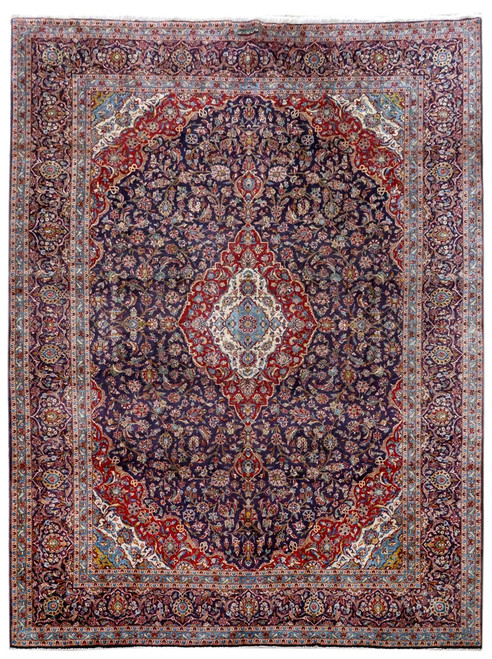
13'6" x 21' Persian Tabriz Rug | Signed Cartouche | Raspberry Red Field, Navy Floral Borders
At 13'6" x 21' this is a genuine palace piece, a hand-knotted wool Tabriz on a cotton foundation that was drawn for a room most rugs never get to fill. The weaver signed it: a small cartouche sits in the upper border, woven in ivory script on a red ground, which in Tabriz means a named workshop stood behind the piece rather than an anonymous village loom. Everything about the drawing supports that, from the balanced star medallion to the way the corner spandrels resolve against a field left largely open. It is heavy, flat lying, in excellent condition, and it ships with a certificate of authenticity. Pieces in the 13 by 21 range are scarce, so if you are shopping oversize Persian rugs for a great room or a formal salon, this one solves the size problem and the design problem at once.
Please Note About the Photographs:
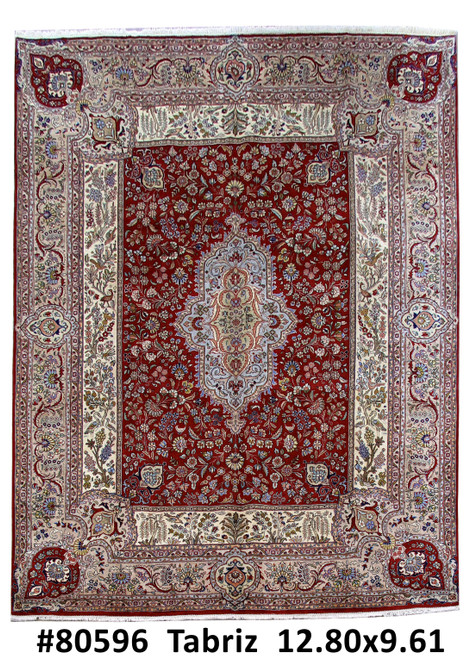
The full flat-lay photograph was shot under bright studio lighting and reads lighter and pinker than the rug actually is. The showroom floor photographs and the medallion close-up show the true tone, a deep raspberry red. The raking close-up of the field is a low-angle shot that reveals the weave structure through the pile; it is a camera angle, not wear or fading. Every rug is professionally steamed and pressed before it leaves us.
Design and Motifs
The center holds a large stepped star medallion built in three layers: an inner rosette of 8 petals in rose and green on ivory, a ring of sage and black panels filled with vases, palmettes and curling leaves, and a scalloped outer edge that throws small hooked finials out into the field. Long pendants run north and south from the medallion, each ending in a lobed cartouche and a tiny cypress-like tip. What makes the layout unusual is the group of detached cruciform panels, roughly 14 of them in navy and ivory, floating in a loose ring around the medallion instead of the usual continuous vine. Each panel carries its own miniature bouquet, so the open red ground between them reads as breathing room rather than emptiness. The 4 corners are anchored by large ivory spandrels of arabesque scrollwork, and the main border runs a near-black ground with a scrolling vine of palmettes, rosettes and serrated leaves, framed by floral guard stripes and a reciprocal trefoil stripe at the outer edge.
A Deep Raspberry Red Field Against Navy and Ivory
The field is a deep raspberry red with a cool rose undertone, closer to a ripe cranberry than to the brick reds of village weaving, and it carries a soft abrash that shifts a shade lighter and darker along the length as the light moves across the wool. Against it the navy blue does the heavy lifting: the cruciform panels, the medallion outlines and the border ground all sit in an indigo so dark it reads near black at a distance and opens into true blue up close. Ivory and pale sage carry the drawing, outlining the medallion and filling the corner spandrels so the design stays legible from across a large room. Inside those areas the palette turns lively with rose pink, salmon, warm gold, chestnut brown and small notes of green in the leafwork and rosettes. The overall effect is a warm, saturated red room anchored by dark borders, which is exactly why this coloring works under heavy furniture and in rooms with dark wood.
Tabriz Weaving and the Signed Cartouche
Tabriz sits in the far northwest of Persia and has been the country's commercial weaving capital for centuries, the place where full cartoon-drawn workshop pieces were produced to order at scale. Tabriz weavers count fineness in Raj, knots per gereh across the width, and the discipline of that system shows here in the clean curve of the medallion outline and the way the two halves of the field mirror each other across a 21 foot length without drifting. A loom this wide takes several weavers working shoulder to shoulder from a single cartoon, which is why a signature matters: the cartouche is the workshop putting its name to the piece. The wool is dense and springy on a cotton foundation, the ends are finished with the original ivory fringe, and the handle is the solid, weighty one collectors expect from a workshop Tabriz. If you want to understand the construction clues that place a piece like this in time, our guide on how to date an Oriental rug walks through what to look for.
13'6" x 21' Persian Tabriz Rug | Signed Cartouche | Raspberry Red Field, Navy Floral Borders
Ask about this rug
This piece is the only one of it, so the things worth knowing about it are particular to it. If you want to talk through the size, the colour in your own light, or the weave, speak to someone here first.