Watch the film
| Size in ft: | Width: 3'3" x Length: 10'3" |
| Size in Inch: | Width: 39" x Length: 123" |
| Size in meters: | Length: 3.12 x Width: 0.99 m |
| Colors: | Ivory, Rust, Navy, Teal Blue, Dark Brown, Pink |
| Shape: | Runner |
| Woven: | 100% Hand-knotted | Handmade |
| Foundation: | Cotton |
| Pile: | |
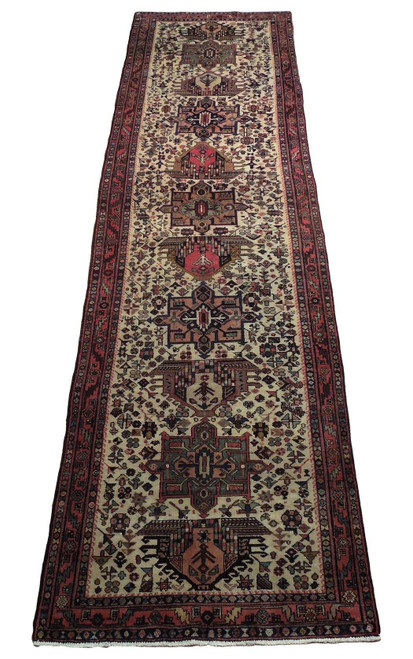
| Design: | Karaja | Stacked Hexagon Medallions | Ivory Field |
| Origin: | Persian Karaja | Made in Persia |
| Condition: | Excellent |
3'3" x 10'3" Persian Karaja Runner Rug | Ivory Field Stacked Hexagon Medallions | Excellent Condition
This is a classic Karaja runner from northwest Persia, hand-knotted in wool on a cotton foundation and measuring 3'3" x 10'3". The field is a soft undyed ivory, and down the length of it runs an unbroken column of hexagonal medallions that alternate between rust and ivory, each one locked to the next by serrated hooks and small stepped diamonds. The pile is still even and the wool has the dry, slightly lustrous handle that village weavers in this district are known for, which is why the condition reads as excellent rather than merely good. At 10 feet 3 inches long and just over 3 feet wide, it is the proportion most people are looking for when they want a hallway runner that reads as a single continuous design instead of a repeating strip. Every rug we ship leaves Freeport with a certificate of authenticity stating origin, materials and construction, and the back of this one is photographed with a ruler against the weave so you can see the knotting for yourself before you buy.
Design and Motifs
The drawing is entirely angular, built on the graph of the loom rather than on a curved cartoon, which is what separates true Karaja work from the more formal city designs. Each hexagon medallion carries a cross axis of small stylized flowerheads, tiny latch hooks and barbed leaf forms, and between the large medallions sit smaller stepped lozenges and 8 pointed star rosettes that keep the column moving down the runner. The ivory ground around the medallions is filled with tiny boteh-like sprigs, combs and arrow forms, the kind of filler motifs a weaver adds from memory. Both main borders are drawn as a procession of rectangular panels alternating with blue and rust rosettes on vine, flanked by narrow guard stripes of dark diamonds that frame the whole piece with a crisp outline. If you like geometric Persian rugs that stay disciplined without becoming repetitive, the slight variations between one medallion and the next are the whole pleasure of this runner.
Color
Color is the reason this runner photographs so well on bare wood. The field is a warm ivory, closer to oatmeal than to white, and against it the large medallions read as a brick rust that leans terracotta in daylight and deepens toward brownish red in the corner close-up. The secondary medallions reverse the scheme, ivory grounds outlined in rust and filled with deep teal and forest green details. Two distinct blues do most of the lifting: a bright mid blue in the border rosettes and a cooler teal in the inner guard stripe and the small field motifs. Dark brown, almost black, outlines the borders and reads as the frame of the composition, while soft salmon pink and a few small apricot accents warm the ivory border panels and keep the palette from feeling cold. There is gentle abrash, the natural banding that comes from hand-dyed yarn, visible across the ivory ground, and the overall effect is multi-colored but calm, with no single tone shouting over the others.
Origin and Weave
Karaja is a small weaving village in the Heriz district of northwest Persia, in the hill country east of Tabriz, and its looms have specialized in narrow formats and stacked medallion columns for generations. The wool from that region is famously tough, grown on sheep grazing mineral-rich pasture, which is why runners from these villages survive decades of foot traffic while keeping a sound, flat handle. This piece is knotted on a cotton warp and weft with a wool pile at a solid village density, firm enough that the back shows clean, well-packed rows and the design stays sharp at every medallion point, and the selvages and ends are intact. It belongs with the honest tribal and village rugs of the northwest rather than with workshop production: a weaver's rug, drawn by hand, and built to be walked on.
3'3" x 10'3" Persian Karaja Runner Rug | Ivory Field Stacked Hexagon Medallions | Excellent Condition
Ask about this rug
This piece is the only one of it, so the things worth knowing about it are particular to it. If you want to talk through the size, the colour in your own light, or the weave, speak to someone here first.