Watch the film
| Size in ft: | Width: 3'3" x Length: 5'4" |
| Size in Inch: | Width: 39" x Length: 64" |
| Size in meters: | Length: 1.63 x Width: 0.99 m |
| Colors: | Rust Burgundy, Blue, Navy, Gold, Ivory, Olive Green, Salmon Pink |
| Shape: | Rectangular |
| Woven: | 100% Hand-knotted | Handmade |
| Foundation: | Cotton |
| Pile: | |
| Age: | 1930's | Antique |
| Design: | Sarouk Mohajeran | All over floral sprays | No medallion |
| Origin: | Persian Sarough | Made in Persia |
| Condition: | Excellent | Full even pile for its age |
3'3" x 5'4" Antique Persian Sarouk Mohajeran Rug | 1930s Rust Burgundy All Over Floral Field | Excellent Condition
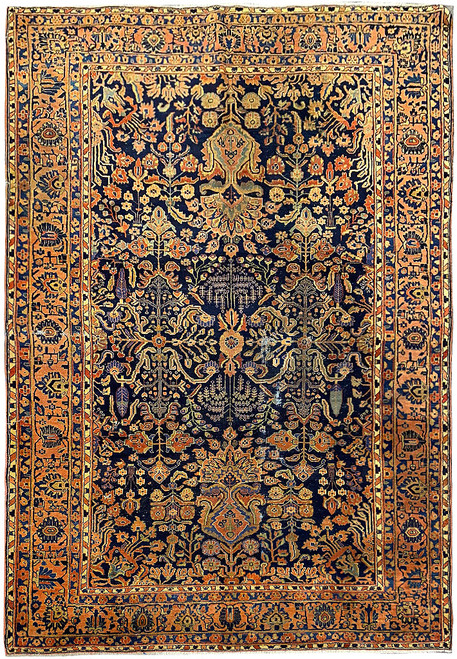
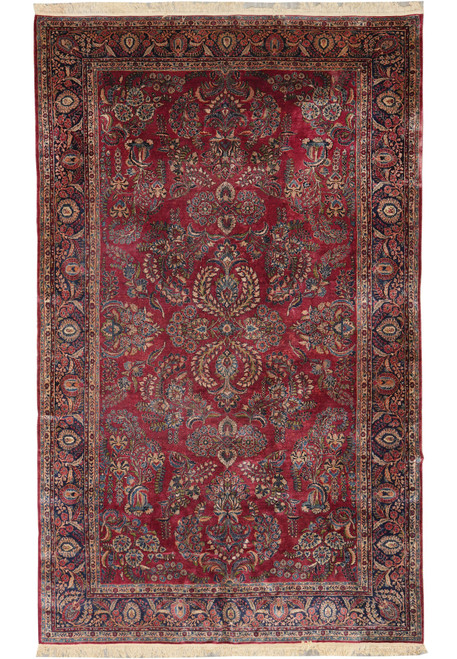
This is a small piece with a serious pedigree: a 1930s Mohajeran weave from the Sarough group, 3'3" x 5'4", hand-knotted in fine wool on a cotton foundation and still carrying full, even pile nearly a century on. Mohajeran is the name collectors look for among antique Persian Sarough rugs, and the reasons are all visible here: heavy glossy wool, a dense beat-down you can feel the moment you lift a corner, and drawing that stays crisp even in flower heads no wider than a fingernail. There is no medallion. The whole field is given over to detached flowering sprays on a rust burgundy ground, the format Mohajeran workshops drew best. At this scale it works as an entry rug, a bedside piece or a framed wall hanging, and it sits among the oldest pieces in our 3x5 Persian rugs. A certificate of authenticity is included with every purchase, documenting origin, age, materials and hand-knotted construction.
Please Note About the Photographs:
The full length studio photograph was taken under bright overhead lights and reads as a deeper wine burgundy, while the daylight close-ups show the field closer to its true rust red. The field is one color throughout; what shifts between photos is the lighting, not fade and not wear. Gentle tonal movement within the red is abrash, the natural variation of hand-dyed wool from the 1930s, and it is a mark of age rather than a flaw.
Design and Motifs
The field carries an all over arrangement of detached floral sprays, each one a small bouquet of blue blossoms and palmettes rising from a cluster of serrated olive leaves. The sprays are set in staggered rows that read as a loose diamond lattice down the center of the rug, with larger crowned bouquets at top, middle and bottom and smaller flowering branches and curling vine tendrils filling the space between. Look at the bottom corners and you will find the classic finishing touch of this weave: a single brown vine curling back on itself into a tight hook, ending in a small bud. The field is framed by a narrow gold and ivory guard stripe set with alternating rosettes, then a wide indigo main border drawn with palmettes, salmon and red blossoms and leaf-tipped vines, then a second gold rosette stripe and a final navy outer band. The corners of the main border are resolved cleanly, with a full flowering palmette turning each one, which is a drawing discipline you do not always see at this size.
A Study in Rust Burgundy and Indigo Blue
The ground is a saturated rust burgundy, a tomato-leaning red that deepens toward wine in low light and warms toward brick where the daylight catches the wool. Against it the weaver placed two distinct blues: a dark indigo used for the main border and for the hearts of the larger blossoms, and a bright cornflower to sky blue used for petals, leaf tips and the fine outlining of the vines. Gold and saffron carry the guard stripes and the smaller leaf clusters, olive and deep green hold the foliage, and salmon pink, soft rose and ivory give the flower heads their highlights, with small accents of chocolate brown in the stems. The ivory of the guard stripes has mellowed to a buttery gold with age, which is exactly what you want to see in a rug of this period. Buyers shopping the broader run of red and burgundy Persian rugs will notice how much warmth the old madder reds hold compared with later production.
Mohajeran, Sarough and the Weave Quality
Sarough is a weaving district in central Persia, in the Markazi region around Arak, and Mohajeran is the village within it whose output stood above the rest. Mohajeran pieces were woven with a heavier, glossier wool, a tighter knot and finer drawing than the commercial Sarough production that flooded the American market in the same decades, and dealers have priced them separately ever since. The structure is what makes them last: a cotton foundation with heavy wefting and a hard beat-down, so the back is firm and the pile stands upright rather than splaying. Turn the corner over, as in the fold photograph, and you can read the knot nodes in neat ranks across the back, which is how a weave of this period is judged. The 1930s attribution is consistent with the palette, the all over spray layout and the handle of the wool; if you want to understand how those clues are read, our guide on how to date an Oriental rug walks through the same method we used here.
3'3" x 5'4" Antique Persian Sarouk Mohajeran Rug | 1930s Rust Burgundy All Over Floral Field | Excellent Condition
Ask about this rug
This piece is the only one of it, so the things worth knowing about it are particular to it. If you want to talk through the size, the colour in your own light, or the weave, speak to someone here first.