Watch the film
| Size in ft: | Width: 4'7" x Length: 5'10" |
| Size in Inch: | Width: 55" x Length: 70" |
| Size in meters: | Length: 1.78 x Width: 1.40 m |
| Colors: | Coral, Blue, Ivory |
| Shape: | Rectangular |
| Woven: | 100% Hand-knotted | Handmade |
| Foundation: | Cotton |
| Pile: | |
| Age: | 1950's |
| Design: | Herati | All-over Boteh Repeat |
| Origin: | Persian Mahal | Made in Persia |
| Condition: | Very Good | Low pile with even age patina |
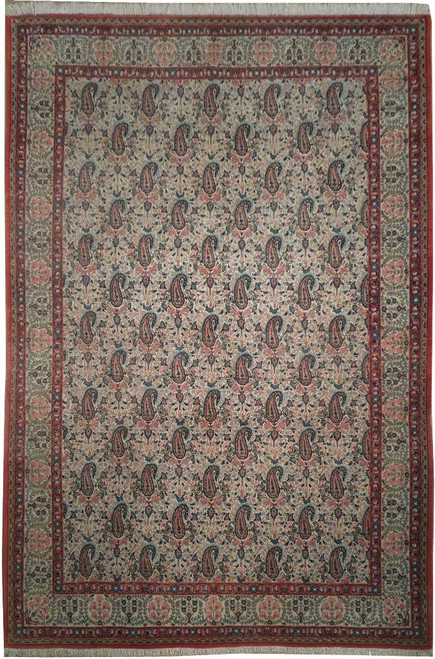
4'7" x 5'10" Persian Mahal Rug | All-Over Boteh on Coral | 1950s Low Pile
This is a village piece from the 1950s that has spent its life on a floor and looks the better for it. The field is a warm coral that has softened unevenly across the width, and it carries row after row of small blue boteh, each one drawn slightly differently by hand. The wool is low now, close to the cotton foundation in places, which is exactly what gives an older Persian rug that flat, painted look that new weaving cannot imitate. At 4'7" x 5'10" it is a genuine small-room size, easy to place at a bedside, under a coffee table or in a foyer where the repeating pattern reads well from above. Every rug we sell ships with a certificate of authenticity confirming it is hand-knotted, its origin and its materials.
Please Note About the Photographs:
This rug is honestly low in pile and the photographs show it. The lighter patches in the field, the variation in the coral tone and the slightly thinner areas along one end are age and use, not staining and not repair work. The rug lies flat, the ends and sides are intact, and it is structurally sound and fully usable. It is professionally cleaned, steamed and pressed before it leaves us. Buy it as a decorative antique with character rather than as a plush pile rug.
Design and Motifs
The field is given over entirely to a repeating boteh, the teardrop or paisley form that Persian weavers have used for centuries, set in staggered rows with the tips all leaning the same way. Each boteh is outlined in dark indigo and filled with tiny stepped squares, hooks and dots in lighter blue and ivory, so from a distance the field reads as an even blue lattice and up close it breaks into small individual drawings. Between the rows sit little rosettes, serrated leaves and angular vine fragments that tie the repeat together in the herati manner. There is no medallion and no centre, which is the point of all-over Persian rugs: furniture can sit anywhere on it without cutting the composition in half. The border system is unusually generous for a rug this size, with a wide ivory main band carrying a hooked vine and small animal and vessel forms, flanked by narrow indigo and rust guard stripes with rosette chains.
Coral, Indigo and Ivory in the Palette
The dominant color is coral, a warm brick to terracotta red that shifts band by band across the field in the way madder-dyed wool does as it ages, moving from a deeper rust at the ends toward a lighter salmon through the middle. Against it the boteh are worked in a deep indigo with mid-blue and teal fills, and the contrast between cool blue and warm coral is what gives the rug its energy. Ivory appears in three roles: as the outlines and small squares inside each boteh, as tiny dots scattered through the ground, and as the wide main border, where it lifts the whole design and keeps the dark blue framing from feeling heavy. Small accents of gold, soft green and brown surface in the border drawing and in the rosettes between the boteh rows. The overall effect is a warm, faded, antique palette that sits comfortably with wood floors, stone tile, leather and cream upholstery.
Mahal Weaving and Persian Village Quality
Mahal rugs come from the villages of the Arak region in west central Persia, an area that has supplied the American market with sturdy, handsome, moderately knotted rugs for well over a century. They are not city workshop pieces and they are not trying to be: the drawing is done from memory rather than from a cartoon, the boteh vary slightly in size and spacing, and the weave is a solid single wefted village construction on a cotton foundation with a tough local wool pile. That combination is why so many Mahals survive decades of real use. The signs of age here are textbook, from the abrash in the field to the softened pile and the gently irregular sides, and anyone curious about reading them can see how specialists date an oriental rug. This one dates to the 1950s and wears its 70 years plainly and well.
4'7" x 5'10" Persian Mahal Rug | All-Over Boteh on Coral | 1950s Low Pile
Ask about this rug
This piece is the only one of it, so the things worth knowing about it are particular to it. If you want to talk through the size, the colour in your own light, or the weave, speak to someone here first.