Watch the film
| Size in ft: | Width: 6'8" x Length: 9'7" |
| Size in Inch: | Width: 80" x Length: 115" |
| Size in meters: | Length: 2.92 x Width: 2.03 m |
| Colors: | Red, Indigo Navy, Ivory, Sky Blue, Sage Green, Rose, Gold |
| Shape: | Rectangular |
| Woven: | 100% Hand-knotted | Handmade |
| Foundation: | Cotton |
| Pile: | |
| Design: | Heriz | Stepped Diamond Medallion | All Over Field |
| Origin: | Persian Heriz | Made in Persia |
| Condition: | Excellent | Even pile throughout |
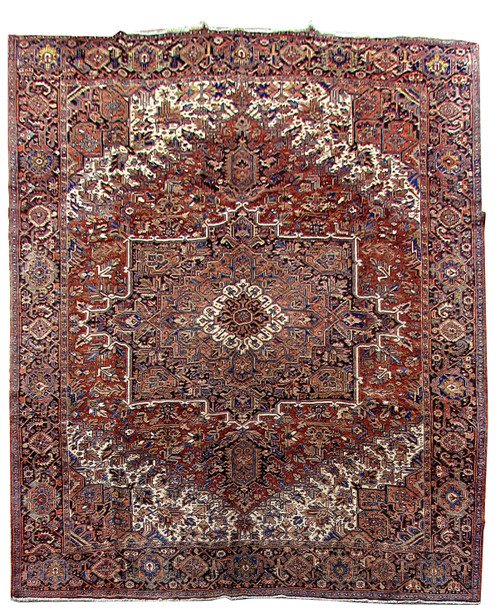
6'8" x 9'7" Persian Heriz Rug | Brick Red Field | Stepped Ivory Diamond Medallion | Wool Pile
This 6'8" x 9'7" Heriz is the kind of village weaving people keep for forty years and then pass down. The wool pile is thick, springy and even from end to end, knotted on a cotton foundation, and the brick red field has the faint vertical shifts of tone that only hand-dyed yarn produces. It reads as a true room-size piece, big enough to hold a sofa group or a dining table without crowding the walls, and it falls squarely into the most useful footprint we sell, the 7x10 Persian rug range. Selvages and ivory fringe are original and intact, the ends are secure, and the back shows a clean, regular knot structure with no repairs visible in the photographs. Every rug we sell ships with a certificate of authenticity confirming it is hand-knotted in Persia.
Design and Motifs
The weaver set a stepped indigo lozenge at the center, outlined twice in ivory with a sawtooth edge, and filled it with small paisley boteh and angular rosettes. Above and below it, two smaller stepped pendants in ivory and sage anchor the long axis. The field around the medallion is not left open the way a plain Heriz often is; it carries a full all-over lattice of hooked leaves, eight petal rosettes, serrated palmettes and diamond florets, each drawn in straight lines on the diagonal because a village loom builds curves out of steps. Broad ivory diagonals cut across all 4 corners to form the spandrels, and the drawing inside them repeats the same vocabulary at a smaller scale. The main border runs a navy ground with alternating rosettes and split leaf palmettes, framed by narrow ivory guard stripes of running vine. This is a good example of why buyers who look for geometric Persian rugs keep coming back to the Heriz group.
A Brick Red Field Set Against Deep Indigo
The ground is a warm brick red that leans terracotta in daylight and deepens toward oxblood under lamps, with soft abrash bands drifting across the width. Against it, the border and medallion sit in a near black indigo that gives the whole rug its weight. The drawing is picked out in at least 5 supporting tones: a clear sky blue in the large palmettes, a muted sage green in the leaves and one guard stripe, chalky ivory in the outlines and rosette centers, a dusty rose that softens the reds, and a pale gold that appears in the small diamond florets. The ivory reads bright in the corner detail and slightly creamy in the flat overhead, which is normal for undyed wool photographed in different light. If you want a rug that anchors warm woods, leather and brass without going pink or orange, this palette does it. The age of a piece like this shows in exactly these colors, and our guide on how to date an Oriental rug explains what to look for.
Heriz Weaving in Northwest Persia
Heriz is a cluster of villages east of Tabriz, on the slopes below Mount Sabalan, and its reputation rests on two things. The first is the wool: mineral-rich water in that district produces a fleece that is unusually tough and takes dye with a deep, saturated finish, which is why Heriz pile resists flattening under furniture for generations. The second is the drawing. Village weavers work from memory and from small cartoons rather than a full workshop drawing, so every curve is built from straight lines and stepped corners, giving the design its bold, architectural character. Knot counts in the district generally sit under 200 knots per square inch, and that is by intention: a slightly coarser knot on a heavy wool pile is what makes these rugs last. The back of this piece shows that structure clearly, a firm, tight handle with no floppiness, and a rug in this condition at 6'8" x 9'7" is ready to go straight into daily use.
6'8" x 9'7" Persian Heriz Rug | Brick Red Field | Stepped Ivory Diamond Medallion | Wool Pile
Ask about this rug
This piece is the only one of it, so the things worth knowing about it are particular to it. If you want to talk through the size, the colour in your own light, or the weave, speak to someone here first.