Watch the film
| Size in ft: | Width: 7'10" x Length: 11'7" |
| Size in Inch: | Width: 94" x Length: 139" |
| Size in meters: | Length: 3.53 x Width: 2.39 m |
| Colors: | Red, Blue |
| Shape: | Rectangular |
| Woven: | Hand-Knotted |
| Pile: | Wool |
| Origin: | Persia |
| Design: | Esfahan |
| Age: | 1980's |
| Condition: | Excellent |
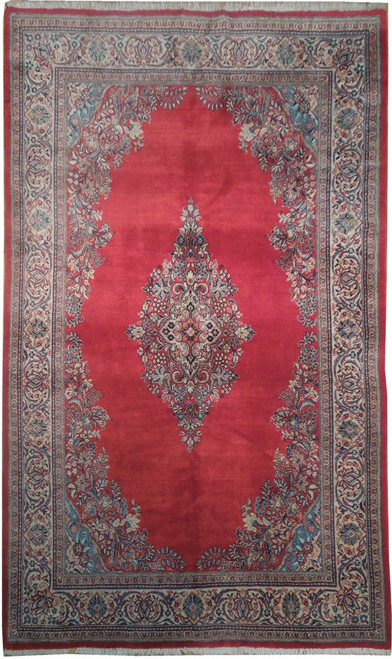
7'10" x 11'7" Persian Najafabad Rug | Isfahan Floral Medallion | 1980s, Excellent Condition
This is a 1980s Najafabad, woven just west of Isfahan in the full Isfahan drawing tradition, and it is the kind of piece that explains why that tradition is famous. The 7'10" x 11'7" format covers a standard 8 by 12 floor plan, and the whole surface is drawn in one continuous breath: a medallion on axis, flowering vines swinging out to the corners, and a navy border that frames the field without crowding it. The wool pile has the slightly glossy, well-settled handle that only comes from four decades of careful use, and the pile height is even from end to end with no bald patches, no repairs visible in the photographs, and clean hand-tied fringes at both ends. Every rug we sell ships with a certificate of authenticity recording origin, age, materials and size, so what is written above is what you can put in writing for insurance or an appraisal.
Please Note About the Photographs:
The detail photographs were taken close up under indoor light, which pushes the red field toward a rose or magenta cast. The overhead shots are the truer reading: a warm, slightly cool-toned red. The faint lines you can see in the angled photographs are fold marks from pallet storage, not wear, not fading and not damage. They relax once the rug is laid flat, and every rug leaves us professionally steamed and pressed.
Design and Motifs
The field is built around a lobed star medallion with an ivory and gold heart, a small navy rosette at the exact center, and a ring of lotus heads and curling split leaves radiating from it. From that center the drawing opens into a dense all-over system of thin vines, serrated ivory lancet leaves, palmettes and eight petal rosettes, all of it mirrored top to bottom and left to right so the eye reads order rather than clutter. Turquoise spandrels fill the 4 corners of the field and carry their own arabesque, giving the red ground a clear cornered frame. The border scheme runs 5 bands deep: a narrow outer stripe, an ivory guard band of linked buds, the wide navy main border with alternating palmettes and flowering sprays, another ivory guard stripe, and a fine inner line against the field. The drawing is curvilinear throughout, with no broken or angular lines, which is the signature of the Isfahan school and a direct test of the weaver's knot count.
Color
The field is a clear, saturated red that leans cool, closer to a cochineal rose than to brick or tomato, and in close-up it photographs as a deep cerise. Against it, the main border is a dense indigo navy that reads almost black at the outer edge and lightens into true blue where the pile catches light. Between the two sits the most distinctive note in the rug: a bright peacock turquoise used in the spandrels, in the medallion petals and sprinkled through the vine work, a blue-green that most Persian weavers use sparingly and that this weaver was confident with. Ivory and a soft buttery gold carry the leaves and guard stripes, keeping the red and navy apart, and small flickers of deep green, rust, apricot, pink and charcoal appear inside individual flower heads. The palette puts this squarely among traditional red and burgundy Persian rugs, and the gentle softening of the red over 40 years is exactly what collectors want to see in a vegetal-looking palette.
Origin and Weaving Quality
Najafabad is a town roughly 20 miles west of Isfahan in central Persia, and its weavers have always worked from Isfahan cartoons, following the same curved-line vocabulary the Safavid court workshops established in the 16th century. The practical difference is scale rather than taste: Najafabad looms were set up for room-size and large formats like this 7'10" x 11'7" piece, with a slightly heavier, longer-wearing wool pile on a cotton foundation, while city Isfahan workshops concentrated on finer small formats. You can read the quality on the reverse, where the knot rows are straight and tightly packed and the pattern is legible from the back, which is how a well-executed Isfahan drawing should look. If you want the background on this weaving group, our complete guide to Isfahan rugs covers the history, the design conventions and what separates workshop pieces from the rest.
7'10" x 11'7" Persian Najafabad Rug | Isfahan Floral Medallion | 1980s, Excellent Condition
Ask about this rug
This piece is the only one of it, so the things worth knowing about it are particular to it. If you want to talk through the size, the colour in your own light, or the weave, speak to someone here first.