Watch the film
| Size in ft: | Width: 7' x Length: 11' |
| Size in Inch: | Width: 84" x Length: 132" |
| Size in meters: | Length: 3.35 x Width: 2.13 m |
| Colors: | Coral Red |
| Shape: | Rectangular |
| Woven: | Hand-Knotted |
| Pile: | 3/8" Wool |
| Origin: | Persia |
| Design: | Sarouk |
| Age: | 1940's |
| Condition: | Excellent |
7' x 11' Antique Persian Sarough Rug | Coral Red All Over Floral Sprays | 1940s Excellent Condition
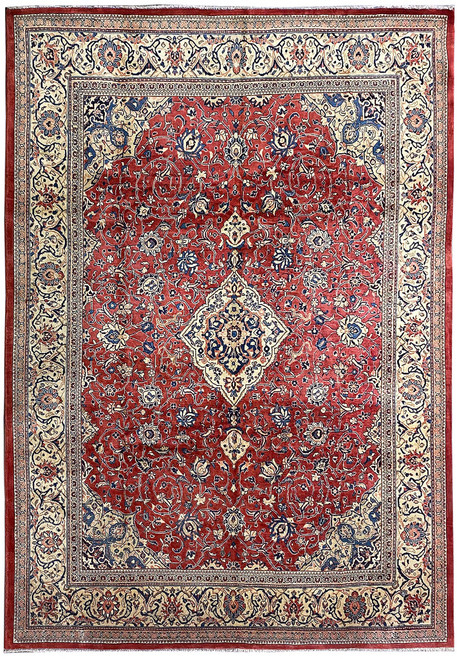
This is the piece collectors still call a Grandma Sarouk: a 1940s west Persian room rug with a deep coral red ground, detached floral sprays drawn across the whole field, and a navy border that frames the whole thing like a picture. It measures 7' x 11', woven on a cotton foundation with a 3/8" wool pile that has worn evenly across eight decades, and the ends and sides are original. The wool has the slight sheen that only comes from age and use, and the reds have mellowed from the flat tomato of a new rug into something warmer and softer. Antique Persian Sarough rugs of this generation are getting harder to find with the pile intact, and this one still has body underfoot. A certificate of authenticity ships with the rug.
Please Note About the Photographs:
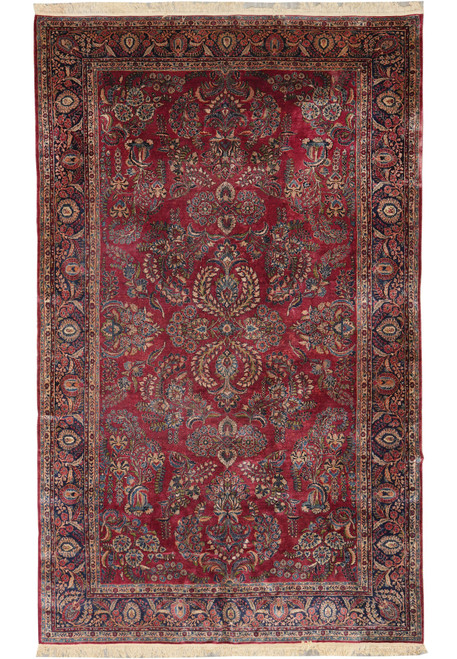
The first image was shot under different lighting and reads cooler and pinker than the rug actually is. The floor photographs and the close-up details are the accurate record: the field is a warm coral red leaning toward terracotta, not rose. Antique dyes also shift with the angle of light through the day, which is normal for a rug of this age.
Design and Motifs
There is no central medallion here. Instead the weaver filled the field with a repeating, mirrored arrangement of floral sprays, the classic Sarouk formula and one of the most liveable layouts in Persian weaving, since an all over floral design reads correctly from every side of the room and forgives furniture placed on top of it. Look closely and the vocabulary is specific: slender footed vases sprouting upright stems, 8 petal rosettes, curling serrated leaves that hook back on themselves, and small budded sprigs scattered into the open ground between the larger clusters. The composition is built in vertical columns that alternate between tall spray and low bouquet, so the eye moves up the rug rather than around it. The border system runs 3 bands, a wide navy main border carrying heart shaped palmettes and fan shaped half rosettes, flanked by 2 narrow ivory and rose guard stripes of linked blossoms. The 4 corners are resolved cleanly, which is a good sign of a careful weaver working from a proper cartoon rather than improvising.
A Coral Red Field Against Deep Indigo
The field is a coral red with real depth to it, sitting somewhere between terracotta and old brick, and it moves subtly across the rug the way naturally dyed wool always does. Against that ground the drawing is carried almost entirely in indigo: a near black navy for the outlines and the darkest flower heads, a mid blue for the rosette centers, and a soft powder blue that lifts the smaller blossoms out of the pattern. Ivory and cream do the work of separating one motif from the next, and a warm camel gold runs through the leaves and vase stems, warming the whole palette. Touches of rose and salmon appear in the border palmettes, echoing the field without repeating it. The main border is a dense navy, so saturated that in raking light it reads almost black, and it gives the coral field a hard edge that makes the rug look larger and more architectural than its 7' x 11' footprint. It is a red rug that behaves well with oak, walnut, brass and cream plaster.
Sarough Weaving and the 1940s Workshops
Sarough is a village near Arak in west central Persia, and its weavers built a reputation in the first half of the 20th century for exactly this product: thick, tightly packed wool on a cotton foundation, heavy enough to lie flat without underlay and dense enough to survive generations of traffic. The 1940s pieces were woven largely for export, which is why so many turned up in American houses and why the trade nickname stuck. Quality varies hugely across that output, and the tell is in the drawing and the wool. This one has crisp outlines that have not blurred, a pile that stands upright rather than splaying, and back knotting that is regular from selvage to selvage, as the reverse photograph shows. If you want to understand how weavers, dealers and appraisers read an antique like this, our guide on how to date an Oriental rug walks through the same evidence: dye behavior, foundation material, wear pattern and drawing style.
7' x 11' Antique Persian Sarough Rug | Coral Red All Over Floral Sprays | 1940s Excellent Condition
Ask about this rug
This piece is the only one of it, so the things worth knowing about it are particular to it. If you want to talk through the size, the colour in your own light, or the weave, speak to someone here first.