Watch the film
| Size in ft: | Width: 8'11" x Length: 12'5" |
| Size in Inch: | Width: 107" x Length: 149" |
| Size in meters: | Length: 3.78 x Width: 2.72 m |
| Colors: | Red, Blue, Ivory |
| Shape: | Rectangular |
| Woven: | 100% Hand-knotted | Handmade |
| Foundation: | Cotton |
| Pile: | |
| Age: | 2000's |
| Design: | Traditional Kerman | Central Medallion | Floral Sprays |
| Origin: | Persian Kerman | Made in Persia |
| Condition: | Excellent |
8'11" x 12'5" Persian Kerman Rug | Red Floral Field with Blue Border | 2000s, Excellent Condition
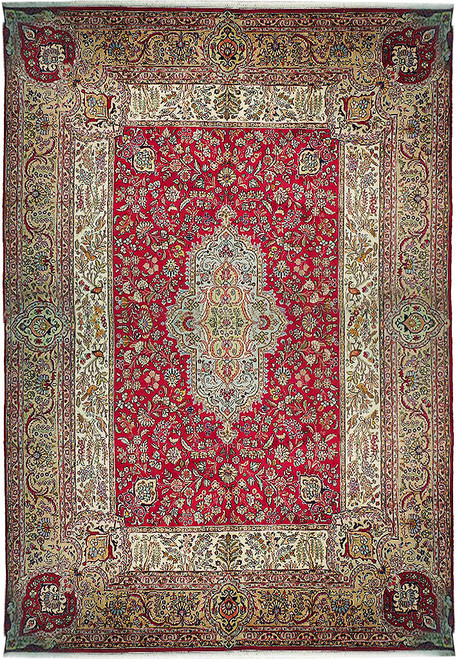
A room-size Kerman from the 2000's, hand-knotted in wool on a cotton foundation, with the drawing style that made this corner of southeast Persia famous: a soft curved line, flower heads rendered petal by petal, and a field that stays open enough to breathe. At 8'11" x 12'5" it covers a standard 9 by 12 floor plan, so it sits comfortably in the same footprint buyers shop when they browse 9x12 Persian rugs, and the pile still has full height with clean, even ends and selvedges. Every rug we sell leaves here with a certificate of authenticity listing origin, materials, size and knotting.
Please Note About the Photographs:
The red field photographs differently depending on the light source. The overhead studio shot reads as a brighter tomato red, while the daylight floor shots show the deeper ruby tone you see in person. The lighter sheen running across the pile in the flat shot is light catching the wool at an angle, not wear, fading or damage.
Design and Motifs
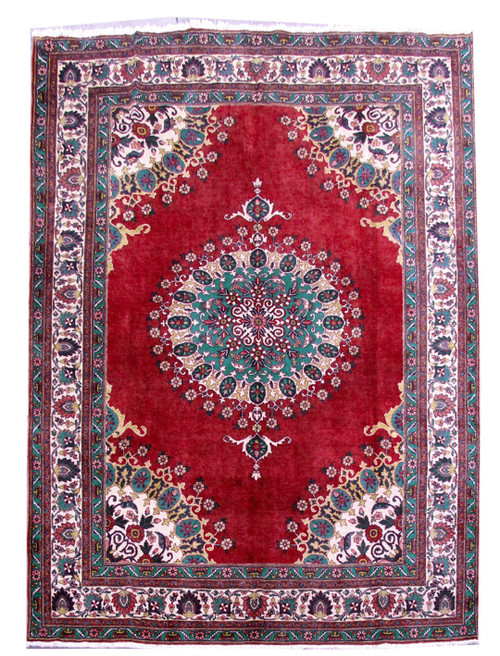
The center holds a small lobed medallion, blue with an ivory and blush rosette core, ringed by rose pink blossoms and feathery leaves and finished top and bottom with a crowned pendant. Around it the open field carries a loose, almost garden-like scatter: large kidney-shaped floral cartouches at the 4 corners of the inner field, upright bouquets, single sprays of forget-me-not blue blossoms, and curling leaf tendrils that are never quite repeated twice. Deep blue spandrels sweep in from each corner, outlined in ivory tracery and filled with palmettes and vine. The wide main border runs royal blue with alternating red and ivory palmettes, split leaves and small vases, held between ivory and pale celadon guard stripes that have their own running flower chain. It is a traditional Kerman layout, drawn with curves rather than the straight lines of village geometric work.
A Ruby Red Field Framed in Royal Blue
The field is a clear ruby red, warm rather than brick, and it is the single most useful thing about this rug in a traditional room: it anchors dark wood, oxblood leather and cream walls at once. Against that ground the weaver worked a cool palette, which is what keeps the rug from reading heavy. There are two distinct blues, a saturated royal blue in the medallion, spandrels and main border, and a much lighter powder blue used for the small flower heads scattered across the field. Ivory does the outlining and the guard stripes, with rose pink, soft celadon green, camel tan and small touches of saffron and dark navy inside the flowers. Light sits differently on the pile from either end, so the red deepens or brightens as you walk around it, a normal characteristic of good hand-spun wool and one reason collectors shop red and burgundy Persian rugs in person whenever they can.
Kerman: Weaving in Southeast Persia
Kerman sits in the southeast of Persia, a desert city with a weaving record stretching back centuries and a reputation built on draftsmanship. Kerman workshops kept full-time designers, and the pictorial, garden-inspired borders and finely drawn floral fields are the signature of the town. The local wool is long-stapled and takes dye cleanly, which is why Kerman reds and blues hold their clarity instead of going muddy. On the close-up of the weave you can see the single wefted, tightly packed rows that let the weaver carry a curved line through a palmette without breaking it into steps, work that needs a real knot count to execute. This piece is a straightforward, well-woven city example from the 2000's: not an antique, no restoration, no surprises, just a full-pile Kerman ready to go straight down on the floor.
8'11" x 12'5" Persian Kerman Rug | Red Floral Field with Blue Border | 2000s, Excellent Condition
Ask about this rug
This piece is the only one of it, so the things worth knowing about it are particular to it. If you want to talk through the size, the colour in your own light, or the weave, speak to someone here first.