Watch the film
| Size in ft: | Width: 9'5" x Length: 12'6" |
| Size in Inch: | Width: 113" x Length: 150" |
| Size in meters: | Length: 3.81 x Width: 2.87 m |
| Colors: | Maroon, Indigo Navy, Ivory, Teal Green, Camel Gold, Soft Rose |
| Shape: | Rectangular |
| Woven: | 100% Hand-knotted | Handmade |
| Foundation: | Cotton |
| Pile: | |
| Design: | Karaja | Staggered diamond medallions | All over field |
| Origin: | Persian Karaja | Made in Persia |
| Condition: | Excellent |
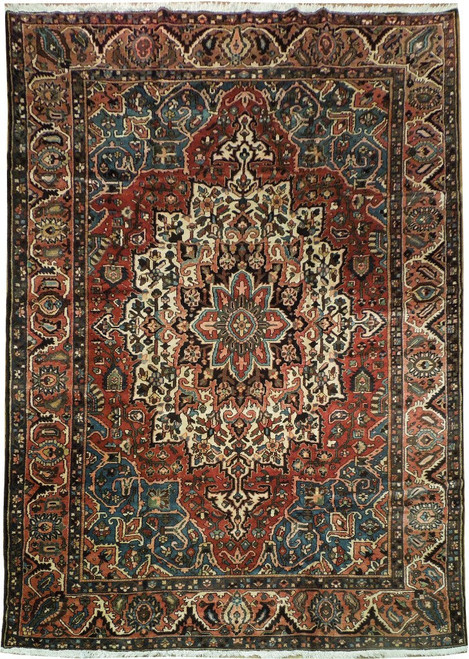
9'5" x 12'6" Persian Karaja Rug | 3 Staggered Columns of Ivory Diamond Medallions | Maroon Village Weave
This is a room size Karaja from the villages of northwest Persia, hand-knotted in wool on a cotton foundation and measuring 9'5" x 12'6". Karaja weavers do not draw curves. They draw straight lines, notched outlines and stepped edges, and this piece is a textbook example: a maroon field carrying 3 staggered columns of medallions, boxed in by a deep indigo border that runs the full perimeter. The pile is even and firm underfoot, the wool still carries its natural sheen in raking light, and the rug lies flat without a wave, which is what you want in a piece this size. It sits comfortably in the footprint most buyers shop when they search 9x12 Persian rugs, with a little extra reach on the length. Every rug we sell ships with a certificate of authenticity confirming origin, materials and hand-knotted construction.
Design and Motifs
The field is an all over repeating layout rather than a single centre medallion, which is the classic Karaja signature. Ivory diamonds sit in 3 vertical columns, the centre column offset against the two outer ones, so the eye reads a diagonal lattice across the whole rug. Each ivory diamond holds a small 4 part core split into brown, teal and rose quarters, ringed by tiny hooked blossoms. Between them sit larger cross shaped medallions in indigo and teal, built from stepped arms and 8 lobed rosettes, each one outlined twice in ivory so the drawing reads cleanly against the dark ground. The open red between the medallions is packed with village filler: zigzag combs, small ewers, latch hooks, cypress sprigs, rosettes and little squared ornaments, no two drawn quite the same. A narrow camel and rose vine stripe separates the field from the wide navy main border, which carries a march of geometric palmettes, stepped hooks and tree forms, finished with two matching red guard stripes. If you like geometric Persian rugs, this one gives you a full vocabulary of them on a single field.
The Maroon Field and Its Indigo Frame
The ground colour is a warm maroon that shifts between brick and a cooler rose depending on where the light falls, the kind of variation that comes from wool dyed in small lots and woven in as it came off the spindle. Against it, the border is a near black indigo, dark enough at the edges to act as a picture frame and make the field glow. The medallions supply the light: ivory running to a soft antique cream, with a few reading closer to camel gold in the corners. Teal green is the third voice here, used inside the cross medallions and in scattered fillers, and it keeps the red from going monochrome. Smaller touches of chocolate brown, dusty rose and a pale straw yellow appear in the tiny ornaments, and a camel coloured minor stripe bridges field and border. The overall temperature is warm, so this reads well on oak, walnut and stone floors, and it holds its own in a room built on other red and burgundy Persian rugs tones without competing.
Karaja: A Village Weave of Northwest Persia
Karaja is a small weaving village in the Heriz district of northwest Persia, on the road toward Ahar and northeast of Tabriz. The region is known for hard, high lanolin wool from mountain flocks, and for a weaving habit that favours strength over fineness: a heavy cotton warp and weft, a firm double beat and a medium clipped pile that takes decades of traffic without thinning. The back view shows exactly that structure, a tight even grid of knots with the design legible right through to the foundation and the original ivory fringe intact at the end. Karaja drawing is its own thing within the Heriz group, more compartmental and more Caucasian in feeling than the big single medallion Heriz layout, and collectors have chased that look for generations. A rug of this size from a village loom would have been woven on a large upright loom by a single family over many months, which is why the field motifs drift and repeat by hand rather than by cartoon. That slight irregularity is the proof of the loom, and it is the reason a good Karaja never looks machine made from across a room.
9'5" x 12'6" Persian Karaja Rug | 3 Staggered Columns of Ivory Diamond Medallions | Maroon Village Weave
Ask about this rug
This piece is the only one of it, so the things worth knowing about it are particular to it. If you want to talk through the size, the colour in your own light, or the weave, speak to someone here first.