Watch the film
| Size in ft: | Width: 10'11" x Length: 13'4" |
| Size in Inch: | Width: 131" x Length: 160" |
| Size in meters: | Length: 4.06 x Width: 3.33 m |
| Colors: | Red, Ivory, Blue, Green |
| Shape: | Rectangular |
| Woven: | 100% Hand-knotted | Handmade |
| Foundation: | Cotton |
| Pile: | |
| Signature: | Woven inscription in the green guard border |
| Design: | Tabriz | All-Over Floral | Shah Abbas Palmettes |
| Origin: | Persian Tabriz | Made in Persia |
| Condition: | Excellent |
10'11" x 13'4" Persian Tabriz Rug | All-Over Shah Abbas Floral on Red | Signed Border, Excellent
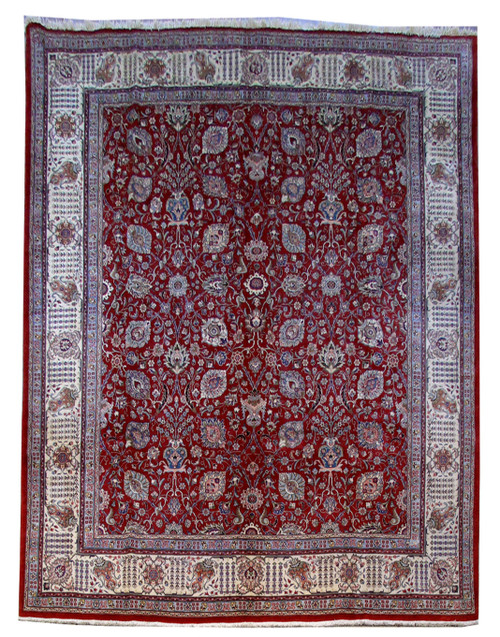
At 10'11" x 13'4" this Tabriz fills a formal living room or a full great room with room left for a sofa group and a pair of chairs. The drawing is an all-over floral rather than a single central medallion, so the field reads the same whether you walk in from the sofa end or the doorway, and furniture placed anywhere on it never hides the point of the design. The pile is 3/8" wool on a cotton foundation, the handle is firm and the condition is excellent, and one end carries a woven inscription in the green guard band, the mark of a workshop piece rather than an anonymous commercial weave. Among large 11x13 Persian rugs this is an unusually complete piece, and it ships with our certificate of authenticity.
Please Note About the Photographs:
The first overhead photograph is a corrected studio image and reads a touch brighter and cooler than the rug does in person. The warehouse and close-up photographs, taken on the floor under normal light, show the true tone: a warm tomato red field with ivory borders. Nothing in the weave differs between the images.
Design and Motifs
The field is a classic Tabriz interpretation of the Shah Abbas repeat, one of the most demanding patterns in the Persian repertoire to draw well at this scale. Large serrated palmettes sit on thin arcing vines, each one flanked by curling lanceolate leaves that sweep outward like feathers, with smaller lotus blossoms, 8 petal rosettes and tiny buds filling the ground between them. Look closely at the field detail and you can see how the vines actually connect: no motif floats, every palmette is tied back into the scroll, and the repeat mirrors cleanly across the center line. This is why buyers who want pattern rather than a focal point gravitate toward all-over rugs of this type. The ivory main border alternates a broad palmette with a cusped floral cartouche joined by a fine blue tendril, framed on both sides by narrow guard stripes: a gold band of small X crosses, a sage green band of stylized blossoms, and a navy band that pulls the border tight against the field. The inscription is worked in navy wool into the green stripe at one end, small enough that most people will notice it only when they kneel down.
A Tomato Red Field With Ivory, Navy and Sage Green
The field is a bright warm red, closer to tomato than to burgundy, and it holds that clarity evenly from end to end with only the gentle abrash you expect from hand-dyed wool. Against it the palmettes are outlined in deep navy and filled with sage and olive green, old gold, soft peach and a pale sky blue that lifts the whole field a shade; the largest blossoms are cored in ivory, which gives the eye a set of light landing points scattered across the red. The border reverses the scheme: an ivory ground, cool and creamy rather than white, carrying brick red palmettes, navy and cornflower blue florets, olive green leafwork and small pink and gold accents. The guard stripes do the transition work, a mustard gold band and a sage green band separating the hot field from the cool ivory so neither one shouts. In a room the practical effect is a rug that reads red from the doorway and multi-colored up close, which means it sits comfortably with navy upholstery, walnut and mahogany furniture, cream walls and brass lighting.
Woven in Tabriz, Northwest Persia
Tabriz sits in the northwest of Persia and has been the country's commercial and technical weaving capital for centuries, the city that supplied the designers and master weavers other regions learned from. Tabriz weavers measure fineness in Raj, the number of knots across one gereh of about 2.75 in of width, and they work with a hooked knife that lets a workshop weaver follow a curved cartoon line precisely, which is exactly what a Shah Abbas repeat demands: every vine here is a true curve, not a stepped approximation. The wool of the region is strong and slightly lustrous, and the firm cotton foundation under a 3/8" pile is what gives this piece its solid, flat, room-filling handle. That combination is the reason good Persian Tabriz rugs survive generations of traffic, and the woven inscription in the border ties this one to a named workshop rather than a market loom.
10'11" x 13'4" Persian Tabriz Rug | All-Over Shah Abbas Floral on Red | Signed Border, Excellent
Ask about this rug
This piece is the only one of it, so the things worth knowing about it are particular to it. If you want to talk through the size, the colour in your own light, or the weave, speak to someone here first.