| Size in ft: | Width: 11'2" x Length: 14'3" |
| Size in Inch: | Width: 134" x Length: 171" |
| Size in meters: | Length: 4.34 x Width: 3.40 m |
| Colors: | Red, Ivory |
| Shape: | Rectangular |
| Woven: | 100% Hand-knotted | Handmade |
| Foundation: | Cotton |
| Pile: | |
| Design: | Tabriz | All-Over Floral | Shah Abbasi Palmettes |
| Origin: | Persian Tabriz | Made in Persia |
| Condition: | Excellent |
11'2" x 14'3" Persian Tabriz Rug | All-Over Shah Abbasi Floral | Semi-Antique, Excellent Condition
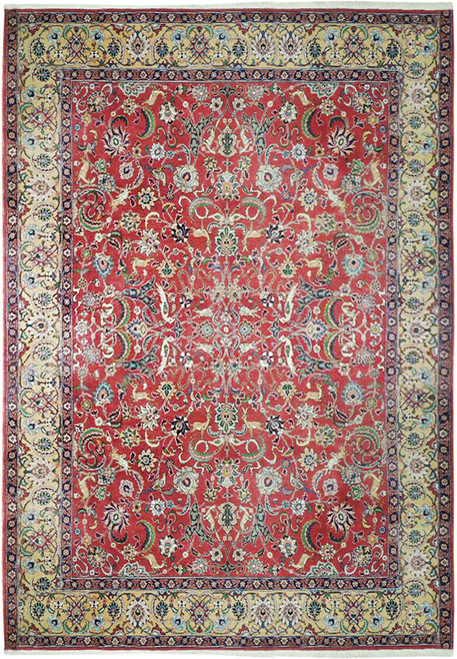
This is a proper room-filling Tabriz: 11'2" x 14'3" of hand-knotted wool on a cotton foundation, woven in northwest Persia with the even, disciplined handle that Tabriz workshops are known for. The pile stands at 3/8" and is uniform from end to end, the ends and edges are intact, and the drawing on the back is crisp enough to follow every vine (see the ruler photograph). Nothing about it is timid. A deep red field carries an all-over floral system, and a wide ivory border frames it on all 4 sides, which is exactly why this size works so well in a formal living room or under a long dining table without the pattern disappearing beneath furniture. Anyone shopping oversize Persian rugs knows how rarely a piece this large turns up with the pile and color still this honest. It ships with a certificate of authenticity documenting origin, materials and hand-knotted construction.
Design and Motifs
There is no central medallion here. Instead the weaver laid out a mirrored all-over composition: large Shah Abbasi palmettes opening like fans, lanceolate leaves curving away from them, and slender arabesque vines that link one flower head to the next without ever crossing awkwardly. Look closely at the field and you find layered detail at 3 scales, the big cream and blue palmettes, mid-size rosettes and carnation sprays, then tiny 5 petal blossoms scattered on thin stems to fill the negative space. The field is framed by a narrow reciprocal inner guard, a wide ivory main border of alternating palmettes and split leaves, and 2 further minor stripes carrying a running flower head motif. The 4 corners resolve cleanly, a detail that separates workshop drawing from village improvisation. The curved line work throughout is smooth and continuous, the hallmark of a cartoon drawn by a professional designer rather than woven from memory.
A Deep Red Field Against Ivory and Teal
The ground is a true red with terracotta warmth in it, not a cold cherry and not a brown brick, and it shifts slightly with the nap so the field looks a shade deeper from one end of the room than the other. Against it the main border reads ivory to soft cream, warm rather than chalky white, which keeps the contrast generous without turning stark. The floral work inside both areas is where the palette really opens up: indigo and mid blue in the palmette centers, a cool teal green in the guard stripes and leaf tips, salmon and apricot in the carnation heads, dry gold and olive in the split leaves, and small touches of dark brown used as outlining to hold each shape apart. Ivory highlights on the largest palmettes act as the light source and pull the eye through the field. The wool takes a soft sheen under lamplight, so the reds glow in the evening rather than going flat.
Tabriz: The City and the Weave
Tabriz sits in northwest Persia and has been the commercial and technical center of Persian weaving for centuries, the city that supplied designers and master weavers to workshops across the country. Its reputation rests on structure: Tabriz weavers work on the Raj system, counting knots per gereh across the width, and they weave with a hook-ended tool that produces the tight, regular, flat-lying back you can see in the close-up photograph of this rug. That discipline is what lets a piece this large stay square and lie truly flat, with no waisting along the 14'3" length. The wool used in the region is springy and durable, which is why semi-antique Tabriz pieces like this one still show full pile after decades of service. If you are comparing the city's output, browse the full range of Persian Tabriz rugs to see how the all-over floral format sits alongside the medallion and Mahi drawings from the same looms.
11'2" x 14'3" Persian Tabriz Rug | All-Over Shah Abbasi Floral | Semi-Antique, Excellent Condition
Ask about this rug
This piece is the only one of it, so the things worth knowing about it are particular to it. If you want to talk through the size, the colour in your own light, or the weave, speak to someone here first.