Watch the film
| Size in ft: | Width: 4'1" x Length: 5'10" |
| Size in Inch: | Width: 49" x Length: 70" |
| Size in meters: | Length: 1.78 x Width: 1.24 m |
| Colors: | Multi autumn colors, Rose, Gold, Sage green, Powder blue, Ivory, Brown |
| Shape: | Rectangular |
| Woven: | 100% Hand-knotted | Handmade |
| Foundation: | Cotton |
| Pile: | Flat tapestry weave | Wool |
| Age: | 1950's | Vintage |
| Design: | 17th Century Falconry Scene | Millefleurs Ground | Acanthus Leaf Border |
| Origin: | European Tapestry | Made in France |
| Condition: | Excellent |
4'1" x 5'10" French Tapestry Wall Hanging | 17th Century Falconry Scene | Handwoven 1950s
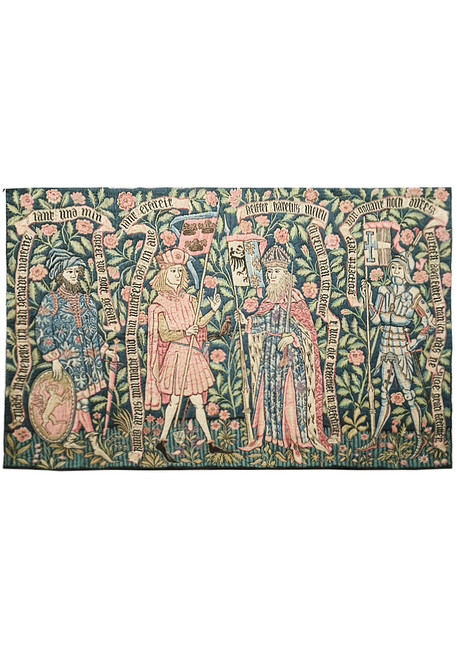
This is a wall piece before it is a floor piece. Woven in France in the 1950s after a 17th century courtly subject, the 4'1" x 5'10" panel is a flat tapestry weave with no pile at all, and the reverse is finished with a brown cotton lining and a stitched sleeve so it can be hung the day it arrives. Because there is no pile to soften the drawing, the detail stays sharp from a few feet away: eyebrows, fingers, the barring on a hawk's wing, the pearls on a headdress. The handy 4x6 size suits the space above a sofa, a console or a stair landing without dominating the wall, and the piece is in excellent condition with the original inventory tag still attached. A certificate of authenticity is included with every piece we ship.
Design and Motifs
The scene is a hunting party at the moment the birds are released. On the left a young falconer in a gold lattice-patterned tunic and rose hose steadies a walking staff while a large hawk spreads its wings across his forearm; on the right a lady in a plumed hat and a sweeping rose gown lifts her gloved hand as a second falcon beats past her shoulder. Between and beneath them the ground is a true millefleurs, packed with small blossoms, ferns, strawberry leaves and grasses, and salted with animals that reward a close look: a spotted hound, a rabbit, a pheasant, ducks and a peacock walking the lower edge. The field is framed by a rose-ground floral vine border of carnations, daisies and iris heads, then a narrow blue-grey guard stripe, then a bold outer band of gold and olive acanthus leaves that scroll continuously around all 4 sides. A twisted gold rope runs along the inner edge of the picture like a hanging cord, a device borrowed straight from Renaissance tapestry cartoons.
A Palette of Autumn Rose, Old Gold and Faded Blue
The dominant note is a dusty autumn rose, closer to terracotta than pink, and it carries both the upper field and the wide floral border so the eye reads the whole panel as one warm surface. Set into it is a large pale oval of sage green and powder blue foliage that acts as a light halo around the two figures. The costumes work in old gold and antique brass, with the falconer's tunic drawn in a fine ivory lattice over ochre and the lady's gown shaded from deep rose to a bleached salmon along the folds. Flowers are picked out in chalk white, cream, soft cornflower blue and a muted brick red. The outer acanthus band shifts between mustard, olive and warm brown against a blue-grey ground, which gives the edge enough weight to hold the composition. The weaver used hatching, long interlocking teeth of two shades, to model the faces and drapery, so the transitions are gradual rather than blocky. Nothing in the palette is loud; it reads as aged, gentle and easy to place in a room with wood tones or a warm neutral wall.
French Weaving of a 17th Century Subject
French tapestry ateliers spent the mid 20th century reviving the great medieval and Renaissance hunting and millefleurs cartoons for private homes, working at a smaller scale than the vast originals but holding to the same technique: a cotton warp carrying dense wool wefts, each color area built up by hand with its own bobbin and locked to its neighbor. That method is slow and it is the reason a face this size can be given an expression at all. This piece shows the hallmarks throughout, with tight fine wefts, clean vertical joins, straight selvedges and a back as legible as the front, visible where the corner is turned in the photographs. The brown cotton backing and sleeve were applied at the workshop, protecting the reverse and keeping the panel flat on a rod. Handwoven decorative textiles of this quality and age from Europe surface far less often than floor weavings, and a complete figural example in excellent condition is a genuinely uncommon find.
4'1" x 5'10" French Tapestry Wall Hanging | 17th Century Falconry Scene | Handwoven 1950s
Ask about this rug
This piece is the only one of it, so the things worth knowing about it are particular to it. If you want to talk through the size, the colour in your own light, or the weave, speak to someone here first.