Watch the film
| Size in ft: | Width: 6'7" x Length: 9'6" |
| Size in Inch: | Width: 79" x Length: 114" |
| Size in meters: | Length: 2.90 x Width: 2.01 m |
| Colors: | Ivory, Pink, Green, Blue |
| Shape: | Rectangular |
| Woven: | 100% Hand-knotted | Handmade |
| Foundation: | Cotton |
| Pile: | |
| Age: | 1970's | Semi-antique |
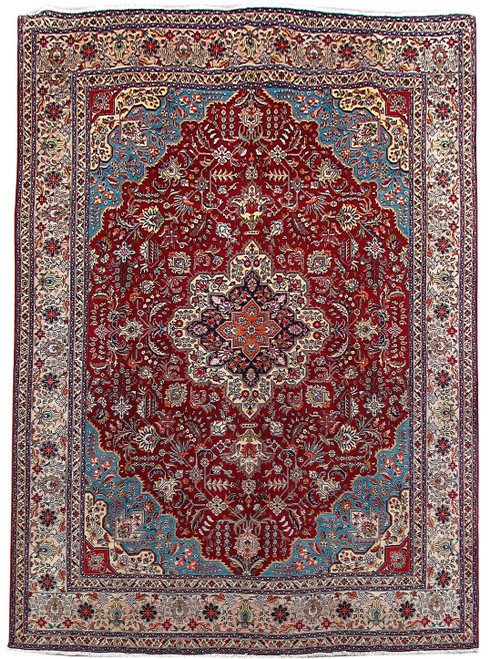
| Design: | Tabriz Floral Medallion | Corner spandrels | Vine and palmette field |
| Origin: | Persian Tabriz | Made in Persia |
| Condition: | Perfect |
6'7" x 9'6" Persian Tabriz Rug | Ivory Field, Rose-Pink Border, Blue Floral Medallion | 1970s
This is a light, formal, city-woven piece from the 1970s: an ivory ground Tabriz drawn with the curved line and tight finish that the Tabriz workshops built their name on. The pile is fine wool on a cotton foundation, the handle is firm without being stiff, and after roughly 50 years the field still reads clean and even across all 9'6" of length, with full pile in the center and no thinning at the ends. The photographs show it flat and at an angle on parquet so you can judge the drawing and the depth of the pile honestly. As one of the more usable proportions in the house, it sits comfortably in the family of 7x10 Persian rugs that anchor a sofa group or a bed without swallowing the room. Every rug we ship carries a certificate of authenticity confirming it as a hand-knotted Persian piece.
Design and Motifs
The layout is the classic Tabriz formula, executed with unusually delicate drawing. At the center sits a lobed rosette medallion built in concentric rings, its inner disc a soft slate blue holding an 8 petal flower head, surrounded by pointed lotus and palmette forms outlined in dark navy. Above and below the medallion, two pendant cartouches reach out into the field and dissolve into split-leaf arabesques. The ivory field itself is never idle: thin vine tendrils curl in mirrored pairs, carrying serrated palmettes, tulips, small carnations, feathery blue cypress-like leaves and clusters of tiny wine-red buds. The 4 corners are filled with quarter spandrels that repeat the medallion vocabulary at a smaller scale, and the drawing is symmetrical on both axes, a sign the weavers worked from a properly squared cartoon. The main border runs a continuous meander of rosettes and palmettes on a rose ground, flanked by narrow guard stripes of ivory carrying small blossoms and paired leaves, so the eye is stopped cleanly at the edge rather than drifting off it.
The Color Story: Ivory, Rose-Pink and Blue
The field is a warm ivory, closer to unbleached cream than white, which gives the whole rug a daylight quality and keeps the palette from ever feeling heavy. Against it, the main border reads as a dusty rose-pink with a faint salmon cast, a color that Tabriz weavers use to soften an ivory ground without introducing red. The medallion core is a muted slate to sky blue, echoed throughout the field in the blue leaf sprays and in the small blue petal flowers of the guard stripes. Sage and olive greens carry the leaves and stems, while deep burgundy and wine appear only in small doses: bud tips, flower centers, a few accent blossoms in the border. Dark navy does the outlining work, drawing every vine and petal edge so the pastels stay crisp rather than muddy. Touches of pale gold and pure white lift the rosettes. The effect is a genuinely light rug with real color depth in it, easy alongside oak flooring, cream walls and pale upholstery.
Tabriz: The Weaving City and Its Standards
Tabriz sits in the northwest of Persia and has been the commercial and technical capital of Persian weaving for centuries, the city where the cartoon-drawn curvilinear medallion was refined and exported to the rest of the country. Tabriz weavers count fineness in Raj, the number of knots across a gereh of about 2.75 inches: 40 Raj is commercial work, 50 Raj is fine, 60 Raj sits at roughly 400 knots per square inch and is collector territory. The drawing on this piece, with its hairline vines and small multi-color flower heads, belongs to the finer end of that scale, because that much detail cannot be resolved on a coarse weave. Tabriz workshops also work with a hook, the qollab, rather than the fingers alone, which is part of why the back is so regular and the edges so straight. Add the tough, springy wool of the region and a firm cotton foundation, and you get the trait Tabriz is bought for: a rug that holds its shape, lies flat and keeps its drawing crisp decade after decade. You can see more of the tradition in our Persian Tabriz rugs collection.
6'7" x 9'6" Persian Tabriz Rug | Ivory Field, Rose-Pink Border, Blue Floral Medallion | 1970s
Ask about this rug
This piece is the only one of it, so the things worth knowing about it are particular to it. If you want to talk through the size, the colour in your own light, or the weave, speak to someone here first.