Watch the film
| Size in ft: | Width: 7'3" x Length: 8'11" |
| Size in Inch: | Width: 87" x Length: 107" |
| Size in meters: | Length: 2.72 x Width: 2.21 m |
| Colors: | The Main Color Of This Rug Is Blue, With Navy Blue, Tan, Gold, And Brown. |
| Shape: | Rectangular |
| Woven: | Hand-Knotted |
| Pile: | Wool |
| Origin: | China |
| Design: | Art Deco Pejing |
| Age: | 1930's |
| Condition: | Excellent- Minor Wear , Stable |
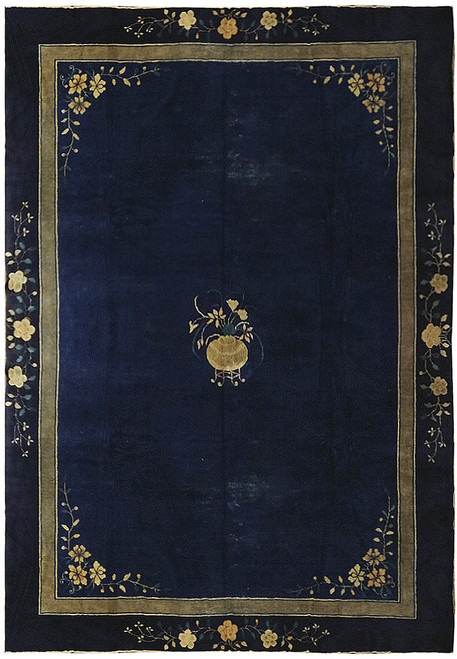
7'3" x 8'11" Antique Chinese Peking Rug | Art Deco Pictorial Design | Circa 1930s, Woven Inscription
This is a Peking piece from the 1930s, the decade when Chinese city workshops were drawing for Western rooms and doing it beautifully. The field is left almost entirely open in a soft sky blue, with a single gold pagoda and bare tree floating near the center and the storytelling pushed out to the corners and borders. It is a near-square format at 7'3" x 8'11", which suits rooms where a standard long rectangle always looks wrong. Small Chinese characters are woven into the outer field along one end, an inscription the weaver put there rather than a later addition. As a hand-knotted antique Oriental rug, it ships with our certificate of authenticity documenting age, origin, materials and measurements.
Please Note About the Photographs:
The open blue ground reads brighter in the full overhead shot and softer, greener and more mottled in the close-ups. That banding is abrash, the natural variation of hand-dyed wool dyed in separate lots, and it is the signature of a genuine antique rather than a flaw. The pile also shows light, even low areas in the field consistent with a rug woven in the 1930s; the foundation is sound, the rug lies flat, and it is professionally steamed and pressed before it leaves us.
Design and Motifs
The composition is built on emptiness, which takes nerve. A single gold pagoda with a domed roof and a leafless tree sits alone at the center of the open ground, and the rest of the drawing gathers in the 4 corners: tall lidded urns, low altar tables, stacked books and scroll boxes, an incense burner, a flowering plant in a jardiniere, and small animals and birds tucked in among them. This is the hundred antiques idea, the scholar's desk objects and treasures scattered as a display of learning and good fortune. Blossoming branches, grape leaves and butterflies spill inward from the border line. The border system runs 5 layers deep: a wide tan and gold main band carrying pavilions, bridges and tiny landscape vignettes, an inner navy band of flowering prunus and trailing vine, narrow gold guard stripes of leafy scroll, and small squared character panels set at intervals along the frames like seal marks.
A Palette of Sky Blue, Indigo and Old Gold
Two blues carry the rug. The field is a medium sky blue that shifts toward teal where the dye lots change, soft and slightly silvered under the light, while the main inner border drops to a deep indigo navy that makes the field look brighter by contrast. Against those blues the drawing is worked in old gold, from a warm apricot gold in the pagoda roofs and urns down to a pale straw in the smaller blossoms. The wide outer border reads tan to camel, a dusty neutral that keeps the whole thing from turning into a jewel box, and there is brown in the vine stems and in the shading of the larger leaves. Slate and powder blue fill the pavilion walls and some of the foliage. If you are hunting through navy blue rugs for something that is blue without being cold, the gold does that work here.
Peking Weaving in the Art Deco Years
Peking, the old name for Beijing, was the center of northern Chinese carpet weaving, and the workshops there spent the 1920s and 1930s producing the open-field, pictorial pieces that collectors now file under Chinese Art Deco. The wool from northern flocks is long-stapled and heavy, so the pile takes light the way silk does and holds a clean, sculpted edge around each motif; you can see it in the gold branch details, where the outline reads sharp against the indigo ground. The knot count is moderate by city standards, deliberately so, because this style depends on broad areas of clear color rather than on miniature drawing. Cotton warps and wefts give the rug its firm, flat handle. For anyone assessing period pieces, our guide on how to date an Oriental rug covers the wear, dye and back-of-rug evidence that places a weaving like this one in the 1930s.
7'3" x 8'11" Antique Chinese Peking Rug | Art Deco Pictorial Design | Circa 1930s, Woven Inscription
Ask about this rug
This piece is the only one of it, so the things worth knowing about it are particular to it. If you want to talk through the size, the colour in your own light, or the weave, speak to someone here first.