| Size in ft: | Width: 11'2" x Length: 14'6" |
| Size in Inch: | Width: 134" x Length: 174" |
| Size in meters: | Length: 4.42 x Width: 3.40 m |
| Colors: | Navy Blue, Rust, Blue, Tan, Gold |
| Shape: | Rectangular |
| Woven: | 100% Hand-knotted | Handmade |
| Foundation: | Cotton |
| Pile: | |
| Age: | 1930s | Antique |
| Design: | Art Deco | Open Field | Vase and Flowering Branch |
| Origin: | Peking (Beijing) | Made in China |
| Condition: | Excellent | Full even pile |
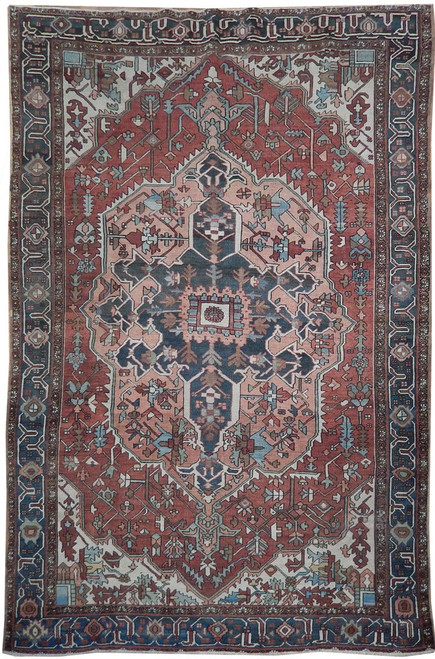
11'2" x 14'6" Antique Chinese Art Deco Rug | Navy Blue Open Field | 1930s Peking Weave
Nearly a century old and still carrying a full, even pile, this hand-knotted Chinese Art Deco piece from the 1930s is the sort of antique that decorators hunt for and rarely find in this size. The field is a deep indigo navy that shifts with the light, left almost entirely open apart from a handful of gold flowering sprays and a single vase-and-bird vignette at the center. Wool pile on a cotton foundation, woven in the Peking tradition, it measures 11'2" x 14'6" and sits squarely in the oversize antique rug range for a great room or formal dining room. The original inventory tag is still attached, shown in the final photograph, and a certificate of authenticity ships with the rug.
Please Note About the Photographs:
The wide border reads as a soft dusty rust in the flat overhead photograph and as a warmer gold in the angled studio shots. Both are the same wool; antique vegetal dyes of this age simply read differently depending on the direction of the light and the lay of the pile. The true tone sits between the two, a muted apricot-rust with gold outlining. Faint shading across the navy field is the natural abrash of the indigo, not wear or fading.
Design and Motifs
This is the restrained side of Chinese Deco drawing, where the empty ground does most of the work. A single asymmetric composition anchors the center: a lidded vase set on rockwork, a flowering prunus branch arching out of it, and a small bird perched on the upper stem. Around it float 8 small bouquets, vases and butterfly sprays, spaced wide enough that the eye reads negative space first and ornament second. All 4 corners of the field carry larger spandrel arrangements, tall vases with scrolling vines, peony heads and ribboned tassels that climb toward the inner guard. The border system runs in 3 bands: a narrow gold outline, a plain blue guard, and a wide main band of continuous flowering vine with chrysanthemum and peony heads worked in navy and gold, finished by a solid navy outer edge. There is no repeating lattice and no medallion, which is exactly what separates a 1930s Deco Peking weave from the crowded classical Chinese pieces that came before it.
A Study in Navy Blue, Rust and Gold
The field is a saturated navy blue drawn from indigo, and it is not a flat navy: close in, the wool moves between midnight and a lighter cobalt where the dye lot changed on the loom, giving the ground a silky, watered depth. Against it, the ornament is worked in warm gold, soft butter yellow, apricot and touches of pale ivory, with small accents of coral pink and a brighter medium blue in the leaves and butterfly wings. The wide border is the color counterweight, a muted rust that photographs closer to apricot or antique gold depending on the light, outlined top and bottom in a clear gold line and separated from the field by a band of lighter blue. Tan appears in the vine work and in the rockwork at the base of the central vase. The overall effect is cool and formal from across the room, then warm and surprisingly delicate once you are standing on it, which is why blue-ground Deco pieces like this one work under dark wood and brass as easily as they do in a white modern space.
Woven in China in the 1930s
Peking and the northern Chinese workshops were weaving heavily for the American and European export trade between the wars, and the 1930s output is the high point: thick, springy wool clipped and carved slightly around the outlines, a moderate knot count on a sturdy cotton foundation, and designs pared back to suit Western interiors. That construction is why this rug survives in excellent condition with full pile at close to 95 years old. A closed, largely open-field composition at 11'2" x 14'6" also demanded a wide loom and steady dyeing, since any inconsistency shows instantly on plain ground. If you are weighing it against other Oriental rug traditions, or want to understand how weavers, tags and construction help in dating an antique rug, the back of this piece tells the story clearly: even hand-knotting, original selvedges, and cotton warps that have aged to a soft cream.
11'2" x 14'6" Antique Chinese Art Deco Rug | Navy Blue Open Field | 1930s Peking Weave
Ask about this rug
This piece is the only one of it, so the things worth knowing about it are particular to it. If you want to talk through the size, the colour in your own light, or the weave, speak to someone here first.