Watch the film
| Size in ft: | Width: 7'4" x Length: 10' |
| Size in Inch: | Width: 88" x Length: 120" |
| Size in meters: | Length: 3.05 x Width: 2.24 m |
| Colors: | Black, Gold, Olive |
| Shape: | Rectangular |
| Woven: | 100% Hand-knotted | Handmade |
| Foundation: | Cotton |
| Pile: | |
| Age: | Antique | 1900's |
| Signature: | Woven cartouche in the outer border |
| Design: | Antique Tabriz | All-Over Floral |
| Origin: | Persian Tabriz | Made in Persia |
| Condition: | Excellent | Antique patina |
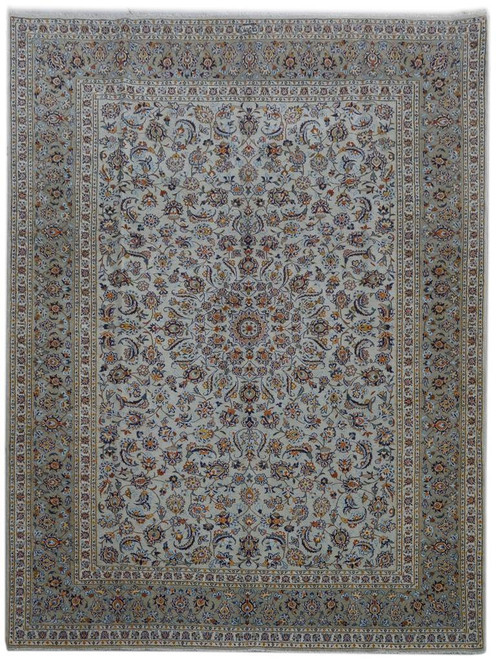
7'4" x 10' Antique Persian Tabriz Rug | All-Over Floral Field | 1900's, Signed Cartouche
This is a 1900's antique from Tabriz, and it has aged into the palette collectors chase rather than the one a factory can print: gold and ivory wool that has gone honey soft, ink black vine work drawn with a city weaver's confidence, and an olive cast running through the leaves. The pile is short and even across the full 7'4" x 10' after a century of use, the wool still has a quiet sheen where the light catches it, and the last band of the outer border carries a woven cartouche, the mark of the weaver or the workshop that made it. At this scale it is the most usable format in the house, which is why good antique 7x10 Persian rugs rarely sit for long. It ships with a certificate of authenticity documenting origin, age, materials and hand-knotted construction.
Please Note About the Photographs:
The first overhead photograph was shot under bright studio light and reads paler and cooler than the rug does in person. The angled floor shots and the pile close-ups are the accurate reference for the gold, camel, olive and ink black tones. The folded corner in several photos was turned back on purpose to show the weave and the depth of the wool, and is not a crease or a flaw. Every rug is professionally steamed and pressed before shipping.
Design and Motifs
There is no central medallion doing the work here. Instead the field carries a true all-over floral design, a repeating lattice of large palmettes, 8 petal rosettes, tiny cross-shaped florets and long curving split leaves that hook around each blossom like a pair of parentheses. The whole thing mirrors perfectly along both axes, and the only concession to a center is a small dark 8 pointed starburst set in the open, lighter heart of the field. Around it sit 3 distinct border systems: a slim vine and berry guard, an inner stripe of blossoms on a dark ground, and the wide main border of linked cartouche-and-palmette forms on camel, finished with another narrow rosette guard and the original fringe at both ends. The corners resolve cleanly, the vines meet where they should, and the signature cartouche is woven directly into the border band at one end rather than added to the field.
Color: Gold, Olive and Ink Black
The field moves from a pale ivory and wheat center outward into deeper gold and old camel, with broad passages where the ground darkens to a near black ink tone that reads blue-black in daylight. Against that dark ground the palmettes and rosettes come up in cream, bone and light gold, so the pattern stays legible even in the densest corners of the field. The leaf drawing carries the olive note, a dry sage-to-bronze green that appears in the split leaves and in the small stems, and there are occasional soft rust and terracotta flickers in the smaller florets. The main border is the warmest part of the rug, a toffee and cinnamon camel that pushes the cooler field forward, edged in charcoal. Natural abrash, the gentle horizontal shift in tone that comes from hand-dyed yarn lots, runs across the ivory field and is a hallmark of genuine antique work, not a defect. The overall effect is a neutral, low-contrast antique that sits easily with oak, brass, linen and walnut.
Tabriz Weaving in Northwest Persia
Tabriz sits in the far northwest of Persia and has been the most commercially serious weaving city in the country for centuries, working from drawn cartoons on cotton foundations with the Raj system used to grade fineness across the width. That workshop discipline is exactly what you see in the back of this piece: straight, tight knot rows, consistent tension edge to edge, and a flat handle with no buckling after a hundred years on the floor. Tabriz weavers were also the ones who signed their work, and a border cartouche like this one on an early 20th century piece is the sort of detail specialists use when they date an antique Oriental rug. The hard local wool clipped low over a firm cotton warp is why the pile has worn evenly rather than thinning, and why this rug will still be taking traffic long after the room around it changes.
7'4" x 10' Antique Persian Tabriz Rug | All-Over Floral Field | 1900's, Signed Cartouche
Ask about this rug
This piece is the only one of it, so the things worth knowing about it are particular to it. If you want to talk through the size, the colour in your own light, or the weave, speak to someone here first.