Watch the film
| Size in ft: | Width: 9'6" x Length: 12'10" |
| Size in Inch: | Width: 114" x Length: 154" |
| Size in meters: | Length: 3.91 x Width: 2.90 m |
| Colors: | Red, Ivory, Rose, Sky Blue, Soft Green, Brown |
| Shape: | Rectangular |
| Woven: | 100% Hand-knotted | Handmade |
| Foundation: | Cotton |
| Pile: | |
| Signature: | Woven cartouche in the ivory border |
| Design: | Tabriz | All-over floral | Palmette and vine |
| Origin: | Persian Tabriz | Made in Persia |
| Condition: | Excellent |
9'6" x 12'10" Persian Tabriz Rug | Red All-Over Floral Field | Signed Border Cartouche
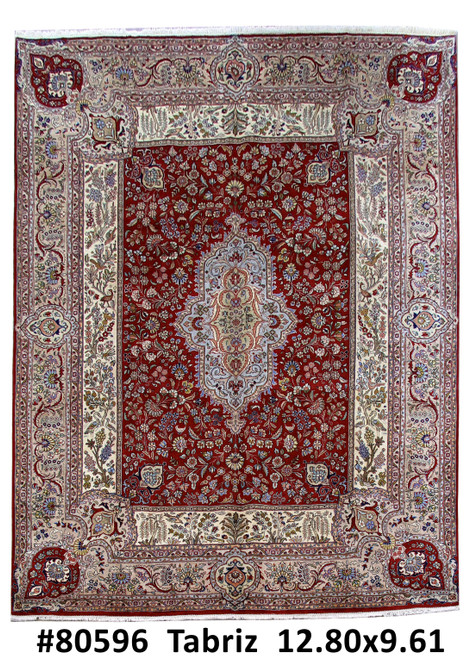
This 9'6" x 12'10" hand-knotted Tabriz covers a full room in one continuous red garden, with no central medallion to interrupt it. The weaver signed the work in a small cartouche set into the ivory border, which is the mark of a workshop piece rather than an anonymous commercial run, and the drawing holds its symmetry cleanly from one end of the field to the other. The pile is a full 3/8" wool on a cotton foundation, and at just under 10 by 13 it sits squarely in the most useful of the 10x13 Persian rug sizes for a large seating group. Every rug we ship travels with a certificate of authenticity.
Design and Motifs
The field is a classic all-over floral design, built from a thin scrolling vine that travels the full length of the rug and throws off large fan palmettes, rosettes, lotus blossoms and small cypress-like sprays at regular intervals. Rows alternate in scale, so a broad open palmette sits between two tighter serrated blossoms and the eye keeps moving instead of settling on one point. Each large flower is outlined in dark brown, which pushes the softer interior colors forward and keeps the pattern legible from standing height. The main ivory border carries a turning palmette and curled leaf procession, flanked by narrow guard stripes of blue and rose meander, and the corners resolve properly rather than being cut short. Small paired bird forms are worked into the field among the vines, a detail Tabriz designers use sparingly and one you only notice once you are close.
The Red and Ivory Palette
The ground is a true tomato red, clear and warm rather than brown or oxblood, and it reads slightly deeper along the ends where the pile lies against the light. Against it the weaver worked a palette of ivory, pale rose, dusty pink, sky blue, slate blue, soft sage green and mustard gold, with dark brown and near black used only for outlining. The ivory border is the largest area of light color in the rug and it frames the red field the way a mat frames a painting, cooling it down so the red never becomes heavy. Look closely at the field flowers and you will see three or four tones inside a single blossom, pink shading into cream, blue shading into slate, which is what gives the surface its depth in photographs 3 and 5. In a room with white or cream walls the ivory border picks up the trim, while the red carries warm woods and leather.
Tabriz Weaving in Northwest Persia
Tabriz sits in the northwest of Persia and has been the country's most commercially disciplined weaving city for centuries, the place where design cartoons, dyeing and finishing were organized as a trade rather than a village craft. Fineness there is measured in Raj, the number of knots across a gereh of about 2.75 in, and the workshops run everything from sturdy 40 Raj floor rugs up to 70 Raj pieces that are effectively collector work. This rug belongs to the solid workshop tier: tight enough at the back to hold the curved line of the vine and the fine outlining on every blossom, and heavy enough in the pile to take real traffic for decades. The signed cartouche is the detail that separates it from the ordinary run, since a weaver only signs work he expects to be judged on. Wool at this weight, on a cotton foundation, laid flat in a large room, is the kind of rug that is still being handed down when the furniture around it has been replaced twice.
9'6" x 12'10" Persian Tabriz Rug | Red All-Over Floral Field | Signed Border Cartouche
Ask about this rug
This piece is the only one of it, so the things worth knowing about it are particular to it. If you want to talk through the size, the colour in your own light, or the weave, speak to someone here first.