Watch the film
| Size in ft: | Width: 7'8" x Length: 10'8" |
| Size in Inch: | Width: 92" x Length: 128" |
| Size in meters: | Length: 3.25 x Width: 2.34 m |
| Colors: | Multi-Color |
| Shape: | Rectangular |
| Woven: | Hand-Knotted |
| Origin: | Persia |
| Design: | Heriz |
| Condition: | Excellent |
7'8" x 10'8" Persian Heriz Rug | Navy Field with Salmon Star Medallion | Camel Border
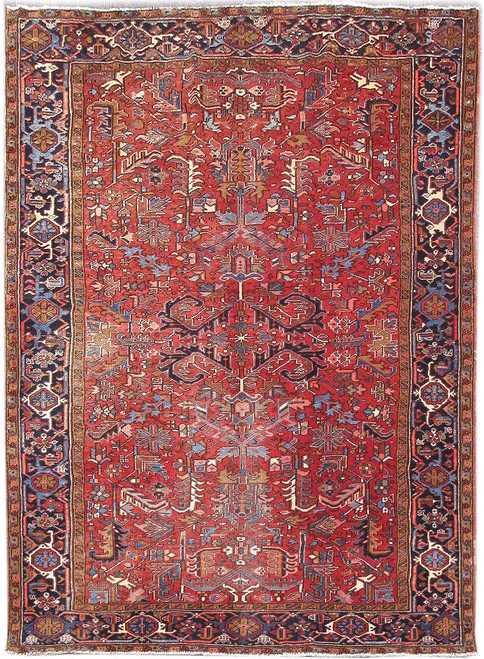
Most Heriz rugs that come through our warehouse lean red. This one does not, and that is exactly why we bought it. The field is a deep navy that photographs close to black, the medallion is a soft salmon rose rather than the usual brick, and the wide main border is a dry camel gold that you rarely see hold up this cleanly. At 7'8" x 10'8" it sits right in the most usable range of our 8x11 Persian rugs, big enough to anchor a full seating group without swallowing the room. The pile is wool on a cotton foundation, the handle is firm and heavy the way good village weaving should be, and the pile depth is even from end to end with sound selvedges and original fringe. It ships with our certificate of authenticity documenting origin, materials and hand-knotted construction.
Design and Motifs
The center is an 8 point star medallion drawn in salmon and ivory, stepped in outline, with a denim blue rosette at its core and a small rose cartouche inside that. Red hooked arms reach out from the middle in 4 directions, and pendant cartouches crown the medallion top and bottom. Around it the navy field carries large serrated palmettes, hooked vine ends and angular leaf forms, each one drawn with the straight lines and stepped corners that separate true village geometric Persian rug designs from city curvilinear work. All 4 corners are filled with generous ivory spandrels laced with camel trellis lines, small red rosettes and blue florettes, which is what gives the rug its light, open appearance from a distance. The main border runs a repeating camel ground with alternating rose palmettes and stiff blue leaves, framed on both sides by narrow red guard stripes of tiny stars and flower heads.
A Multi-Color Palette Led by Navy, Salmon and Camel
Color is the whole argument for this piece. The ground is an inky navy blue that reads near black in the medallion shots and softens to midnight in the angled view, and against it the salmon rose of the medallion and the ivory of the spandrels look almost lit from behind. Between those poles sit brick red and terracotta in the palmettes, camel and dry gold through the border and trellis work, denim and steel blue in the outlines, and small flecks of sage green and cream in the flower heads. That range is why it files as a multi-color Persian rug rather than a red one, and it is far easier to decorate around: the salmon and camel pull warmth into cool grey rooms, while the navy grounds cream walls and natural oak floors. All of the dyes have aged together evenly, with the gentle tonal movement across the field that only comes from hand-spun wool taking dye at slightly different rates.
Heriz: Village Weaving in the Shadow of Mount Sabalan
Heriz is a district of villages in northwest Persia, east of the city of Tabriz and below Mount Sabalan, and its reputation rests on two things: water and wool. The mineral-rich water of the region is credited with the hardness of the local fleece, and that wool gives Heriz pile its dense, almost waxy feel and its legendary resistance to traffic. Weavers here work from memory and from village drawings rather than a fully painted cartoon, which is why the geometry is bold and slightly irregular, so different from the fine curvilinear work of the Persian Tabriz rugs woven a short distance away. The ruler shot shows the knotting plainly: a good, honest village count on a cotton foundation, built for strength rather than for miniature detail. That construction is the reason 100 year old Heriz rugs are still on floors today, and the reason this 7'8" x 10'8" example still shows full, even pile.
7'8" x 10'8" Persian Heriz Rug | Navy Field with Salmon Star Medallion | Camel Border
Ask about this rug
This piece is the only one of it, so the things worth knowing about it are particular to it. If you want to talk through the size, the colour in your own light, or the weave, speak to someone here first.