Watch the film
| Size in ft: | Width: 7'10" x Length: 10'9" |
| Size in Inch: | Width: 94" x Length: 129" |
| Size in meters: | Length: 3.28 x Width: 2.39 m |
| Colors: | Dull Red, Navy Blue, Ivory, Teal Blue, Gold, Soft Green |
| Shape: | Rectangular |
| Woven: | 100% Hand-knotted | Handmade |
| Foundation: | Cotton |
| Pile: | |
| Age: | Antique |
| Design: | Heriz Medallion | Angular Geometric | Stepped Corner Spandrels |
| Origin: | Persian Heriz | Made in Persia |
| Condition: | Excellent | Evenly aged antique pile |
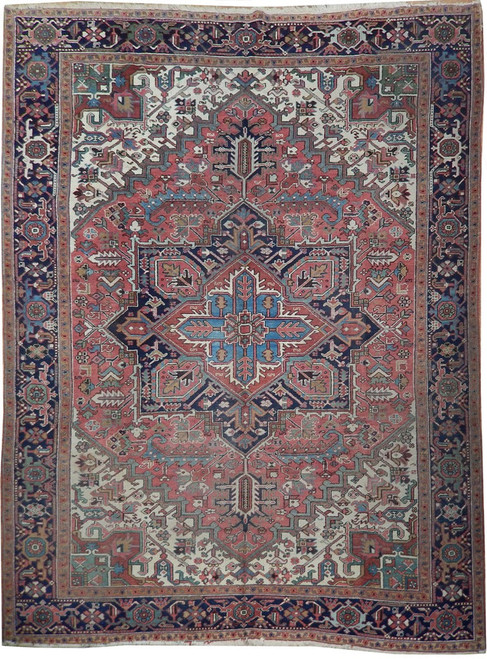
7'10" x 10'9" Persian Heriz Rug | Antique Geometric Medallion | Dull Red Field, Navy Border
This is an antique Persian Heriz woven on a cotton foundation with a dense wool pile, and it carries everything collectors look for in the type: a dull red field softened by decades of use, a big angular medallion drawn in ivory and navy, and corner spandrels that step rather than curve. At 7'10" x 10'9" it sits squarely in the most useful of all 8x11 Persian rugs, large enough to carry a full seating group yet still workable in a modest room. The handle is heavy and firm, the selvages are original, and the cotton fringe is clean and full, as image 6 shows alongside a 12 inch ruler. Every rug we sell ships with a certificate of authenticity confirming it is hand-knotted in Persia.
Design and Motifs
The drawing is pure village Heriz, which is to say entirely straight lines and controlled angles. A broad stepped medallion fills the center of the field, outlined in ivory and filled with serrated leaves and hooked returns in navy and teal, with a small 8 petal rosette pinned at the exact center. Above and below it, tall anchor pendants reach into the field, each finishing in a spearhead of navy and cream. The 4 corners repeat the medallion geometry in reduced form, so the field reads as one unified figure rather than a scattered pattern. Around it, the navy main border runs a chain of hexagonal rosettes and angular vine brackets in ivory, gold and rust, framed by ivory guard stripes of small boxed florets. The vocabulary is exactly what buyers search for in geometric Persian rugs, and the close-up in image 5 shows how confidently the weaver kept the lines square across the width.
A Dull Red Field Cooled by Navy, Ivory and Teal
The ground color is a dull red, closer to brick and terracotta than to bright scarlet, and it moves gently across the field in the soft horizontal banding that comes from hand-dyed wool. That muted red is the reason this rug settles so easily into rooms with warm wood floors, as the parquet photographs show. Against it, the main border reads deep indigo navy, nearly black in low light, which pulls the whole composition tight. Ivory does the structural work: it outlines the medallion, the pendants and the corner brackets, and it lights up the guard stripes. Between those three there are quieter notes of teal blue in the rosettes, dusty gold and camel in the border vines, and a scatter of soft sage green and pale celadon in the leaf tips. There is no harsh contrast anywhere in this palette, only warm reds cooled by blues, which is why antique Heriz rugs remain the safest choice for a room you do not want to redecorate around.
Heriz: Village Weaving in the Shadow of Mount Sabalan
Heriz is a cluster of villages in northwest Persia, east of Tabriz and below Mount Sabalan, and its reputation rests on two things: wool and water. The local sheep grow an unusually tough, high-lanolin fleece, and the mineral-rich water used in washing gives the dyes their characteristic depth. Weavers here work from memory and from the loom rather than from a fully cartooned drawing, which is why the medallion on one side is never a perfect mirror of the other, and why these rugs have the life that machine-regular pieces lack. Knot counts in the villages usually sit under 200 per square inch, but that is the point: a coarser knot on a thick wool pile is what makes a Heriz survive a century of traffic and still lie flat and heavy, as this one does.
7'10" x 10'9" Persian Heriz Rug | Antique Geometric Medallion | Dull Red Field, Navy Border
Ask about this rug
This piece is the only one of it, so the things worth knowing about it are particular to it. If you want to talk through the size, the colour in your own light, or the weave, speak to someone here first.