Watch the film
| Size in ft: | Width: 6' x Length: 7'10" |
| Size in Inch: | Width: 72" x Length: 94" |
| Size in meters: | Length: 2.39 x Width: 1.83 m |
| Colors: | Maroon, rose, ink black, ivory, teal blue, camel |
| Shape: | Rectangular |
| Woven: | 100% Hand-knotted | Handmade |
| Foundation: | Cotton |
| Pile: | |
| Design: | Heriz | Geometric medallion | Stepped corner spandrels |
| Origin: | Persian Heriz | Made in Persia |
| Condition: | Excellent | Even pile with soft age patina |
6' x 7'10" Persian Heriz Rug | Antique Geometric Medallion | Rose-Maroon Field, Excellent Condition
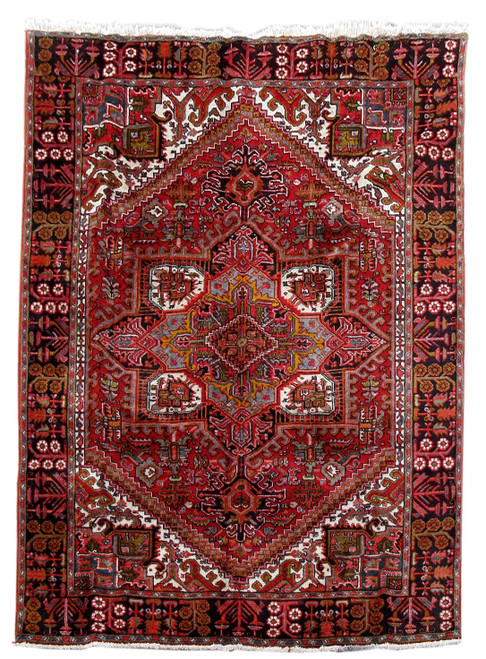
This is a genuine village Heriz from northwest Persia, hand-knotted in wool on a cotton foundation and worn in the best possible way: the pile is even from end to end and the maroon field has mellowed into the warm rose tone that only decades of light and honest use can produce. At 6' x 7'10" it is a practical room size rather than a big showpiece, which makes it one of the easier pieces to place among antique Persian rugs of this age and quality. The back photograph, shot against a ruler, shows the tight cotton warps and the clean, regular knotting of a well-made Heriz village weave. Every rug we ship carries a certificate of authenticity recording origin, materials and measurements.
Design and Motifs
The drawing is classic Heriz: one large stepped medallion set on the vertical axis, anchored by ivory and camel pendants top and bottom, with heavy angular spandrels closing all 4 corners of the field. Around the medallion the field fills with hooked serrated leaves, split palmettes, small rosettes and squared-off vine stems, every curve resolved into straight lines and right angles in the way village looms east of Tabriz have always translated a court pattern. The main border runs a chain of diamond rosettes and 8 petal florets on ink black ground, framed inside and out by narrow ivory and rose guard stripes with a running vine. Small asymmetries are visible in the corner resolutions and in the way individual leaves are drawn, which is exactly what separates authentic geometric Persian rugs from machine-printed copies of them.
Color: Maroon Mellowed to Rose Against Ink Black
The field began as a deep maroon and now reads as a soft rose-brick, deeper in the corners and fractionally lighter through the center where the pile has caught the most light. That gentle movement of tone, called abrash, runs in faint horizontal bands and gives the surface a hand-dyed depth no uniform color can match. Against it the border sits in a near-black brown that photographs as ink, throwing the ivory florets and the small blocks of teal and mid blue forward. The secondary palette is quiet and well judged: chalky ivory outlines, camel and olive in the leafwork, pale salmon pink in the palmettes, and a dusty rosewood that echoes the field inside the border diamonds. Collectors browsing red and burgundy Persian rugs tend to look for precisely this faded, slightly dusty red rather than a bright new one.
Heriz Origin and Weaving Quality
Heriz is a group of villages east of Tabriz, below Mount Sabalan, where the mineral-rich water and the local pasture produce wool that is famously tough and slightly glassy in luster. Weavers there work from memory and a simple squared plan rather than a fully painted cartoon, which is why the geometry is angular and the corners step instead of curve. Knot counts in village Heriz work are typically under 200 per square inch, and that is by design: a heavier knot on a stout cotton foundation with a thick wool pile is what allows these rugs to be walked on for three or four generations and still show a full nap, as this one does. The patina, the natural dye behavior and the border drawing all point to a mid-century or earlier piece, and our guide on how to date an oriental rug explains the same markers we used to read it.
6' x 7'10" Persian Heriz Rug | Antique Geometric Medallion | Rose-Maroon Field, Excellent Condition
Ask about this rug
This piece is the only one of it, so the things worth knowing about it are particular to it. If you want to talk through the size, the colour in your own light, or the weave, speak to someone here first.