Watch the film
| Size in ft: | Width: 8'4" x Length: 11'7" |
| Size in Inch: | Width: 100" x Length: 139" |
| Size in meters: | Length: 3.53 x Width: 2.54 m |
| Colors: | Red, Rust, Navy Blue, Ivory, Sky Blue, Camel, Rose |
| Shape: | Rectangular |
| Woven: | 100% Hand-knotted | Handmade |
| Foundation: | Cotton |
| Pile: | |
| Design: | Heriz Medallion | Geometric | Stepped Corner Spandrels |
| Origin: | Persian Heriz | Made in Persia |
| Condition: | Excellent | Ready to use |
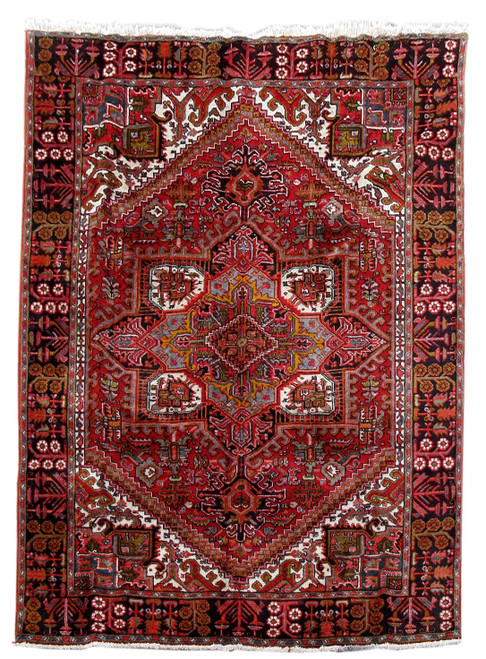
8'4" x 11'7" Persian Heriz Rug | Geometric Medallion, Red Field | Excellent Condition
This is a full room size Heriz in the format buyers ask for most often, wide enough to sit under a sofa and two chairs and long enough to carry a dining table with the chairs pulled out. The field reads deep red with rust and terracotta shading through it, the drawing is entirely angular, and the wool has the dry, springy handle that Heriz weavers are known for. Pile depth is even across the whole rug, the sides and ends are sound, and the colors have settled into the soft, slightly variegated tone that only comes from good dyes and years of gentle use. Among large Persian rugs this is the size that solves the most rooms. It ships with a certificate of authenticity documenting origin, materials and hand-knotted construction.
Design and Motifs
The center holds a stepped, many-pointed medallion built in navy and sky blue around a small ivory rosette with a dark core, and it is anchored top and bottom by tall navy pendants carrying serrated leaf forms. Around the medallion the field fills with hooked vines, big curled palmettes and angular leaf sprays, all drawn in straight lines and diagonal steps rather than curves, which is exactly what separates village work from city workshop drawing. The 4 corner spandrels break to ivory and repeat the same hooked vine at a larger scale, so the eye reads a clear diamond of red framed by cream. The main border is a navy ground carrying alternating rosettes, star medallions and turtle palmettes, flanked by narrow guard stripes in rose, camel and ivory. It is a textbook composition for geometric Persian rugs, balanced without being mechanically symmetrical.
A Field of Red, Navy and Ivory
Red is the governing color, but it is not one flat red. The ground moves between brick, rust and a warmer terracotta as the light crosses it, with faint horizontal abrash that proves the wool was dyed in separate lots. Against that, the navy of the medallion and the main border reads almost black in the shadowed parts of the photographs and opens into a clear indigo in direct light. Ivory does the structural work, filling the 4 spandrels, outlining the medallion and running through the guard stripes so nothing blurs together. Secondary notes are soft rather than loud: sky blue in the hooked vines, camel and olive gold in the leaf tips and border rosettes, and a dusty rose that appears in the inner guard stripe and in scattered flower heads. The overall effect is warm and forgiving, which is why a red Heriz sits comfortably with wood floors, leather and both traditional and modern furniture.
Heriz Weaving in Northwest Persia
Heriz is a cluster of villages east of Tabriz, on the slopes below Mount Sabalan, and the reputation of the weave comes from two local advantages. The water is mineral rich, which is widely credited with the toughness and the high lanolin content of the fleece, and the sheep pastured on those slopes grow a coarse, resilient wool that resists crushing better than softer city wool. Weavers there work from memory and from village drawings rather than a full cartoon, which is why the medallion here is squared off and the vines take angular turns. Knot density in Heriz village work is normally below 200 knots per square inch by design, since a heavy knot on a cotton foundation is what gives these rugs their famous structure. The result is a hand-knotted rug built for a busy room, not a display piece, and this one has the pile and the color left in it to serve for generations.
8'4" x 11'7" Persian Heriz Rug | Geometric Medallion, Red Field | Excellent Condition
Ask about this rug
This piece is the only one of it, so the things worth knowing about it are particular to it. If you want to talk through the size, the colour in your own light, or the weave, speak to someone here first.