Watch the film
| Size in ft: | Width: 9'6" x Length: 13'5" |
| Size in Inch: | Width: 114" x Length: 161" |
| Size in meters: | Length: 4.09 x Width: 2.90 m |
| Colors: | Rust, Black, Blue, Ivory, Olive |
| Shape: | Rectangular |
| Woven: | 100% Hand-knotted | Handmade |
| Foundation: | Cotton foundation |
| Pile: | |
| Design: | Heriz | Stepped geometric medallion | Ivory corner spandrels |
| Origin: | Persian Heriz | Made in Persia |
| Condition: | Excellent |
9'6" x 13'5" Persian Heriz Rug | Geometric Medallion | Rust Field, Excellent Condition
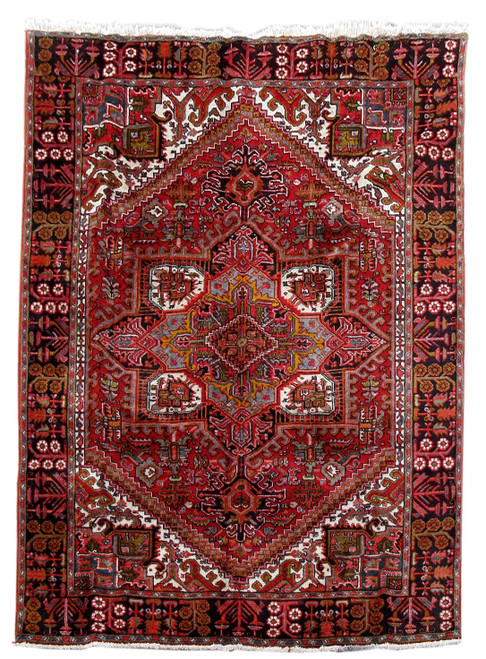
Knotted by hand in the Heriz district of northwest Persia, this 9'6" x 13'5" rug lands in the footprint most American great rooms are planned around, the same proportion buyers shop when they look at 10x13 Persian rugs. The foundation is cotton, the pile is thick village wool, and the drawing is unmistakably Heriz: one broad stepped medallion set into a rust red field, ivory spandrels at the 4 corners, and a deep navy main border of palmettes and rosettes. The pile is full and even from end to end, the outlines are still crisp, and the colors have held, which is why it grades excellent. It ships with a certificate of authenticity recording origin, materials and hand-knotted construction.
Design and Motifs
The center holds a small 8 petal rosette inside a slate blue octagonal core, which sits within a broad stepped and hooked medallion that fills roughly a third of the field. Above and below it, tall anchor pendants reach toward each end, drawn in navy and ivory with tiny stepped outlines that read like pixels rather than curves. The open ground around the medallion is packed with angular vine work, hooked leaves, serrated palmettes and small cruciform flowerheads, all of it laid out in straight lines and 45 degree turns, the hallmark of Persian geometric rugs from this district. The ivory corner spandrels carry the same vocabulary in a lighter key, and the main border alternates large hexagonal rosettes with stiff leaf sprays, framed by narrow guard stripes of running vine on ivory.
A Closer Look at the Colors
The field is a warm rust red that shifts between brick and terracotta as the light moves across the pile, with gentle abrash bands where the weavers changed dye lots. Inside the medallion the tone cools into a soft slate blue that lightens the whole center, while the outlines, the main border ground and the smallest details drop to a deep navy that photographs close to black. Ivory does the heavy lifting for contrast: it edges the medallion, fills the 4 corner spandrels, and traces the guard stripes so the geometry stays legible from across the room. Threads of olive and khaki appear in the leaf sprays and the outer stripe, and small touches of pale blue and cream scatter through the field. Read as a whole, it is a red rug with cool blue relief rather than a hot red rug, which is why it sits comfortably with walnut furniture, painted millwork and warm grey walls alike.
Heriz: The Weaving Villages of Northwest Persia
Heriz is a cluster of villages east of Tabriz on the slopes below Mount Sabalan, and its reputation rests on two things. The first is the wool, grown on mountain sheep and washed in mineral-rich water that leaves the fiber unusually tough and slightly lustrous. The second is the way the rugs are drawn: village weavers work largely from memory and from a small paper sketch rather than a full workshop cartoon, so every curve resolves into a step, and the result is the bold angular medallion you see here. Heriz weaving is deliberately sturdy rather than fine, built on a heavy cotton warp with a thick wool pile, and the back shown in the last photograph makes that construction plain. That is exactly why these rugs end up in the busiest rooms of a house and are still there two generations later, which you can see in the honest, unworn surface of this one.
9'6" x 13'5" Persian Heriz Rug | Geometric Medallion | Rust Field, Excellent Condition
Ask about this rug
This piece is the only one of it, so the things worth knowing about it are particular to it. If you want to talk through the size, the colour in your own light, or the weave, speak to someone here first.