Watch the film
| Size in ft: | Width: 7'3" x Length: 9'6" |
| Size in Inch: | Width: 87" x Length: 114" |
| Size in meters: | Length: 2.90 x Width: 2.21 m |
| Colors: | Burgundy, Blue, Ivory, Green |
| Shape: | Rectangular |
| Woven: | 100% Hand-knotted | Handmade |
| Foundation: | Cotton |
| Pile: | |
| Design: | Heriz Sherabian | Geometric Medallion | Ivory Corner Spandrels |
| Origin: | Persian Heriz | Made in Persia |
| Condition: | Excellent |
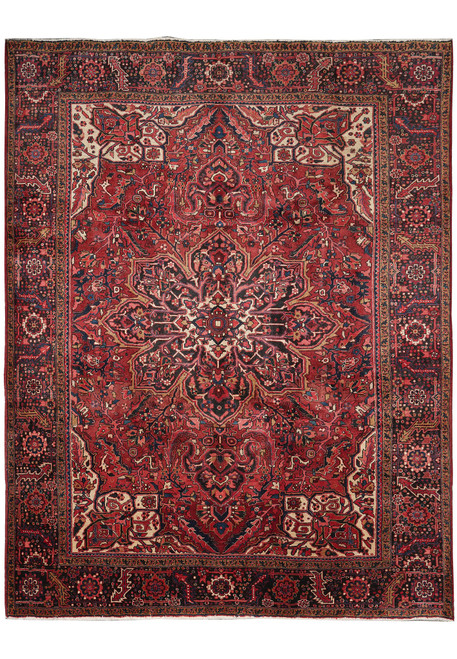
7'3" x 9'6" Persian Heriz Rug | Sherabian Geometric Medallion | Burgundy & Navy | Excellent Condition
This is a hand-knotted Persian Heriz in the Sherabian drawing, a village piece from the Heriz district of northwest Persia that measures 7'3" x 9'6" and sits right in the most useful of all the 7x10 Persian rugs. The pile is wool on a cotton foundation, clipped at a medium height that still shows the crisp outline work in the medallion and the spandrels. Condition is excellent: the pile is even across the field, both ends keep their original kilim finish and flat ivory fringe, and the sides are tight with no sign of repair. Every rug we ship carries a certificate of authenticity recording origin, size, materials and construction, so what is written here travels with the rug.
Please Note About the Photographs:
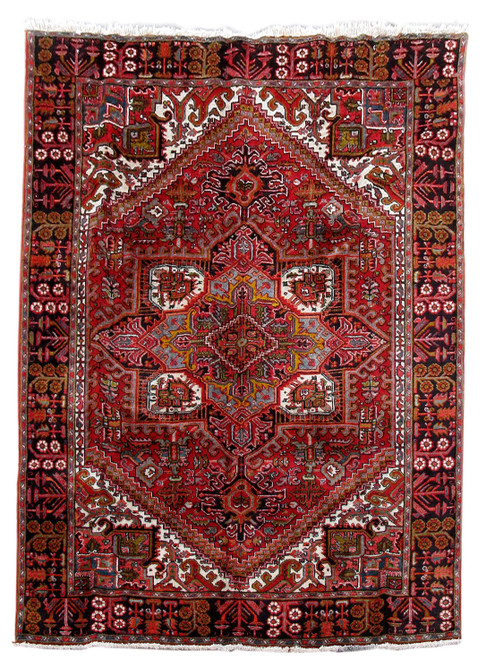
The two full-length photographs were taken under cooler studio light and read darker and browner than the rug does in person. The close-up images are the truer reading: the field is a clear wine and brick red with cooler slate blue shading, not a muddy brown. Nothing in the darker frames is wear, shadow or fade.
Design and Motifs
The center holds a stepped geometric medallion built out in squared tiers, with an 8 petal rosette at its heart and four lobed cartouches set into the corners of the medallion frame, each filled with a small quatrefoil. Hooked arms push out north, south, east and west from the medallion into the open field, which is drawn with large serrated leaves, angular palmettes and long curling vine stems. This is the semi-floral reading of the Heriz vocabulary: the flowers are recognizable but every line is resolved into straight runs and sharp turns, the trait that defines genuinely village-drawn geometric Persian rugs. Two ivory corner spandrels anchor each end, stepped along their inner edge and packed with vine work and small blossoms. The main border runs a repeating sequence of rosette roundels and split palmettes between narrow floral guard stripes, with a fine barber pole minor stripe keeping the whole frame disciplined.
Color Palette
The field is a deep burgundy that moves between wine and brick red as the light crosses the pile, a tone that places this piece squarely among the red and burgundy Persian rugs that read warm in a north-facing room. Against it the medallion is a dark indigo navy, shaded with a soft slate blue that outlines the petals and the stepped tiers and gives the center its depth. Ivory does the structural work: it lights the two corner spandrels, draws the thin outlines of the vine stems and runs as a pearl bead stripe along the inner and outer guard borders. Forest green shows up in the serrated leaves and in small leaf tips scattered through the field, cool and quiet rather than loud. Gold and apricot rosettes punctuate the navy main border at regular intervals, with touches of rust, dusty rose and a pale celadon in the smaller flowers. The result is a rich, layered multi-color palette held together by the burgundy ground.
Heriz Weaving and the Sherabian Drawing
Heriz is a group of villages east of Tabriz, below Mount Sabalan, in the northwest corner of Persia. The wool from those flocks is famously tough and slightly coarse, and the mineral-rich local water is credited with the way Heriz reds and blues hold their saturation over decades of use. Weavers there work on a loom from memory rather than a full cartoon, which is why the drawing comes out angular: straight lines, stepped corners, medallions resolved into tiers. The Sherabian name belongs to this district tradition and is used for the more carefully drawn, better balanced Heriz pieces, and you can see it here in how evenly the medallion sits between the spandrels and how the border corners turn without crowding. Knot counts in the district are generally modest by city standards, but that is the point: a heavy wool pile on a cotton foundation is what makes a Heriz the practical choice for a room that gets walked on daily, as the back shown in the final photograph makes plain.
7'3" x 9'6" Persian Heriz Rug | Sherabian Geometric Medallion | Burgundy & Navy | Excellent Condition
Ask about this rug
This piece is the only one of it, so the things worth knowing about it are particular to it. If you want to talk through the size, the colour in your own light, or the weave, speak to someone here first.