Watch the film
| Size in ft: | Width: 8'1" x Length: 10'1" |
| Size in Inch: | Width: 97" x Length: 121" |
| Size in meters: | Length: 3.07 x Width: 2.46 m |
| Colors: | Ruby Burgundy, Beige, Olive |
| Shape: | Rectangular |
| Woven: | Hand-Knotted |
| Pile: | Woll And Silk |
| Origin: | India |
| Design: | Tabriz Mahi |
| Age: | New |
| Condition: | Perfect |
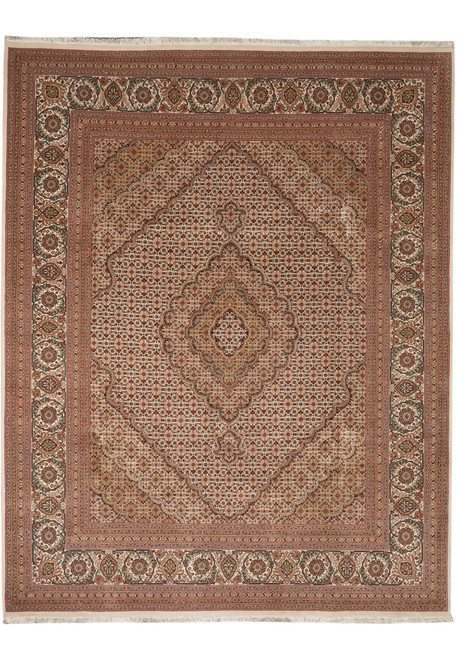
8'1" x 10'1" Tabriz Mahi Design Rug | Ruby Burgundy Wool & Silk | Made in India, Never Used
Laid flat, this 8'1" x 10'1" hand-knotted rug reads as one uninterrupted field of tiny lattice work with a single lobed medallion floating dead center. It is a Tabriz Mahi drawing, woven in wool with silk highlights, and the silk earns its place: the medallion outlines, the little 4 petal flowers scattered through the field and the vine tips in the border all catch light on a different plane from the wool around them. The pile is new and has never been walked on, the fringe is still crisp off the loom, and the rug ships with a certificate of authenticity confirming it as a genuine hand-knotted piece. It also lands in the most requested proportion we stock, 8x10 area rugs, which covers a full seating group with the front legs of the sofa and chairs resting on the wool.
Please Note About the Photographs:
Several of the floor photographs show pale, cloudy patches across the field. That is studio light bouncing off the silk highlights and the natural lay of the pile, not wear, not fading and not damage. The tone shifts as you walk around the rug and as the light changes through the day, which is exactly what a wool and silk pile is meant to do.
Design and Motifs
The field is worked in the Mahi, or fish, pattern: a fine diamond lattice, a small rosette set inside each diamond, and 4 curved leaves flanking it that give the motif its fish name. The repeat here is unusually small for a rug this size, which is what makes the field look almost like woven textile rather than drawn pattern. At the center sits a scalloped medallion on a black ground, filled with a 4 lobe palmette cluster around a single ivory rosette, and ringed by a beige lattice cartouche that reads as a halo against the darker field. Pendant heads drop from the top and bottom of the medallion, and 4 corner spandrels close the composition with the same lattice on a darker ground. The main border runs ivory, drawn with large palmettes, boteh shapes, curling acanthus leaves and a continuous vine, with narrow guard stripes of small rosettes on either side. The drawing is symmetrical on both axes and the corners resolve cleanly, which is the first thing to check on a Mahi rug and the first thing that goes wrong on a careless one.
A Closer Look at the Colors
The field is ruby burgundy, a deep cool red that turns almost wine colored in low light and warms toward brick where the silk catches the sun. Against it, the lattice is drawn in charcoal black and olive, with cream and ivory 4 petal flowers pricking the surface like scattered stars. The medallion halo and the spandrel grounds are beige running to camel, so the center of the rug reads noticeably lighter than the field around it and the medallion appears to lift off the surface. Inside the black medallion core the palette opens up: soft camel petals, rust, sage green, slate blue and small ivory leaf tips. The main border is ivory to bone white, with the palmettes shaded in mushroom, olive and dusty rose and outlined in the same black as the medallion. Guard stripes carry a khaki gold ground with red and slate blue rosettes. A solid ruby selvage wraps all 4 sides and ends in a natural ivory fringe. The combination is traditional without being heavy, and the ivory border keeps the whole thing from reading dark in a room with limited daylight.
Origin and Weaving Quality
This rug was made in India, where the best contemporary hand-knotted weaving in the world is now done. The Mahi drawing is one of the most copied patterns in the entire Oriental rug repertoire, and copying it well is hard, because the lattice only holds together at a high knot count. The weavers here have the density to carry it: the back is tight and even, the knot rows are regular from end to end, and the motifs stay legible right down to the individual leaf tips. A cotton foundation gives the rug a flat, stable lie with no ripple, and the wool has been clipped low so the pattern stays sharp while the silk highlights sit slightly proud of the surface. Handled in person, it feels dense rather than plush, the kind of weave that holds furniture impressions for hours rather than years. This is new production in perfect condition, bought direct and offered without the mark-up chain that usually sits behind a rug of this weave.
8'1" x 10'1" Tabriz Mahi Design Rug | Ruby Burgundy Wool & Silk | Made in India, Never Used
Ask about this rug
This piece is the only one of it, so the things worth knowing about it are particular to it. If you want to talk through the size, the colour in your own light, or the weave, speak to someone here first.