Watch the film
| Size in ft: | Width: 8'2" x Length: 10' |
| Size in Inch: | Width: 98" x Length: 120" |
| Size in meters: | Length: 3.05 x Width: 2.49 m |
| Colors: | Ruby Burgundy, Ivory, Olive Green, Black. |
| Shape: | Rectangular |
| Woven: | Hand-Knotted |
| Pile: | Wool And Silk |
| Origin: | India |
| Design: | Mahi Tabriz |
| Age: | New |
| Condition: | Perfect |
8'2" x 10' Mahi Tabriz Design Rug | Ruby Burgundy Herati Field | Wool & Silk, Made in India
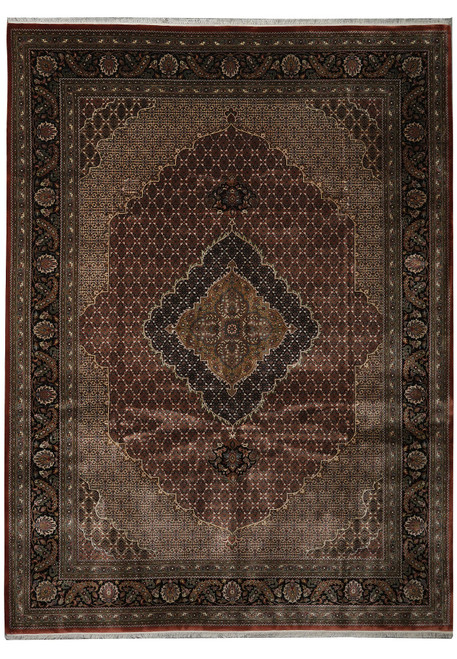
Measuring 8'2" x 10', this hand-knotted rug carries the classic Mahi drawing worked in wool with silk highlights over a cotton foundation. It is brand new, has never been laid in a home, and the pile is still perfectly level from edge to edge, with clean ivory fringe at both ends and a tightly overcast deep red selvedge. Every rug we import ships with a certificate of authenticity confirming it is 100% hand-knotted, knot by knot, and this piece is no exception. Among 8 x 10 area rugs this is the proportion most rooms are actually built around, wide enough to carry all 4 legs of a sofa group and long enough to sit under a dining table with chairs pulled back.
Design and Motifs
The field is a continuous herati lattice, the pattern collectors call mahi, or fish: a grid of small diamonds, each holding a rosette and each framed by 4 curling lanceolate leaves that read like fish circling a pool. The repeat is tiny and unbroken, running straight through the field and continuing into the ivory spandrels at all 4 corners, which is exactly how the drawing should behave when it is drawn properly. At the center sits a scalloped lobed medallion in ivory with a soft rose core, finished top and bottom with slender arrowhead pendants that reach toward the ends of the rug. The border system is generous for this size: a wide ivory main band of palmettes and radiating rosettes linked by thin vinework, flanked by camel guard stripes with reciprocal barbs and fine black outlines, so the pattern steps down in scale from the field out to the edge instead of stopping abruptly.
A Ruby Burgundy Field Against Ivory and Olive
The field reads as a deep ruby burgundy, a dark pomegranate tone that photographs almost aubergine in the wide shots and opens up to a clear cool red in the close detail images. Inside that field every herati diamond is outlined in black, which is what gives the pattern its precision, and the small flowers within it are picked out in ivory, olive green, camel and a soft powder blue that lifts the whole surface. The medallion, spandrels and main border are ivory to cream, so the light parts of the rug frame the dark parts rather than competing with them, and the rose and terracotta accents in the border palmettes echo the medallion core. The silk in the pile sits mostly in the ivory and pale highlights, and it shows as a low sheen that shifts as you walk around the rug. It is a warm, traditional palette that works against wood floors, cream walls, and leather or neutral upholstery.
Made in India in the Tabriz Mahi Tradition
This rug was hand-knotted in India, and that is a point in its favor rather than a caveat. India is where most of the world's best contemporary hand-knotted work is now produced, with master weavers reproducing the classic city drawings at a level of finish that is genuinely hard to find elsewhere. The Mahi pattern is the signature drawing of the Tabriz workshops, and it is unforgiving: the lattice has to stay square across 98 inches of width or the fish motifs wander. Turn this one over, as in the back and fold photographs, and the knots are small, even and tight, with the design reading almost as clearly on the reverse as on the face. That density, over a cotton foundation and under a clipped wool and silk pile, is what makes an Oriental rug like this one hold its shape and its detail through decades of daily use.
8'2" x 10' Mahi Tabriz Design Rug | Ruby Burgundy Herati Field | Wool & Silk, Made in India
Ask about this rug
This piece is the only one of it, so the things worth knowing about it are particular to it. If you want to talk through the size, the colour in your own light, or the weave, speak to someone here first.