| Size in ft: | Width: 8' x Length: 11' |
| Size in Inch: | Width: 96" x Length: 132" |
| Size in meters: | Length: 3.35 x Width: 2.44 m |
| Colors: | Rich Ruby Red, Ivory Beige, Olive, Brown |
| Shape: | Rectangular |
| Woven: | 100% Hand-knotted | Handmade |
| Foundation: | Cotton |
| Pile: | Wool and Silk |
| Age: | New |
| Design: | Tabriz Mahi | Herati Fish Lattice | Ivory Floral Border |
| Origin: | Made in India |
| Condition: | Perfect | Never used |
8' x 11' Tabriz Mahi Design Rug | Ruby Red Herati Field | Wool and Silk, Made in India
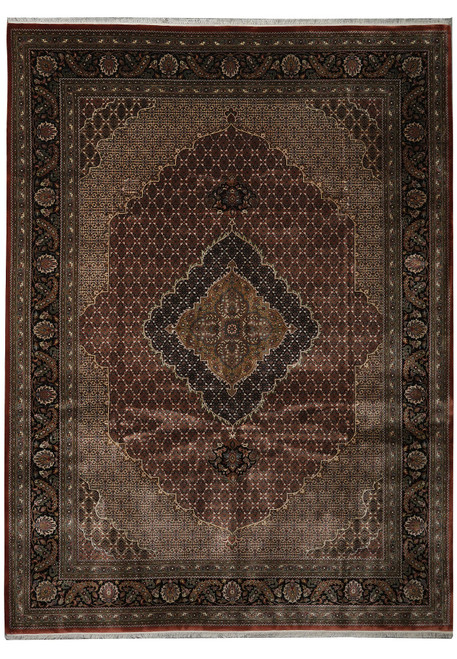
This rug is a full-strength reading of the Tabriz Mahi drawing: a ruby red ground filled edge to edge with the tiny herati lattice, an ivory scalloped medallion at the center, and an ivory main border of rosettes and palmettes holding it all together. It is hand-knotted in wool with silk highlights over a cotton foundation, which is why the field shifts between matte and liquid as you walk around it. The scale is one of the most useful in the house, and buyers who already know they need this footprint tend to shop 8x11 hand-knotted rugs first and narrow by pattern second. The piece is new, never walked on, with full pile, straight sides and clean cotton fringe, and it ships with a certificate of authenticity.
Please Note About the Photographs:
The pale, cloud-like patches across the field in the overhead photographs are light bouncing off the silk highlights and the direction of the pile, not wear, fading or damage. Wool and silk reads light from one side and dark from the other, and the effect moves as you change your viewing angle. Every rug is professionally steamed and pressed before it leaves our warehouse.
Design and Motifs
Mahi means fish, and the name comes from the pair of curved leaves that flank each small rosette inside the diamond lattice, reading like fish circling a flower. Here that lattice covers the entire field in a strict diagonal grid, with a 4 petal ivory rosette dropped into the center of many diamonds and small blue and olive flowerheads scattered through the rest, visible clearly in the low-angle close-ups. The center holds a scalloped ivory medallion, itself filled with the same miniature lattice, framing a lobed black core that carries dark red and ivory rosettes. Matching anchor pendants extend above and below, and four large ivory-lit corner spandrels step out of the ground with feathered outlines. The main border runs ivory, with linked palmettes, 8 petal rosettes and red vine stems, and it is fenced by several narrow guard stripes in camel, olive and wine that keep the eye moving toward the center rather than off the edge.
A Ruby Red Field Framed in Ivory and Olive
The ground is a rich ruby red that deepens toward burgundy where the pile leans away from the light and lifts to a clear wine tone where it leans into it. Against that ground the lattice is drawn in ivory, soft camel and a muted olive green, with pinpoints of slate blue and cream that keep the field from going flat. The medallion is the lightest area of the rug, an ivory beige that reads almost pale gold in the detail shots, and its black center gives the composition a firm anchor. The border repeats the same ivory beige with olive leaves, brown tendrils and deep red rosette hearts, so nothing in the palette arrives from outside the field. Practically, this is a warm room-darkening red that sits well with walnut and mahogany floors, cream upholstery, brass and aged leather, as the room photograph shows.
Made in India, Woven to the Tabriz Mahi Standard
This rug was hand-knotted in India, which is where most of the world's serious contemporary hand-knotted work is now produced. The weaving houses there took on the classic Mahi cartoons decades ago and today execute them with a knot count fine enough to hold the tiny lattice cleanly, which you can judge for yourself on the folded-back corner: crisp, even rows, well-defined motif edges and no drawn-out or blurred lines. The wool is spun for luster rather than bulk, the silk is used sparingly to outline the medallion, the pendants and parts of the lattice, and the cotton foundation keeps the rug flat and dimensionally stable at this size. If you are weighing the terminology, our guide on what separates a Persian rug from a broader Oriental rug explains exactly where a piece like this sits, and why a well-woven Indian Mahi delivers the classic look at a fraction of the workshop price.
8' x 11' Tabriz Mahi Design Rug | Ruby Red Herati Field | Wool and Silk, Made in India
Ask about this rug
This piece is the only one of it, so the things worth knowing about it are particular to it. If you want to talk through the size, the colour in your own light, or the weave, speak to someone here first.