Watch the film
| Size in ft: | Width: 8'2" x Length: 9'4" |
| Size in Inch: | Width: 98" x Length: 112" |
| Size in meters: | Length: 2.84 x Width: 2.49 m |
| Colors: | Gray, Silver Gray, Taupe, Slate Blue, Soft Salmon, Ivory |
| Shape: | Rectangular |
| Woven: | 100% Hand-knotted | Handmade |
| Foundation: | 100% Cotton |
| Pile: | |
| Age: | New | Vegetable dyed |
| Design: | Chobi Peshawar | Khotan Medallion Grid | Floral Vine Border |
| Origin: | Peshawar | Made in Pakistan |
| Condition: | Brand New | Never used |
8'2" x 9'4" Chobi Peshawar Rug | Khotan Medallion Grid in Soft Gray | Vegetable Dyed Handspun Wool, New
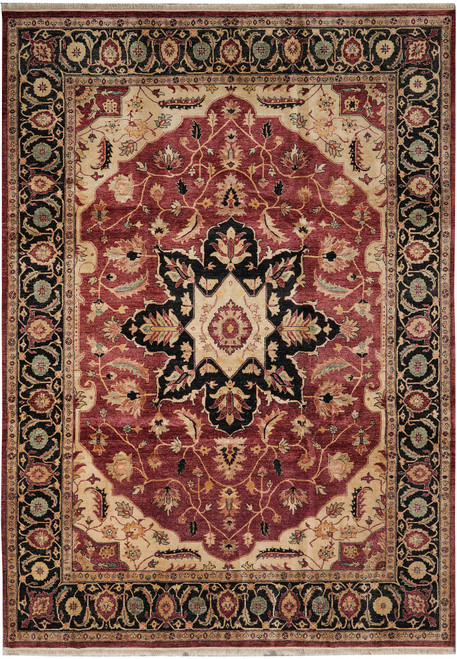
This is a brand new, never used Chobi Peshawar woven in handspun wool on a cotton foundation, and at 8'2" x 9'4" it sits in that useful near square footprint that covers a seating group without crowding a room. The field is a quiet silver gray, and across it run orderly rows of rounded medallions outlined in slate blue, each one holding a small cruciform rosette. Nothing shouts. The whole piece works at low contrast, which is exactly why this kind of Oriental rug has become the default choice for buyers who want a genuine hand-knotted floor and a calm one. Every rug we sell, including this one, ships with a certificate of authenticity confirming that it is hand-knotted, its materials, and its origin.
Please Note About the Photographs:
The first photograph was taken under cooler light and reads bluer than the rug actually is. The remaining photographs, shot on the parquet floor of our Freeport showroom, are the truer reading: a warm silver gray with taupe and faint salmon in the drawing. Ask us for additional daylight photographs or a video if you want a closer look before you commit.
Design and Motifs
The layout comes out of the Khotan and Samarkand tradition of East Turkestan: a strict grid of rounded octagonal medallions, 6 across the width, repeated in staggered rows up the length of the field. Each medallion is drawn as a thin outlined ring with a small 4 armed cruciform rosette floating at its center, and between the rings sit tiny stepped and leaf forms that keep the open ground from looking empty. There is no central medallion and no spandrel work, so the eye reads the field as one continuous repeat rather than a framed composition, which is what makes an all over pattern like this so easy to furnish around. The border is deliberately narrow for a rug of this size: a single main band carrying a larger version of the same rounded medallion, alternating with small rosettes, flanked by a delicate floral vine guard stripe on each side. The corners are resolved honestly, with the border medallion simply turning the angle rather than being forced into a mitered corner, a village habit that keeps the drawing relaxed.
The Vegetable Dyed Gray Palette
The ground is a soft silver gray that shifts toward warm taupe and greige where the handspun yarn takes the dye unevenly, and that gentle striation across the field is abrash, the natural signature of hand-spun wool rather than a flaw. Against it, the medallion outlines are a muted slate blue, dusty rather than sharp, and the small rosettes and interior fillers carry pale salmon, antique tan and a weathered rose that only register when you stand over the rug. The border ground lightens to a sandy ivory, which lifts the whole perimeter and gives the gray field a clean edge, and the guard stripes pick the blue back up in small floral heads. Because the color sits in the same tonal family throughout, the rug behaves like a textured neutral, and it pairs as easily with warm woods and cream upholstery as it does with cooler, more contemporary rooms. If this tone is the direction you are working in, our full range of grey and charcoal rugs is worth comparing against it.
Peshawar Weaving and the Chobi Tradition
Chobi means wood, and the name points to the method: the wool is colored with dyestuffs taken from plants, roots, walnut husk and indigo rather than chemical dye, then the finished rug is washed to settle the tones into the soft, slightly faded register you see here. The work is done in and around Peshawar in northwest Pakistan, where weavers took up the classical design vocabulary of Central Asia and Anatolia and now produce some of the most consistent hand-knotted wool rugs available anywhere. This piece shows the qualities you buy a Peshawar for: handspun yarn with real body, a tight even knot across the full 8'2" width, straight selvedges, hand-knotted fringe worked off the cotton warps, and a pile clipped low enough to keep the fine outlines legible. The last photograph shows a ruler laid across the weave so you can judge the knot count and the regularity of the rows for yourself. It is a new rug with no wear and no restoration, and with wool of this grade it has a long working life in front of it.
8'2" x 9'4" Chobi Peshawar Rug | Khotan Medallion Grid in Soft Gray | Vegetable Dyed Handspun Wool, New
Ask about this rug
This piece is the only one of it, so the things worth knowing about it are particular to it. If you want to talk through the size, the colour in your own light, or the weave, speak to someone here first.