Watch the film
| Size in ft: | Width: 8' x Length: 15'7" |
| Size in Inch: | Width: 96" x Length: 187" |
| Size in meters: | Length: 4.75 x Width: 2.44 m |
| Colors: | Red, Blue |
| Shape: | Rectangular |
| Woven: | Hand-Knotted |
| Pile: | Flat Weave |
| Origin: | Persia |
| Design: | Tribal |
| Age: | 1903 |
| Condition: | Excellent |
8' x 15'7" Persian Tribal Kilim Rug | Signed & Dated 1903 | Hand-Woven Flat Weave
Most antique flat weaves have to be dated by eye. This 8' x 15'7" Persian kilim does not: the black panel at one end carries a woven inscription in Armenian script together with the year 1903, spelled out in red and ivory wool, with a second set of woven initials scattered through the field. That puts the weaving at more than 120 years old and removes the guesswork entirely. It is a true flat weave with no pile, so the drawing is as sharp on the reverse as it is on the face, it sits almost level under furniture and it hangs beautifully on a wall. Among Persian tribal rugs a dated, inscribed example at this length is genuinely uncommon, and it ships with a certificate of authenticity.
Design and Motifs
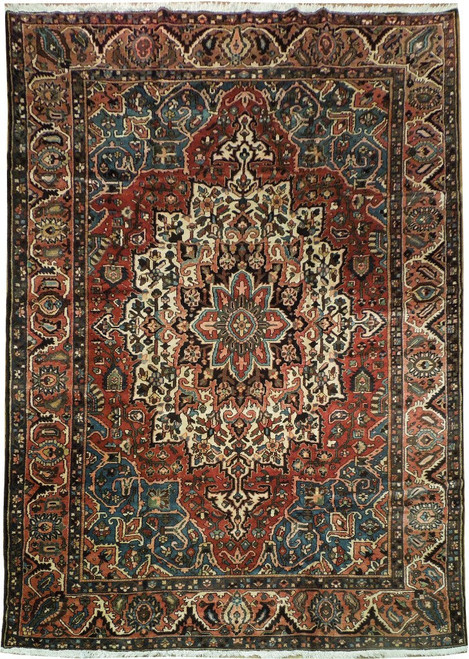
The long field runs on a single column of 3 large crimson hexagonal medallions, each outlined in salmon and pale turquoise and set against deep charcoal black panels that fill the spaces between them. Every medallion is built around a camel or ivory 8 armed star, with hooked arrow shafts firing out to left and right toward 7 part hexagon rosettes, and with paired green vines, teal leaf forms and gold columns rising above and below. The charcoal panels carry mirrored branch and vase forms in orange, brick, ivory and teal, plus tiny woven birds, carnation sprays and stray letters that the weaver added freehand. The main border is a chain of coral outlined hexagon cartouches, no two filled alike, running through purple, emerald, ivory, black and rust rosettes, framed inside and out by sawtooth guard bands in green and red, and finished at the ends with a row of big triangular teeth.
A Madder Red Field Against Charcoal and Turquoise
The two anchors are a saturated madder red and a soft charcoal black that reads brown where the light catches it, and the weaver kept them apart with a thin salmon pink outline so neither color bleeds visually into the other. On top of that framework sits a full tribal palette: emerald and pine green in the vines and guard bands, pale turquoise blue in the leaf forms and medallion outlines, ivory and cream in the stars, birds and lettering, camel and coffee brown in the medallion centers, plus small hits of aubergine purple, saffron gold, rust orange and deep burgundy in the border cartouches. The red has aged evenly across nearly 16 feet with no harsh abrash, and the ivory has mellowed to a warm cream that keeps the whole piece from feeling loud.
Persian Flat Weave Tradition and Weaving Quality
Kilims like this were woven in slit tapestry technique, the wefts packed down hard over the warps so the pattern is formed by the structure itself rather than by knotted pile, which is why both faces are usable and why a good one survives generations of traffic. The Armenian inscription places it with the Armenian weaving communities of northwest Persia, families who signed and dated their work in a way most village weavers never did, and the discipline shows in the even selvedges, the straight sides across a very long loom and the controlled color changes. Because this is a gallery length piece it belongs with the oversize Persian rugs rather than with standard room sizes, and for collectors who want to understand what a woven date is worth, our guide on how to date an Oriental rug explains exactly why an inscribed year like this one matters.
8' x 15'7" Persian Tribal Kilim Rug | Signed & Dated 1903 | Hand-Woven Flat Weave
Ask about this rug
This piece is the only one of it, so the things worth knowing about it are particular to it. If you want to talk through the size, the colour in your own light, or the weave, speak to someone here first.