Watch the film
| Size in ft: | Width: 9'10" x Length: 14' |
| Size in Inch: | Width: 118" x Length: 168" |
| Size in meters: | Length: 4.27 x Width: 3.00 m |
| Colors: | Brown, Blue, Ivory |
| Shape: | Rectangular |
| Woven: | 100% Hand-knotted | Handmade |
| Foundation: | Cotton |
| Pile: | |
| Age: | 1980's | Semi-antique |
| Design: | Tabriz | Lobed Floral Medallion | Curvilinear |
| Origin: | Persian Tabriz | Made in Persia |
| Condition: | Excellent |
9'10" x 14' Persian Tabriz Rug | Neutral Brown Floral Medallion | 1980's Fine Wool
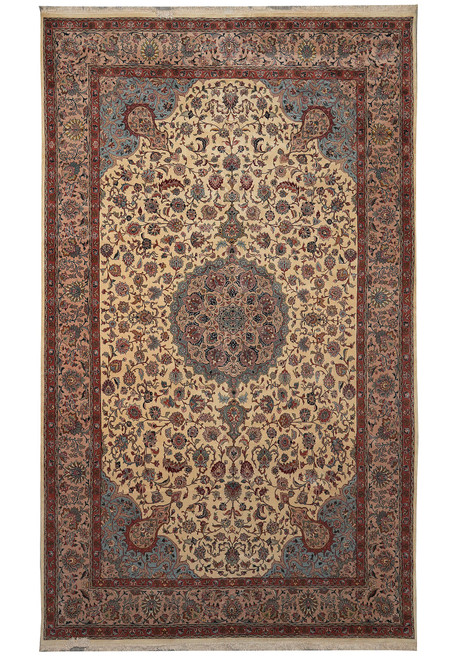
This is a room-filling Tabriz from the 1980's, hand-knotted in fine wool on a cotton foundation and finished at a scale that suits a formal room without dominating it. The field is a quiet camel brown, unusual for a rug of this type and the reason it works so easily with modern furniture, and the drawing across it is dense, curvilinear and completely symmetrical. The pile is still full, the sides and ends are intact, and the back reads clean and even, which is what you want to see in a semi-antique of this age. Buyers looking at 10x14 Persian rugs rarely find one in a neutral ground with this much colour held in the detail. Every rug ships with a certificate of authenticity documenting origin, materials and construction.
Please Note About the Photographs:
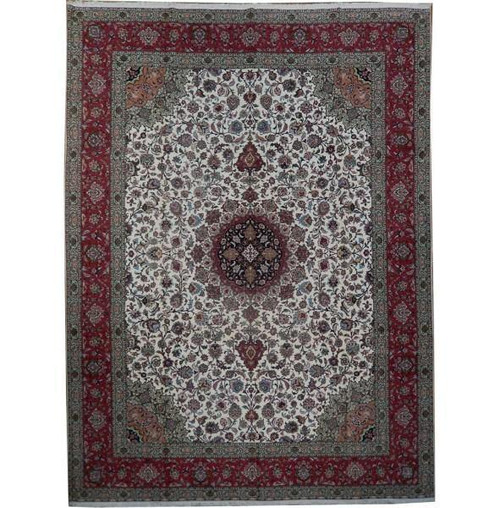
The first flat studio image reads lighter and cooler than the rug is in person. The floor and close-up photographs, shot in daylight, are the accurate record of the colour: a warm camel brown ground with terracotta and navy. Nothing about that difference reflects wear or fading.
Design and Motifs
The centre carries a large lobed medallion built in layers: a small navy core filled with turquoise and cream rosettes, an ivory cartouche ring drawn with palmettes and curling leaves around it, then a broad terracotta lobed outer ring, with slender pendants rising above and below on the long axis. The open field behind it is not open at all on close inspection, it is packed with a fine scrolling vine that carries rosettes, buds and small serrated leaves out to the 4 corners, where navy spandrels close the field with the same vocabulary drawn in reverse. The border system runs 5 bands deep: a wide terracotta main border of alternating palmettes and cypress-shaped leaf sprays, ivory guard stripes with a running meander on either side, and narrow navy bands that hold the whole composition tight. The curvilinear line is confident throughout, and the corners resolve properly, which is the mark of a cartoon followed by a workshop weaver rather than improvised village drawing.
A Neutral Brown Field Carrying Blue, Ivory and Rust
The ground colour is a soft camel brown, closer to taupe in daylight, with a faint pink cast where the light catches the pile. Against it the medallion and spandrels sit in a muted terracotta rust, and the inner medallion ring and guard borders in a warm ivory that reads almost buttery in the close-ups. What keeps the rug from being purely neutral is the blue work: inky navy in the medallion core, the inner border bands and the tiny flower centres, mid sky blue in the rosettes, and a cool seafoam green-blue in the leaves. Scattered through the vine you also find apricot, saffron gold, a deep aubergine brown and small chalk white blossoms that act as highlights across the field. The overall effect at floor level is a warm neutral rug that reveals blue and rust detail the closer you stand, which is why it settles into rooms with grey, cream or walnut tones instead of fighting them.
Tabriz Weaving in Northwest Persia
Tabriz sits in the northwest corner of Persia and has been the country's most organised weaving city for centuries, working from drawn cartoons in city workshops rather than from memory. Tabriz weavers measure fineness in Raj, the count of knots per gereh, about 2.75 inches, across the width, and that system exists because the town's buyers expect precise curved drawing, which only holds together at a real knot count. You can see the result here in the way the medallion lobes round smoothly and the vine keeps its thickness through every turn. Construction is the classic city recipe: a cotton foundation for stability at this length, and a well spun fine wool pile that has stayed lustrous and dense after 40 years. A 9'10" x 14' piece is loom work for an experienced team, and pieces from this period are increasingly the ones collectors reach for now that comparable new Tabriz production has thinned out.
9'10" x 14' Persian Tabriz Rug | Neutral Brown Floral Medallion | 1980's Fine Wool
Ask about this rug
This piece is the only one of it, so the things worth knowing about it are particular to it. If you want to talk through the size, the colour in your own light, or the weave, speak to someone here first.