Watch the film
| Size in ft: | Width: 9'3" x Length: 12'8" |
| Size in Inch: | Width: 111" x Length: 152" |
| Size in meters: | Length: 3.86 x Width: 2.82 m |
| Colors: | Emerald Green, Ivory, Red, Sky Blue, Pink, Navy |
| Shape: | Rectangular |
| Woven: | 100% Hand-knotted | Handmade |
| Foundation: | Cotton |
| Pile: | |
| Age: | 1980s |
| Signature: | Woven cartouche in the border | Script not legible in photographs |
| Design: | Kerman Medallion | Open Field | Cartouche Panel Border |
| Origin: | Persian Kerman | Made in Persia |
| Condition: | Excellent |
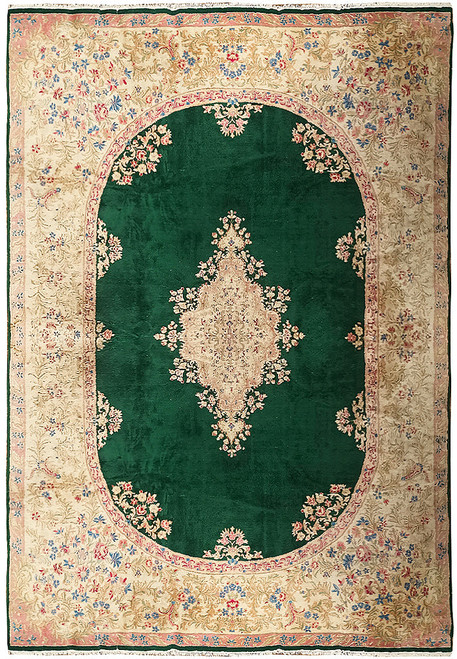
9'3" x 12'8" Persian Kerman Rug | Emerald Green Open Field, Ivory Cartouche Border | Signed, 1980s
A green Kerman of this scale is an unusual thing to find. Most Kerman workshops of the 1980s stayed with ivory or rose grounds, and here the weaver committed nearly the whole 9'3" x 12'8" surface to a deep emerald field, holding the drawing back to a single jeweled medallion and letting the wool itself do the work. The pile is 3/8" wool on a cotton foundation, the handle is supple, and the weaver signed the piece in a small dark cartouche set into the ivory border, which is the mark of a named workshop rather than an anonymous commercial run. It sits comfortably among large Persian rugs that need to anchor a full seating group, and it ships with a certificate of authenticity documenting origin, materials and construction.
Please Note About the Photographs:
The large open green field reads with soft tonal shifts from photograph to photograph, lighter through the center in the overhead shot and deeper in the angled view. That is abrash, the natural variation between dye lots of hand-spun wool, and it is what tells you the color came from a dye vat rather than a machine. It is not wear, not fading and not damage. Every rug is professionally steamed and pressed before it leaves us.
Design and Motifs
The field is drawn as a large cusped panel, outlined in a fine ivory guard line that steps and curves its way around the whole green ground, with a pointed crest at each end. Dead center sits the medallion: a lobed, hooked form filled with red, sky blue and navy scrollwork, carrying an ivory oval at its heart with a small 8 petal rosette inside it, plus twin pendants above and below and a pair of ivory side finials pushing out to left and right. The 4 corners carry rosette panels in pink and ivory on a pale blue ground of dense arabesque vinework, and the space between them is filled with a fine allover trellis of blue scrolling stems. The main border alternates shield-shaped cartouche panels in red, sky blue and ivory, each holding its own floral spray, and the whole assembly is fenced in by narrow guard stripes of running meander and interlaced ribbon in olive and gold.
A Study in Emerald, Ivory and Red
The field is a true emerald, leaning toward pine and teal where the light falls flat and warming to a bottle green where the pile lies the other way. Against it, the ivory outline of the field panel reads almost like piping, and the border ground shifts between cream and a warm buttered ivory. The medallion supplies the heat: a clear tomato red carrying sky blue arabesques, navy accents, and a pale blush pink that reappears in the corner rosettes and in several of the border cartouches. Small touches of gold and olive run through the guard stripes, and the selvedge and end finish pick the green back up so the rug frames itself. This is one of the more confident green Persian rugs we handle, and the palette is easy to live with: green and ivory do the heavy lifting, red and blue come in as jewelry.
Kerman Weaving in Southeast Persia
Kerman sits in the southeast of Persia and has been a drawing town for centuries, the home of the great vase carpets and of a workshop tradition built on curved line rather than angular village geometry. What Kerman weavers do better than most is control a large empty ground, and that is exactly the test this rug sets itself: a single open field, a single medallion, and nowhere to hide a loose knot or a wandering outline. The wool of the region takes dye deeply and keeps a low sheen, which is why the green here has body instead of looking flat. The back, shown against a rule in the last photograph, is even and tightly beaten, the knotting regular from selvedge to selvedge, and the pile is still a full 3/8" with no thinning through the center. Add the woven signature in the border and this is workshop production from the 1980s, kept in excellent order.
9'3" x 12'8" Persian Kerman Rug | Emerald Green Open Field, Ivory Cartouche Border | Signed, 1980s
Ask about this rug
This piece is the only one of it, so the things worth knowing about it are particular to it. If you want to talk through the size, the colour in your own light, or the weave, speak to someone here first.