Watch the film
| Size in ft: | Width: 9'9" x Length: 13'4" |
| Size in Inch: | Width: 117" x Length: 160" |
| Size in meters: | Length: 4.06 x Width: 2.97 m |
| Colors: | Navy Blue, Red, Ivory, Sky Blue, Gold |
| Shape: | Rectangular |
| Woven: | 100% Hand-knotted | Handmade |
| Foundation: | Cotton |
| Pile: | |
| Age: | 1980's |
| Design: | Sarouk | Central floral medallion | All-over vinery |
| Origin: | Persian Mahal | Made in Persia |
| Condition: | Perfect | Full even pile |
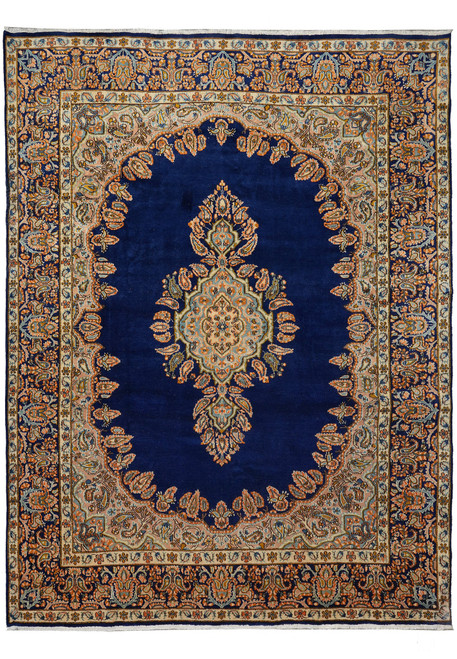
9'9" x 13'4" Persian Mahal Rug | Sarouk Medallion Design | 1980s Navy Blue and Red
A true room-size piece at 9'9" x 13'4", this Persian Mahal was hand-knotted in the 1980s with a wool pile on a cotton foundation, and it reads as one of the more confident village-workshop pieces of its decade. The drawing follows the classic Sarouk formula, a lobed medallion floating on a midnight navy field with a broad tomato red border, and it is carried at a scale that suits a 13 foot room without the pattern ever feeling crowded. The pile is deep and even from selvage to selvage, the wool has the slight sheen that only comes from good fleece and years of settling, and the whole rug lies flat and square. Every rug we sell ships with a certificate of authenticity documenting origin, materials and hand-knotted construction, and this one sits comfortably among our 10x13 Persian rugs for buyers furnishing a formal living room or a large dining space.
Please Note About the Photographs:
A few of the photos show soft fold lines and shadows across the field from the rug being stored folded on a pallet. These are not wear, not fading and not damage. They relax out once the rug is laid flat, and every rug leaving our warehouse is professionally steamed and pressed before shipping.
Design and Motifs
The center holds a lobed 8 point medallion filled with sky blue scrolling arabesque on an ivory ground, ringed in red and finished with a small rosette pendant at each pole. Radiating out from it, the field is worked in mirrored pairs of large curling vine cartouches, each enclosing a palmette or a lotus blossom, with serrated leaves, small red rosettes and gold tulip heads scattered along the vines. The 4 corners carry ivory spandrels drawn with the same vocabulary at a smaller scale, which is the detail that marks the drawing out as a Persian Sarouk design rather than a plain all-over pattern. The main border runs a continuous red band of interlocking spiral scrollwork and standing palmettes, flanked by 2 pairs of minor bands of rosettes and reciprocal vine, then a narrow ivory guard stripe at the outer edge. Symmetry holds along both axes, and the border corners resolve cleanly, which tells you the weavers were working from a proper cartoon rather than improvising.
Midnight Navy Field Against Tomato Red Borders
The field is a deep indigo navy that shifts with the light, reading almost black where the pile leans away and a clear midnight blue where it leans toward you. Against it the border is a warm tomato red with a faint brick undertone, bright but never orange, and the contrast between the 2 is what gives the rug its presence across a big room. The vine work is drawn in ivory and cream that has mellowed toward parchment, so the outlines glow rather than glare, and the interior fills use 2 distinct blues, a soft sky blue in the medallion and petals and a stronger cobalt in the leaves. Small notes of mustard gold, coral pink and a dark oxblood brown appear in the flower centers and add depth at close range. For anyone building a scheme around navy blue Persian rugs, this palette anchors cream walls, walnut furniture and leather beautifully, and the navy outer selvage frames the whole piece like a mat around a print.
Mahal Weaving in the Arak Villages
Mahal rugs come from the cluster of weaving villages around Arak in west-central Persia, the same district that produced the Sultanabad and Sarouk workshop pieces prized by American collectors from the late 19th century onward. Mahal weavers worked on a slightly heavier scale than the town workshops, using thick local wool over a sturdy cotton foundation, which is precisely why these rugs survive decades of family traffic and still show full pile. Sarouk village sits in the same district, so a Mahal woven in the Sarouk drawing is not a copy from elsewhere, it is a neighboring village working a design it grew up with. What you get is workshop drawing with village durability: the medallion and vinery are precise, but the knot count stays moderate and the pile stays deep, giving the rug weight underfoot and a wool surface that takes light rather than reflecting it flat. Pieces of this generation, hand-knotted in the 1980s and still in perfect condition at 9'9" x 13'4", are getting harder to find in this scale.
9'9" x 13'4" Persian Mahal Rug | Sarouk Medallion Design | 1980s Navy Blue and Red
Ask about this rug
This piece is the only one of it, so the things worth knowing about it are particular to it. If you want to talk through the size, the colour in your own light, or the weave, speak to someone here first.