Watch the film
| Size in ft: | Width: 9'10" x Length: 13' |
| Size in Inch: | Width: 118" x Length: 156" |
| Size in meters: | Length: 3.96 x Width: 3.00 m |
| Colors: | Tomato Red, Blue, Navy, Ivory, Gold |
| Shape: | Rectangular |
| Woven: | 100% Hand-knotted | Handmade |
| Foundation: | Cotton |
| Pile: | |
| Age: | 1980's | Semi-antique |
| Design: | Traditional Mahallat | Lobed Central Medallion | All-Over Floral Vine |
| Origin: | Persian Sarouk Mahallat | Made in Persia |
| Condition: | Perfect | Full even pile |
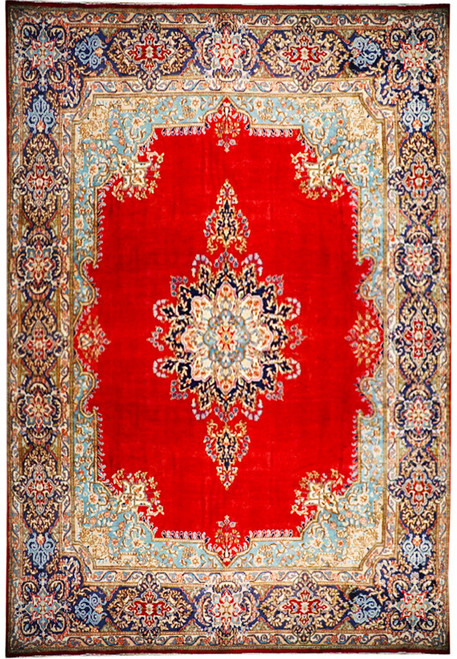
9'10" x 13' Persian Sarouk Mahallat Rug | Tomato Red Floral Medallion | 1980s | Perfect Condition
This is a heavyweight 1980s Persian Sarouk Mahallat rug, hand-knotted in wool on a cotton foundation and still carrying a full, even pile across all 13 feet of its length. Mahallat weaving is built for hard use, and this one shows it: a thick, tightly packed handle, dense wool that springs back under the hand, and crisp drawing that has not softened with age. The field is a true tomato red, the medallion a deep blue, and the main border a near-black navy that frames the whole piece. At 9'10" x 13" in true room size it covers a living room or dining room without crowding the walls, and it is one of the more practical formats in the 10x13 Persian rug range. Every rug we sell ships with a certificate of authenticity confirming origin, materials and hand-knotted construction.
Design and Motifs
A lobed blue medallion sits dead center, filled with an ivory cartouche and an 8 petal rosette at its heart, and finishes top and bottom in stepped pendants that point down the long axis. Around it the red field is completely covered in a curved vine system: split palmettes, lotus blossoms, serrated saz leaves and small cypress-like sprays, all mirrored so that the two halves of the rug answer each other exactly. The 4 corners carry ivory spandrels drawn with the same vine in miniature, which lifts the corners and keeps the red from reading as a single solid block. The wide navy main border runs a repeating palmette and scrolling vine, flanked by teal guard stripes and a fine reciprocal minor stripe at the outer edge. The drawing is village work in the classical idiom: floral, curvilinear, confidently spaced, with none of the stiffness you see in later commercial copies.
A Tomato Red Field with Indigo and Ivory
The field color is the first thing you notice: a bright, warm tomato red with a slight cherry cast where the light catches the pile, clean rather than brick or rust. Against it the medallion is a mid indigo blue that reads almost teal at close range, shaded with lighter petrol tones inside the lobes. Ivory does the structural work, outlining the medallion, filling the corner spandrels and picking out individual blossoms across the field so the pattern stays legible from standing height. Soft gold and apricot appear in the palmettes, with small touches of pale pink, sage green and off-white scattered through the vine. The main border drops to a deep navy that is nearly black in shade, which is what gives the red field its punch, and the two teal guard stripes cool the transition between them. Viewed from the opposite end the wool shows the usual healthy abrash and sheen shift, going slightly deeper and richer, a sign of good hand-spun wool and natural dye behavior.
Mahallat and the Sarouk Weaving Tradition
Mahallat lies in the Markazi region of central Persia, in the same weaving belt as Sarouk and Arak, and its output is sold within the Sarouk group because the construction and the design vocabulary are shared. What Mahallat is known for is density and toughness: a firm cotton foundation, heavily beaten wefts and a thick wool pile that resists crushing under furniture, which is exactly why these rugs survive decades of family traffic and still show full pile. This example is a village workshop piece from the 1980s, woven on a full cartoon rather than improvised, with symmetry that holds true from end to end and borders that turn the corners cleanly. Knot count is moderate by design here; the value is in the wool quality, the dye work and the structural weight rather than in fineness, and it is the reason a Mahallat Sarouk of this size remains one of the most sensible large Persian rugs you can put on a floor that gets used every day.
9'10" x 13' Persian Sarouk Mahallat Rug | Tomato Red Floral Medallion | 1980s | Perfect Condition
Ask about this rug
This piece is the only one of it, so the things worth knowing about it are particular to it. If you want to talk through the size, the colour in your own light, or the weave, speak to someone here first.