Watch the film
| Size in ft: | Width: 10' x Length: 14' |
| Size in Inch: | Width: 120" x Length: 168" |
| Size in meters: | Length: 4.27 x Width: 3.05 m |
| Colors: | Rust, Black, Green, Ivory, Sky Blue, Gold |
| Shape: | Rectangular |
| Woven: | 100% Hand-knotted | Handmade |
| Foundation: | Cotton |
| Pile: | |
| Age: | New |
| Design: | Serapi | Stepped medallion | Ivory spandrels | Black main border |
| Origin: | Made in India |
| Condition: | Perfect | Never used |
10' x 14' Serapi Rug | Rust Field with Black Stepped Medallion | New Wool Pile, Made in India
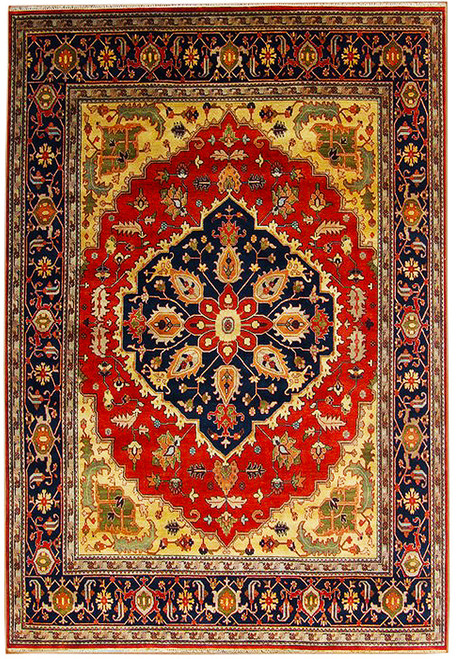
This is a brand new, never used Serapi in the true room size that most buyers are hunting for, a full 10x14 area rug hand-knotted in 100% wool on a cotton foundation. The drawing is the classic Serapi formula: a rust ground carrying one large stepped medallion in black, ivory spandrels at the 4 corners, and a deep black main border. The pile is thick and evenly clipped, the wool has a healthy sheen under showroom light, and the selvedges and fringes are clean and untouched, exactly as you would expect from a piece that has never been on a floor. Every rug we ship leaves Freeport with a certificate of authenticity confirming that it is genuinely hand-knotted, along with the material and origin details listed above. If you are weighing this against a workshop piece from Persia, our guide on what actually separates a Persian rug from an Oriental rug is worth 5 minutes before you buy.
Design and Motifs
Serapi is the finer grade of the Heriz drawing, and this weave shows why collectors ask for it by name. The center medallion is an 8 point star in inky black, outlined in gold and sky blue, with a small ivory cartouche at its heart holding a rust and blue rosette. Four pale green sub-panels sit inside the medallion corners, each filled with a tiny leaf and blossom sprig. Above and below, two large black pendants break into serrated palmette leaves, each with a rust teardrop at its center. The rust field around the medallion is filled with the vocabulary these geometric medallion rugs are known for: angular vine work, white and blue rosettes ringed in green leaves, hooked serrated leaves, and dagger-shaped sprays. The ivory spandrels carry soft green tablet panels with black bird-like sprigs, and the black main border runs a turtle palmette and vine rhythm framed by two narrow rust guard stripes of reciprocal blossoms. Every line is straight, every corner resolves cleanly, and the 2 halves of the field mirror each other closely.
The Rust, Black and Green Palette
The field is a warm rust, a brick tone with orange in it rather than a cool burgundy, and it reads brighter in daylight than under showroom fluorescents. Against it the medallion, pendants and main border are near black with a blue-black cast where the light catches the pile. Between those 2 poles sits a broad ivory field in the spandrels and outer field frame, which gives the design its breathing room and keeps the rug from feeling heavy. The accent work is where the rug gets its charm: soft sage and pistachio greens in the corner panels and leaf sprays, dusty sky blue in the rosettes and outlining, antique gold in the medallion frame and the vine armature, plus small touches of cream, camel and olive scattered through the border. Rust, black and green are the 3 colors that drive the room, and the palette sits naturally with walnut and oak floors, leather, brass, and cream or clay wall colors.
Woven in India in the Serapi Tradition
The back tag reads hand-knotted in India, 100% wool pile, and we say so plainly because India is where most of the world's best contemporary hand-knotted weaving is now done. The workshops that produce Serapi designs there work from hand-drawn cartoons, spin and dye their own wool, and hold the weavers to a village standard of straight lines and stepped corners rather than trying to force curvilinear drawing that the design never called for. Turn this rug over, as in the last photograph, and you can see the knots clearly defined across the cotton warps with no glue, no backing and no machine regularity. The pile is heavy enough to take traffic in a dining room or a busy living room for decades, and the wool is dry-spun with enough lanolin left in it to shed dirt rather than hold it. For a new, unused hand-knotted Oriental rug in this size and this condition, the weave quality here is the whole argument.
10' x 14' Serapi Rug | Rust Field with Black Stepped Medallion | New Wool Pile, Made in India
Ask about this rug
This piece is the only one of it, so the things worth knowing about it are particular to it. If you want to talk through the size, the colour in your own light, or the weave, speak to someone here first.