| Size in ft: | Width: 14' x Length: 24' |
| Size in Inch: | Width: 168" x Length: 288" |
| Size in meters: | Length: 7.32 x Width: 4.27 m |
| Colors: | Dark Blue, Coral Red, Green, Ivory |
| Shape: | Rectangular |
| Woven: | 100% Hand-knotted | Handmade |
| Foundation: | Cotton |
| Pile: | |
| Age: | New |
| Design: | Serapi | Stepped Medallion | Ivory Corner Spandrels |
| Origin: | Made in India |
| Condition: | Perfect | Brand New |
14' x 24' Serapi Design Oriental Rug | Navy Field, Coral Medallion | New, Made in India
At 14' x 24' this is a true palace piece, 336 square feet of hand-knotted wool drawn in the bold Serapi manner, and it is the kind of rug that decides the architecture of a room rather than decorating it. The weaving is brand new and has never been on a floor, with a thick even pile, straight selvages and a flat, heavy body that will lie dead still once it is rolled out. Rugs of this footprint are ordered, not stumbled upon, and the loom time alone runs into years, which is why very few workshops keep oversize 14x24 rugs in production at all. It ships with a certificate of authenticity confirming the hand-knotted construction, the wool pile and the country of manufacture, and despite a rolled weight well over 150 lbs it ships free to all 50 states with no freight surcharge.
Design and Motifs
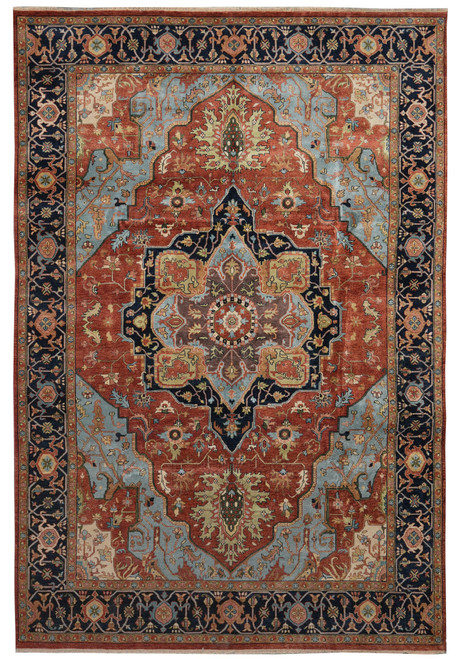
Serapi is the name given to the boldest and most open drawing in the Heriz design family, and this rug follows the formula exactly: a large stepped coral red medallion with an 8 lobed rosette core, long anchor pendants running toward each end, and deep ivory spandrels filling all 4 corners. Everything is drawn with angular, straight-line confidence rather than curved court vinework, which is what makes the pattern read clearly from across a big room. The navy field carries detached palmettes, serrated leaf sprays and hooked vine arms floating in open ground, while the spandrels are packed with rosettes, cypress-like leaf forms and small blossoms in gold, green and brick. The wide rust main border alternates large lobed rosettes with turtle palmettes joined by a thin yellow vine, framed by ivory and navy guard stripes of repeating blossoms and paired hooks. Buyers who favor this kind of angular drawing usually end up comparing it against other geometric rugs, and at this scale the Serapi layout is hard to beat.
Color: Midnight Navy, Coral Red and Ivory
The field is a deep midnight navy, almost blue-black in the shaded photographs and opening up to a clear indigo where the light crosses the pile, and it is that dark ground that gives the rug its depth. Against it the medallion and the main border sit in a warm coral red that leans terracotta rather than cherry, softened by the wool so it never turns orange under lamplight. Ivory does the heavy lifting in the corner spandrels and in the inner guard stripe, bright enough to outline the medallion but creamy rather than white. Through the leaves, rosettes and small filler motifs run sage and olive greens, a muted gray-blue in the outer guard, and a run of gold and camel tones that pick up the yellow vine threading the border. Small touches of soft brown and faded rose appear in the flower heads. The result is a rich, layered, multi-colored palette anchored by only 2 dominant tones, which is why it settles easily over oak, walnut or pale stone.
Origin and Weaving Quality: Hand-Knotted in India
This rug was hand-knotted in India, which is where most of the world's best contemporary hand-knotted work is now made, and a piece this size is proof of it: a 14 foot wide loom, a team of weavers working the same row for years, and a design chart that has to stay true across 24 feet of length without the medallion drifting off center. The pile is wool on a cotton foundation, knotted at the medium-dense count that suits a Serapi, heavy underfoot and built for decades of traffic rather than for a fine silky face. The back photograph shows tight, even, clearly defined knot rows and a firm handle, with the fringe finished flat and the selvages wrapped clean. If you are weighing the difference between a hand-knotted Oriental rug like this one and a machine-made copy, the evidence is all on the reverse side, where the pattern reads as sharply as it does on the face.
14' x 24' Serapi Design Oriental Rug | Navy Field, Coral Medallion | New, Made in India
Ask about this rug
This piece is the only one of it, so the things worth knowing about it are particular to it. If you want to talk through the size, the colour in your own light, or the weave, speak to someone here first.