Watch the film
| Size in ft: | Width: 12' x Length: 15'4" |
| Size in Inch: | Width: 144" x Length: 184" |
| Size in meters: | Length: 4.67 x Width: 3.66 m |
| Colors: | Variation of Salmon, Indigo Blue, Teal, Ivory, Olive |
| Shape: | Rectangular |
| Woven: | 100% Hand-knotted | Handmade |
| Foundation: | Cotton |
| Pile: | |
| Age: | 1930's | Antique |
| Design: | Art Deco | Open Field | Pagoda Landscape Center |
| Origin: | Chinese Art Deco | Made in China |
| Condition: | Very Good | Color variation throughout the field |
12' x 15'4" Chinese Art Deco Rug | Salmon Field, Pagoda Landscape Medallion | 1930s Antique
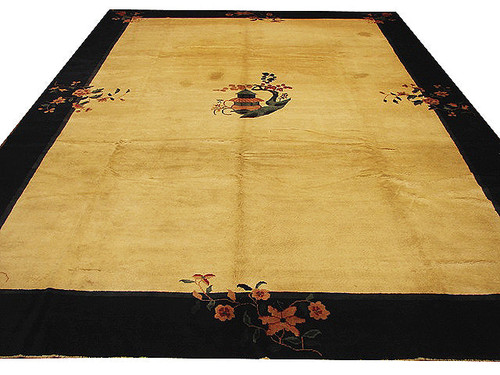
Almost nothing happens in the middle of this rug, and that is the whole idea. A single blue pagoda island sits at the center of a wide salmon field, 4 flowering vases mark the corners, and a deep indigo border closes the composition. It was knotted by hand in the 1930s in thick wool on a cotton foundation, and at 12' x 15'4" it belongs with the oversize antique rugs that were made for long dining rooms and double-height living rooms. Sold as a genuine antique Oriental rug with a certificate of authenticity.
Please Note About the Photographs:
The salmon field shifts from coral to soft apricot to sandy gold, and the photos record that honestly. This is abrash, the natural variation of small hand-dyed wool lots in a rug woven nearly a century ago, plus the patina of age. It is not fading, staining or wear. The soft lines across the field in the overhead images are fold marks from flat storage; they relax once the rug is laid out, and every rug is professionally steamed and pressed before it ships.
Design and Motifs
The center motif is a small woven landscape: a 5 tiered pagoda topped with a finial, a stone stair and a pale olive path climbing a rounded indigo hill, a low pavilion with a lattice roof to the right, a gnarled pine reaching across the roofline, and a hatched strip of water at the base. It reads like a fragment of a scroll painting dropped onto an empty ground. Each of the 4 corners holds a baluster vase with a blossoming branch rising out of it, the flowers drawn as simple 5 petal rosettes in two tones of blue. The main border is a dark indigo band filled with large ivory and olive peony heads, curling leaves and thin connecting vines, framed inside by a teal band of cloud scroll brackets and outside by a narrow guard stripe. There is no medallion, no repeating lattice and no crowding, which is exactly how the Art Deco workshops broke with older Chinese layouts.
Salmon, Indigo and the Character of the Color
The field is a warm salmon, somewhere between coral and terracotta, and it is alive rather than flat: down the middle it lightens toward a sandy peach, along the lower edge it deepens toward rust, and the wool catches light differently depending on which way you walk around it. Against that, the border reads almost black-blue in low light and resolves into a saturated indigo up close, with the inner band running a brighter teal that has glints of turquoise where the pile has worn glossy. The pagoda and the vases pick up the same blues, with midnight outlines for the branches and leaves, olive and old ivory for the path, roof tiles and peony petals. It is a two color rug at heart, salmon and blue, and that restraint is why it sits comfortably with modern furniture, dark wood and plaster walls alike.
Chinese Art Deco Weaving in the 1930s
Rugs like this came out of the big commercial workshops of Peking and Tientsin in the 1920s and 1930s, woven specifically for American and European interiors of the period. The weavers used a heavy, lustrous wool laid over a cotton foundation, a moderate knot count and a deliberately thick pile that was then clipped around the outlines so the motifs stand slightly proud of the ground. Quality in this group is judged by the drawing, the depth of the natural dyes and the handle of the wool rather than by knot count, and on all 3 counts this piece is a good example of the type. Anyone who wants to understand how the wool, the palette and the loom marks help date an antique Oriental rug can see the evidence here, from the fine cotton warps at the end finish to the soft, evenly worn pile across the open field.
12' x 15'4" Chinese Art Deco Rug | Salmon Field, Pagoda Landscape Medallion | 1930s Antique
Ask about this rug
This piece is the only one of it, so the things worth knowing about it are particular to it. If you want to talk through the size, the colour in your own light, or the weave, speak to someone here first.