| Size in ft: | Width: 9' x Length: 12' |
| Size in Inch: | Width: 108" x Length: 144" |
| Size in meters: | Length: 3.66 x Width: 2.74 m |
| Colors: | Beige, Peach Salmon Pink, Green, Blue |
| Shape: | Rectangular |
| Woven: | 100% Hand-knotted | Handmade |
| Foundation: | Cotton |
| Pile: | |
| Age: | 1930's | Approx. 90 years old |
| Design: | Serapi | Stepped lobed medallion | Serrated leaf field |
| Origin: | Persian Serapi | Made in Persia |
| Condition: | Very Good | Soft antique patina |
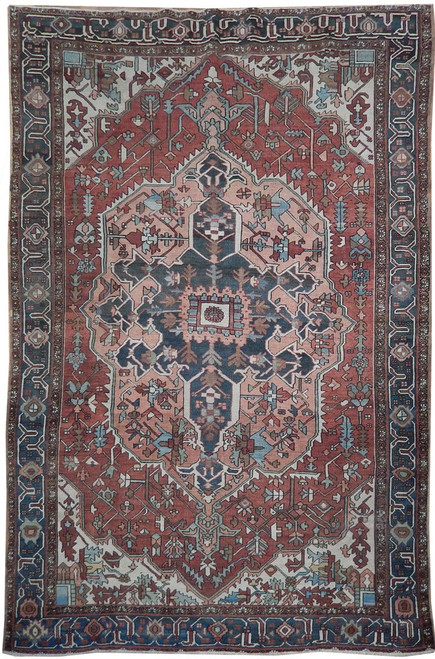
9' x 12' Persian Serapi Rug | Beige Field with Salmon Medallion | 1930s Antique
This is a genuine 1930s Serapi, the grade name reserved for the best of the old northwest Persian village weaving, and it has the two things collectors look for first: a camel-beige field that has mellowed for roughly 90 years, and drawing that is confident rather than crowded. The stepped salmon medallion sits high and wide in the field, the serrated leaves reach out toward the corners, and the whole composition breathes in a way that later reproductions rarely manage. The pile is 100% wool on a cotton foundation, the handle is supple, and the wear is the even, low, silky patina of an antique that was used and cared for rather than abused. At 9' x 12' it is a true room-size piece, and buyers shopping 9x12 Persian rugs will find very few authentic pre-war Serapis left at this size. It ships with a certificate of authenticity.
Please Note About the Photographs:
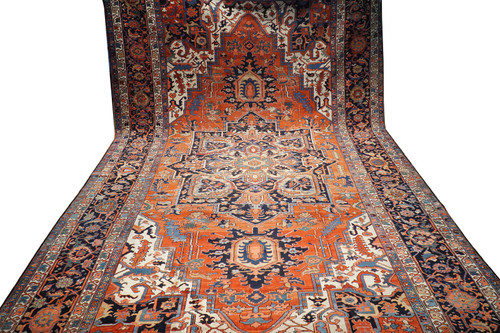
The macro close-ups show an evenly low, softly polished pile with gentle color variation across the field. That is the natural patina of a 1930s hand-knotted rug and part of why antique Serapis are valued; it is not damage, staining or a manufacturing flaw. Every rug is professionally cleaned, steamed and pressed before it leaves our warehouse.
Design and Motifs
The layout is the classic Serapi formula executed with unusual grace. A large stepped and lobed medallion in soft salmon anchors the center, filled with a lattice of slender vines, 8 petal rosettes and sage-blue leaf forms radiating from a small rust roundel. Above and below it, long ivory pendants drop into the field and terminate in anchor-shaped finials outlined in dark brown. The open beige field carries oversized serrated leaves in rust and brick, paired with blue palmettes, cypress sprays and small paired rosettes, all drawn with the slightly angular line that separates village work from city curvilinear weaving. The spandrels are cut sharply from salmon and brick ground and filled with leafy vine. The main border runs a rosette and palmette repeat across a salmon ground, with turquoise-blue flower heads and ivory scrolling vine, framed by narrow guard stripes of reciprocal vine on ivory and a dark outer line. The corners resolve cleanly, which is a mark of a weaver working from a well-planned cartoon rather than improvising at the end.
A Palette of Beige, Salmon and Antique Blue
The field is a warm camel beige, closer to sand and old ivory than to white, and it shifts subtly in tone across the width in the gentle abrash that natural dye lots produce. Against it, the medallion and the wide border read as peach salmon pink, deepening to terracotta and brick red in the serrated leaves, the border rosettes and the outer guard. The blues do the quiet work: a dusty indigo in the palmettes, a softer slate and teal in the smaller flower heads and leaf tips, with clear turquoise sparks in the border blossoms. Sage and olive green appear in the vine work and in the leaf clusters at the ends of the field, and small touches of pale gold and cream lift the rosette centers. Dark brown outlining gives every motif a crisp edge. The overall effect is low contrast and sun-warmed, the kind of aged Persian palette that sits easily on wide-plank oak, pale limestone and modern plaster walls.
Serapi Weaving in the Heriz District
Serapi is not a separate town but a grade: the trade name, taken from the nearby village of Sarab, given to the finest and generally oldest rugs woven in the Heriz district east of Tabriz, on the slopes below Mount Sabalan. The wool from those pastures is famously long-stapled and lanolin-rich, and the mineral content of the local water is credited with the depth and stability of the old dyes, which is exactly why a 1930s piece can still look this alive. The weave is a firm single-wefted village construction on a cotton foundation, knotted at a village count rather than a workshop count, and that slightly coarser gauge is what forces the bold, large-scale, geometrically drawn motifs that define the look. Pieces like this one, with generous open field and disciplined cornering, mark the top of the district's output. If you want to understand what puts a rug in this period, our guide on how to date an oriental rug walks through the dyes, wefting and wear patterns we read on this exact piece.
9' x 12' Persian Serapi Rug | Beige Field with Salmon Medallion | 1930s Antique
Ask about this rug
This piece is the only one of it, so the things worth knowing about it are particular to it. If you want to talk through the size, the colour in your own light, or the weave, speak to someone here first.