| Size in ft: | Width: 7'4" x Length: 11'2" |
| Size in Inch: | Width: 88" x Length: 134" |
| Size in meters: | Length: 3.40 x Width: 2.24 m |
| Colors: | Rust, Blue, Ivory, Salmon |
| Shape: | Rectangular |
| Woven: | Hand-Knotted |
| Pile: | Wool- Low Pile |
| Origin: | Persia |
| Design: | Serapi |
| Age: | 1930's |
| Condition: | Very Good |
7'4" x 11'2" Persian Serapi Rug | Geometric Medallion | Antique 1930s Heriz Village Weave
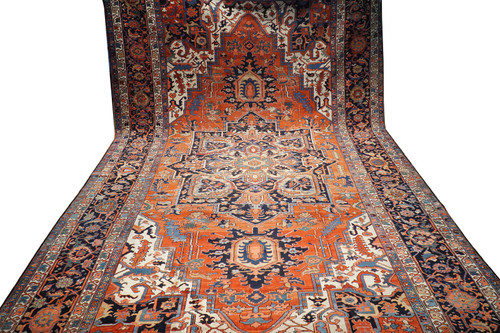
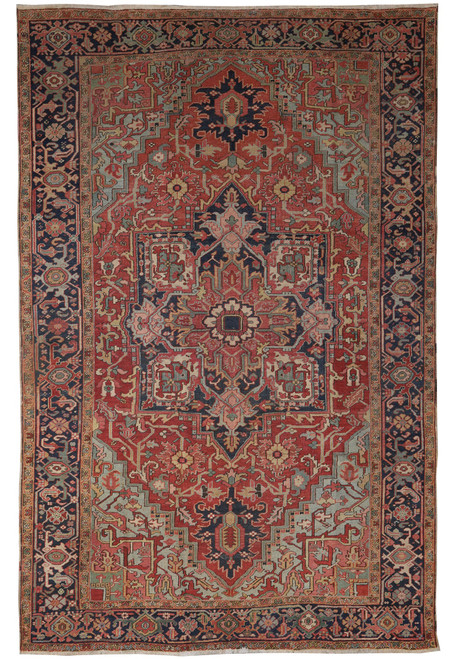
This is a genuine 1930s Serapi, hand-knotted in wool on a cotton foundation in the mountain villages of northwest Persia and carried for roughly 90 years without losing its drawing. The pile is low and evenly worn, which is exactly what collectors look for in a rug of this age: the wool has burnished down to a soft, dry sheen that no new weaving can imitate, the knot heads sit close to the foundation, and the colors have settled into the mellow, slightly sun-touched tones you can see in the close-up photographs. Nothing about it is loud. The rust field, the deep indigo medallion and the open ivory corners work together the way antique Serapis are supposed to, which is why decorators keep buying them faster than the old stock can be replaced. Every rug we sell ships with a certificate of authenticity, and if you want to understand how a piece like this is placed in time, our guide on how to date an oriental rug walks through the same clues we used here.
Please Note About the Photographs:
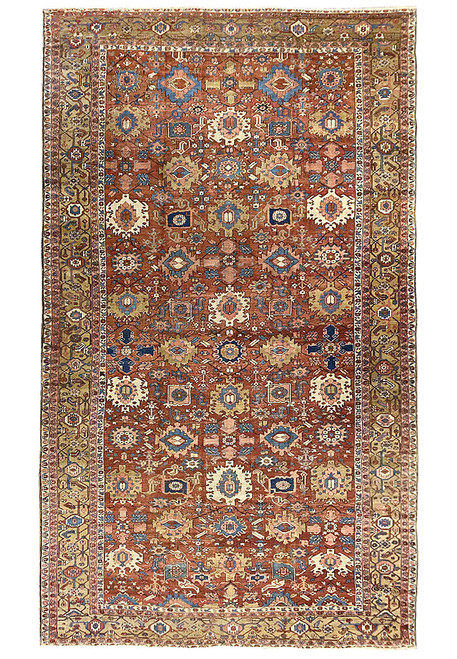
The first photograph was taken under bright studio lighting and reads lighter and pinker than the rug actually is. The floor photographs, shot in natural light, show the true depth of the rust field and the indigo borders. Colors on screen will always vary slightly with your own lighting.
Design and Motifs
The layout is the classic Serapi formula drawn with unusual confidence. A large indigo medallion sits dead center, stepped and serrated at every edge, carrying a small ivory and salmon lozenge at its heart with an 8 petal rosette inside it. Anchored pendants run north and south from the medallion, each one filled with checkerboard blocks and angular leaves, while a wide salmon ground surrounds the medallion and separates it from the rust field. Across that field the weaver scattered serrated leaves, hooked palmettes, blossom heads and little animal-like figures, all of them drawn in straight lines and stepped diagonals, because a village loom with no cartoon builds curves out of angles. The 4 corners are opened up in ivory and filled with big spreading vine work, a device that makes the rug read lighter and larger than its footprint. The main border carries a running chain of geometric rosettes and hooked bars on indigo, framed by narrow flowering guard stripes in brown and ivory. If you like this drawing language, it sits squarely within the family of geometric Persian rugs that anchor a room without competing with it.
A Palette of Rust, Indigo, Salmon and Ivory
Color is where this rug earns its keep. The field is a warm brick rust that shifts between terracotta and a softer clay tone depending on where the light falls, the natural result of hand-spun wool taking dye unevenly and then aging for 90 years. Against it the medallion reads as a deep, slightly green-cast indigo, nearly black in the shadows of the close-up and clearly blue where the light hits it, and the same indigo returns in the wide main border. Between the two sits a broad band of pale salmon, a dusty pink with a peach undertone that softens the contrast and keeps the center from looking heavy. The corner spandrels are an unbleached ivory, warm rather than white, and that same ivory outlines the medallion and picks out the border chain. Through the field the weaver dropped accents of pale sky blue, sage green, camel, chocolate brown and a darker madder red, each in small quantities, so the overall effect is layered rather than busy. Rust, blue, ivory and salmon together make this an easy rug to build a room around, working with cream walls, dark woods, leather and brass alike.
Serapi Weaving in the Villages of Heriz
Serapi is the trade name given to the best and generally oldest weavings from the Heriz district, the cluster of villages east of Tabriz lying below Mount Sabalan. The wool from those flocks is famously tough, and the mineral-rich water used in washing gives Heriz-group rugs their particular clarity of color, which is why 100 year old examples still hold their reds and blues while later commercial work fades. Weaving there is done from memory and village tradition rather than a paper cartoon, so the drawing is angular, the medallion is stepped, and small asymmetries appear from side to side, all of which are marks of authorship rather than faults. Heriz village work is usually woven under 200 knots per square inch on a sturdy cotton foundation, and that relatively coarse, heavy structure is precisely what lets these rugs survive generations of traffic. A Serapi of this age and this size, at 7'4" x 11'2", covers a seating group or a dining table comfortably and belongs in the group of large Persian rugs that get chosen once and then kept for life.
7'4" x 11'2" Persian Serapi Rug | Geometric Medallion | Antique 1930s Heriz Village Weave
Ask about this rug
This piece is the only one of it, so the things worth knowing about it are particular to it. If you want to talk through the size, the colour in your own light, or the weave, speak to someone here first.