Watch the film
| Size in ft: | Width: 7'4" x Length: 10'3" |
| Size in Inch: | Width: 88" x Length: 123" |
| Size in meters: | Length: 3.12 x Width: 2.24 m |
| Colors: | Rustic Red, Ivory, Blue, Green |
| Shape: | Rectangular |
| Woven: | Hand-Knotted |
| Pile: | Wool |
| Origin: | Persia |
| Design: | Heriz |
| Age: | 1980's |
| Condition: | Excellent |
7'4" x 10'3" Persian Heriz Rug | Rustic Red Geometric Medallion | 1980s Village Weave
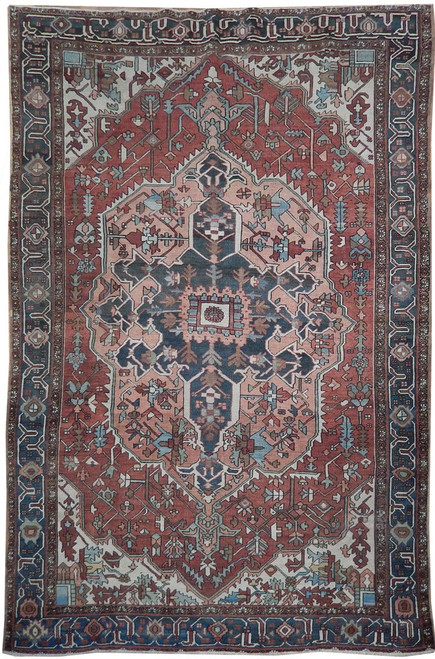
This is village weaving doing what it does best: a rustic red field, a stepped navy medallion with an ivory heart, and wool with enough body to take decades of foot traffic without thinning. It was knotted in the 1980s in the Heriz district of northwest Persia, and the drawing follows the same angular formula the district's looms have repeated for well over a century, which is why it reads older than its years. The pile is deep and even across the whole field, the selvedges are sound, and the fringe is clean, so the rug lies flat and is ready to go straight down. At 7'4" x 10'3" it lands in the most requested proportion in the store, which is why we keep a dedicated run of 7x10 Persian rugs, and it ships with a certificate of authenticity confirming it is hand-knotted and Persian in origin.
Please Note About the Photographs:
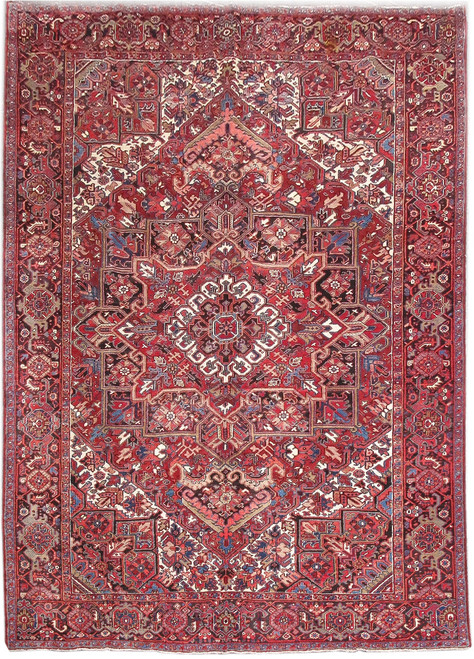
The first studio photograph reads a shade deeper and more burgundy than the rug actually is, because of the lighting on our white backdrop. The floor photographs and the close-up pile shots show the truer color: a warm rustic red with brick and terracotta tones. Nothing in the weave differs between the images, only the light.
Design and Motifs
The center holds a stepped, many pointed medallion ringed in olive and ivory outlines, with an 8 petal rosette at its core drawn in ivory and salmon over a brick red ground. Above and below it, long navy pendants rise like anchors into the field, flanked by angular leaves and tiny hooked blossoms. The field itself is covered in small serrated vines, star rosettes and stylized birds, all drawn with the straight lines and right angle turns that mark this district out from the curved drawing of city workshops. The 4 corners are filled with large ivory spandrels carrying a diagonal lattice of angular vine and palmette, which pulls light into the ends of the rug and keeps the red from taking over. The main border is a deep navy band of hexagonal cartouches alternating with rose and ivory rosettes, framed by narrow olive gold guard stripes with reciprocal hooks, one of the clearest statements of the tradition among geometric Persian rugs.
A Closer Look at the Colors
The field is a rustic red that shifts between brick and terracotta as the light moves across the pile, warm rather than bright, with the softness that only comes from wool that has been walked on and vacuumed for years. Against it sits an inky indigo navy used for the medallion ground, the pendants and the main border, dark enough in the macro shots to look almost black at the base of the knot and clearly blue where the light hits the tips. Ivory does the heavy lifting in the corner spandrels, the medallion center and the thin outline lines, and it has aged to a creamy oatmeal rather than a stark white. Through all of it run olive green and mustard gold outlines, a true mid blue in the small flower heads, salmon and dusty rose in the border rosettes, and camel brown in the guard stripes. The overall read is a classic warm palette for anyone shopping red and burgundy Persian rugs, with enough ivory and navy to sit comfortably on both dark and pale floors.
Heriz Origin and Weaving Quality
Heriz is a cluster of villages east of Tabriz, on the slopes below Mount Sabalan, and its reputation rests on two things the weavers did not have to invent: mineral rich water and famously tough local wool. That wool is what makes a rug like this one last, and the angular village drawing, straight lines, stepped corners and bold medallions, exists because it suits a sturdy coarser weave rather than a fine silky one. Village work here usually sits under 200 knots per square inch, and the trade off is in the buyer's favor: a thick, heavy, dense rug that handles hallways, dining chairs, dogs and children. This example shows the honest marks of a hand-knotted village piece, including slight variation in the field tone where different dye batches of wool met on the loom, which collectors read as a feature rather than a fault. If you want to understand how pieces like this are placed in time, our guide on how to date an Oriental rug walks through the same clues we used here.
7'4" x 10'3" Persian Heriz Rug | Rustic Red Geometric Medallion | 1980s Village Weave
Ask about this rug
This piece is the only one of it, so the things worth knowing about it are particular to it. If you want to talk through the size, the colour in your own light, or the weave, speak to someone here first.