Watch the film
| Size in ft: | Width: 6'10" x Length: 10' |
| Size in Inch: | Width: 82" x Length: 120" |
| Size in meters: | Length: 3.05 x Width: 2.08 m |
| Colors: | Rustic Red, Ivory, Blue, Black, Olive |
| Shape: | Rectangular |
| Woven: | Hand-Knotted |
| Pile: | Wool |
| Origin: | Persia |
| Design: | Heriz |
| Age: | 1980's |
| Condition: | Excellent |
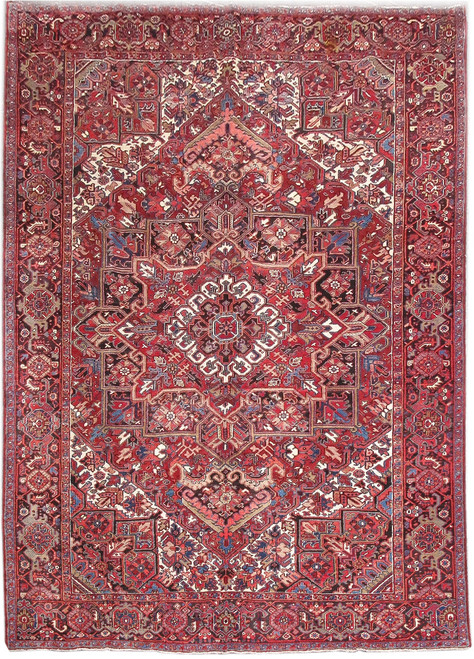
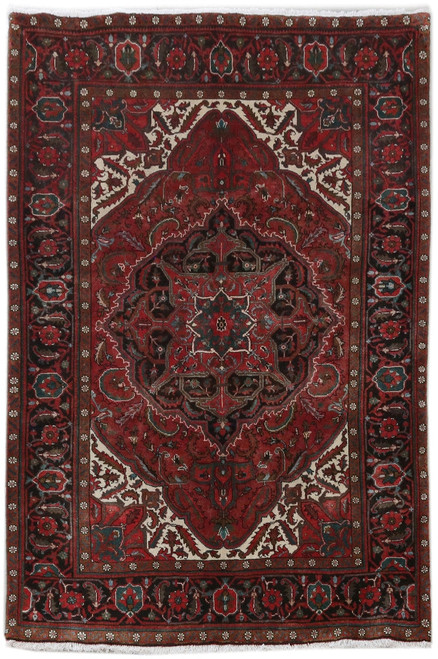
6'10" x 10' Persian Heriz Rug | Rustic Red Geometric Medallion | 1980s Village Weave
This is a 1980s Persian Heriz, hand-knotted in wool on a cotton foundation in the weaving villages east of Tabriz, and it has the two things buyers actually look for in a Heriz: heavy lanolin-rich wool and confident angular drawing. The pile is full and even from end to end, the selvedges are sound, and there are no repairs or stains. The palette has settled the way good madder and indigo do over 40 years, warm rather than raw. At 6'10" x 10' it is one of the most practical proportions in the house, sitting comfortably under a seating group with the front legs of the sofa and chairs on the wool, which is exactly how a Heriz is meant to be used. It falls squarely in the popular range of 7x10 Persian rugs, and every piece ships with a certificate of authenticity.
Design and Motifs
The field is built around one large stepped star medallion, outlined in ivory and filled with mid-blue leaf forms and serrated palmettes that radiate from a small hooked rosette at the dead center. Above and below it sit two anchor-shaped pendants in near-black indigo, each sprouting its own ivory-edged hooks. The red ground between them is packed with angular vinework, blocky palmettes, tiny animal and bird forms and stepped leaves, all drawn in straight lines because the village loom and the coarse-woven Heriz tradition favor the diagonal over the curve. The 4 corners carry ivory spandrels filled with hooked vines and rosettes, a device that lightens the whole composition and gives the eye somewhere to rest. The main border on indigo alternates round rosettes with serrated palmette clusters, flanked by camel and red guard stripes with a running vine. Anyone who likes the honest, bold vocabulary of Persian geometric rugs will recognize this as a textbook example of it.
Rustic Red, Indigo and Ivory in Detail
The field reads as a rustic madder red, deeper and slightly brick toward the center and lifting to a warmer brick tone along the sides, with gentle abrash banding that proves the yarn was dyed in separate lots. The medallion interior brings in two distinct blues: a clear mid-blue in the leaf cartouches and a much darker, almost black indigo in the pendants and outlines. That same dark indigo carries the main border, where it contrasts hard against ivory rosette hearts and camel-gold vine work. Ivory does the structural work here, tracing the outline of the medallion, filling the 4 corner spandrels and picking out the fine guard stripes, so the red never becomes heavy. Olive and soft brown appear in small doses inside the leaves and border vines, and black outlining defines every motif edge. Under lamplight the wool takes on a low sheen that shifts the red toward garnet, while in daylight it sits closer to terracotta.
Heriz Weaving and Village Quality
Heriz is a group of villages spread across the slopes east of Tabriz, below Mount Sabalan, and the reputation of the area rests on two natural advantages: mineral-rich water that sets the dyes, and sheep whose fleece is famously tough and high in lanolin. That wool is what makes a Heriz survive a century of traffic when a finer rug would have gone bald. Weavers here work from memory and from village drawings rather than a fully painted cartoon, which is why the medallion here is a shade off-center and the corner spandrels differ slightly left to right. Those small irregularities are the signature of genuine village work. The knot count is the usual sturdy Heriz range rather than a workshop count, and the pile is left generous so the rug wears slowly. The back photograph shows clean, regular knotting and a firm handle for a rug of this age. If you want to understand how weave, wool and palette combine to place a piece in time, our guide on how to date an oriental rug walks through the same clues we used on this one.
6'10" x 10' Persian Heriz Rug | Rustic Red Geometric Medallion | 1980s Village Weave
Ask about this rug
This piece is the only one of it, so the things worth knowing about it are particular to it. If you want to talk through the size, the colour in your own light, or the weave, speak to someone here first.