Watch the film
| Size in ft: | Width: 8'2" x Length: 10'5" |
| Size in Inch: | Width: 98" x Length: 125" |
| Size in meters: | Length: 3.18 x Width: 2.49 m |
| Colors: | Red, Black, Blue, Olive Green, Ivory |
| Shape: | Rectangular |
| Woven: | 100% Hand-knotted | Handmade |
| Foundation: | 100% Cotton |
| Pile: | |
| Age: | 1980's | Vintage |
| Design: | Vintage Heriz | Stepped Medallion | Ivory Corner Spandrels |
| Origin: | Persian Heriz | Made in Persia |
| Condition: | Excellent |
8'2" x 10'5" Persian Heriz Rug | Vintage Geometric Medallion | 1980s Village Weave
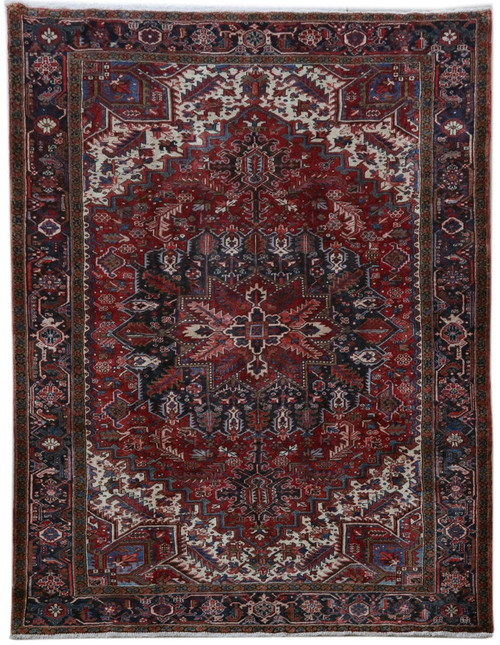
Knotted in the 1980s in the Heriz district of northwest Persia, this 8'2" x 10'5" rug is the classic village statement piece: a deep red field, a stepped navy medallion straight down the center, and ivory corner spandrels that throw light back into the room. The wool is heavy and lustrous, the pile still stands full across the whole field, and the drawing has the slightly irregular, hand-drawn quality that separates a real village Heriz from a factory copy. At just over 8 by 10 feet it sits in the most useful footprint in the house, which is why buyers searching 8x10 Persian rugs so often land on a Heriz. It arrives with a certificate of authenticity documenting origin, age, materials and construction.
Design and Motifs
The center holds a large stepped medallion on a near black ground, filled with a red lozenge, small 8 petal rosettes and a pale blue vase form at its heart. Anchor pendants extend above and below the medallion, and hooked latch motifs push out to the left and right, so the whole center reads as one long linked chain rather than a single closed shape. The 4 corners carry generous ivory spandrels drawn with palmettes, serrated leaves and angular vine work, and the field between them is packed with small blossoms, comb forms, boteh and stray birds, all rendered in straight lines rather than curves. The main border runs a black ground with brick red rosettes and hooked vine, flanked by narrow guard stripes in red and camel. This is the drawing language that defines geometric Persian rugs: every curve resolved into an angle the weaver can count out knot by knot from memory.
A Field of Madder Red with Navy, Olive and Ivory
The field is a warm madder red that shifts as you walk around it, reading brick and tomato where the light hits the pile directly and settling to a deeper burgundy against the nap, exactly the movement collectors look for in red and burgundy Persian rugs. Against it the medallion ground and the main border go almost black, a very dark indigo navy that gives the whole rug its structure and its weight on a pale floor. The secondary palette does the real work: olive green in the small leaf clusters and rosette centers, camel and soft gold in the vine work, cobalt and powder blue in the latch hooks, and clean ivory in the spandrels, the outlined birds and the scattered accents across the field. A few touches of rose and forest green appear in the border cartouches, visible in the close-up photographs. The overall effect is rich rather than busy, because the red field holds everything together.
Heriz: The Village Weave East of Tabriz
Heriz is a cluster of weaving villages east of Tabriz, on the slopes below Mount Sabalan, and its reputation comes from two things. The first is the wool: mineral-rich water and hard mountain pasture produce a fleece so tough and so high in lanolin that Heriz rugs are famous for surviving generations of daily traffic. The second is the drawing, worked from memory and village tradition rather than a full cartoon, which is why no two Heriz rugs of the same design are ever identical. Village Heriz weaving typically sits below 200 knots per square inch, and that is by design: a slightly coarser knot on a cotton foundation with a medium wool pile is what makes the rug so hard-wearing. The back shown here is even and legible, the selvedges are intact and the ends are sound. Anyone curious about reading age from wool, dye and wear will find our guide on how to date an oriental rug a useful companion to this piece, which shows the mellowing you expect from 40 years of age without any loss of pile.
8'2" x 10'5" Persian Heriz Rug | Vintage Geometric Medallion | 1980s Village Weave
Ask about this rug
This piece is the only one of it, so the things worth knowing about it are particular to it. If you want to talk through the size, the colour in your own light, or the weave, speak to someone here first.