Watch the film
| Size in ft: | Width: 8'2" x Length: 11'1" |
| Size in Inch: | Width: 98" x Length: 133" |
| Size in meters: | Length: 3.38 x Width: 2.49 m |
| Colors: | Brick Red, Black, Ivory, Sky Blue, Olive Green, Camel |
| Shape: | Rectangular |
| Woven: | 100% Hand-knotted | Handmade |
| Foundation: | Cotton |
| Pile: | Wool | 3/8" pile |
| Design: | Heriz | Geometric Medallion | Palmette Border |
| Origin: | Persian Heriz | Made in Persia |
| Condition: | Excellent |
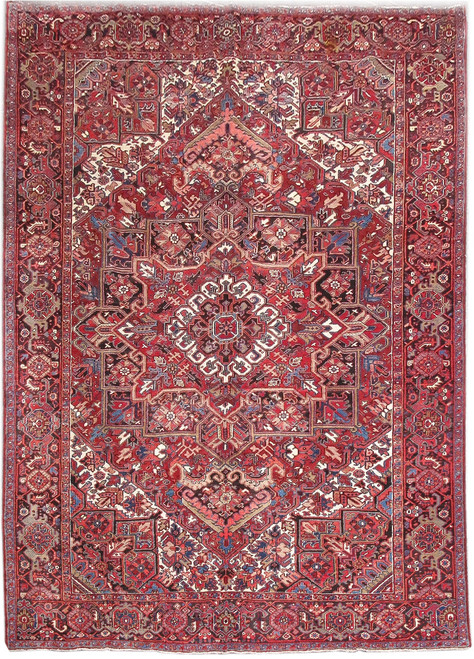
8'2" x 11'1" Persian Heriz Rug | Geometric Medallion | Brick Red & Navy Village Weave
This is a full-size Persian Heriz at 8'2" x 11'1", woven on a cotton foundation with a dense 3/8" wool pile and finished in excellent condition, with the pile still standing evenly across the field. It is the classic village statement piece: a single black-ground medallion anchored in a brick red field, framed by a wide dark border of alternating rosettes and palmettes. The wool has the dry, glassy handle that Heriz weavers are known for, and the back photo shows clean, tight rows with no repairs and no reweaving. Each rug ships with a certificate of authenticity confirming it is hand-knotted in Persia. If you are shopping a specific footprint, this piece also sits in our collection of 8x11 Persian rugs.
Design and Motifs
The drawing is pure Heriz: straight lines, angular turns and no attempt at the curved court vine. At the center sits an 8 petal rosette in sky blue and camel, set inside a stepped black medallion that is outlined twice, first in ivory scrollwork and then in a hooked ivory cartouche that reads almost like a crown at the top and bottom. Four corner spandrels repeat the same black ground with matching rosettes, leaving the open red field between them filled with serrated leaves, small vine palmettes, arrow-shaped leaflets and little ladder and comb figures that the weaver added freehand. The main border alternates an ivory-outlined rosette with a large palmette, and it is flanked by narrow guard stripes of sky blue serrated vine and a fine reciprocal sawtooth edge. It is a design that reads as a clear, symmetrical whole from across the room and as a collection of hand-drawn geometric rugs details up close.
Color Palette
The field is a warm brick red that shifts between terracotta and a deeper madder tone as the light crosses it, a natural abrash that is visible in the angled photos and is the signature of hand-dyed village wool. Against it, the medallion and border grounds read as a very dark charcoal black with a faint navy cast where the pile catches light. The relief comes from ivory, which carries all of the scrolling outlines and the rosette centers, and from a soft sky blue used in the leaflets, the guard stripes and the small squares inside the medallion. Olive green and a muted teal appear in the serrated leaves, and camel gold fills the border rosettes and several of the palmettes, warming the whole scheme. Small touches of pale rose and cream sit in the border flowers. Taken together it is a red and black rug with enough blue, green and gold in the drawing to sit comfortably with wood tones, leather and cooler wall colors.
Heriz Origin and Weaving Quality
Heriz is a group of villages east of Tabriz in northwest Persia, spread along the slopes below Mount Sabalan. The mineral-rich water there gives the local sheep an unusually tough, high-lanolin fleece, which is why a Heriz can be walked on for generations and still hold its pile. Weaving is done on a village loom from memory rather than a full cartoon, which is exactly why the two halves of this field are close but never identical. Knot counts in Heriz work are typically under 200 knots per square inch, and the strength of the rug comes from the heavy wool and firm beat-down rather than from fineness. The back of this piece shows even, regular rows and straight side finishes, consistent with a well-made village loom. Buyers who want to place the weave in a period can read our guide on how to date an oriental rug, and those drawn to this style of drawing will find related work among our tribal rugs.
8'2" x 11'1" Persian Heriz Rug | Geometric Medallion | Brick Red & Navy Village Weave
Ask about this rug
This piece is the only one of it, so the things worth knowing about it are particular to it. If you want to talk through the size, the colour in your own light, or the weave, speak to someone here first.