Watch the film
| Size in ft: | Width: 7'6" x Length: 9'9" |
| Size in Inch: | Width: 90" x Length: 117" |
| Size in meters: | Length: 2.97 x Width: 2.29 m |
| Colors: | Brick Red, Blue, Olive, Ivory |
| Shape: | Rectangular |
| Woven: | 100% Hand-knotted | Handmade |
| Foundation: | Cotton |
| Pile: | |
| Age: | 1980's | Semi-antique |
| Design: | Heriz | Geometric Medallion | Stepped Corner Spandrels |
| Origin: | Persian Heriz | Made in Persia |
| Condition: | Excellent | Intact sides and ends |
7'6" x 9'9" Persian Heriz Rug | Geometric Medallion | 1980s Village Weave, Excellent Condition
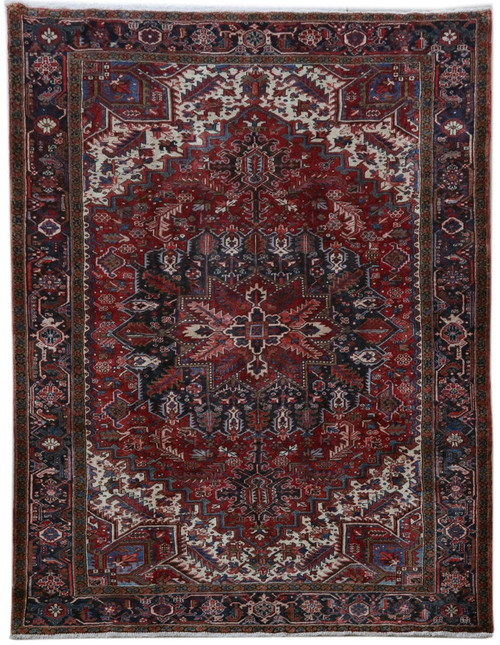
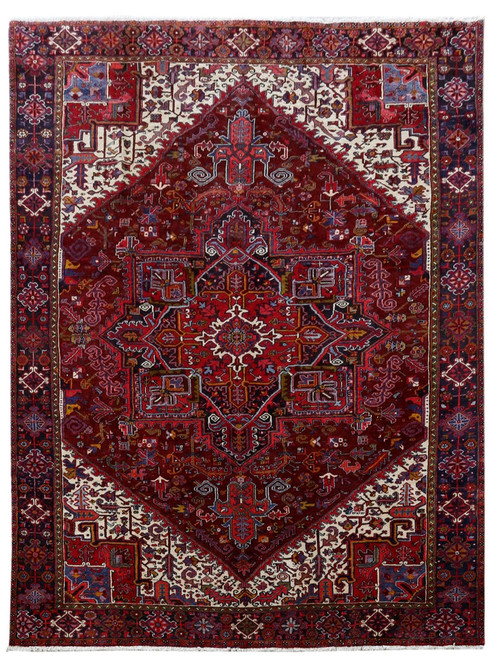
A Heriz is the rug people picture when they picture a Persian rug, and this one is a textbook example woven in the 1980s: 100% wool pile knotted by hand on a cotton foundation, a brick red field, a navy stepped medallion dead center, and ivory spandrels cutting the corners in long sawtooth steps. The weave is village work in the best sense, heavy in the hand, thick through the pile, with wool that has already taken on the faint sheen that only comes from decades of settling. At 7'6" x 9'9" it sits in the most useful footprint in the house, the same proportion buyers shop when they browse 8x10 Persian and Oriental rugs, and it reads as a serious antique-style floor piece without going dark. It ships with our certificate of authenticity confirming origin, materials and hand-knotted construction.
Design and Motifs
The drawing is entirely angular, which is the signature of the Heriz district and the reason these pieces sit at the top of the list for buyers of geometric Persian rugs. A broad hexagonal medallion fills the middle of the field, built from stepped navy outlines around a small squared center that holds an 8 petal rosette, with 4 blocky quatrefoil panels set into the medallion arms. Above and below it sit pendant cartouches, each one a flattened lozenge drawn in indigo and olive. The field around the medallion is packed with hooked vines, serrated leaves, squared palmettes and little cruciform blossoms, never a curved line anywhere. The ivory spandrels step inward in a long zigzag that gives the layout its lift. Three borders frame the whole thing: a navy main band of alternating hooked panels and olive rosettes, flanked by narrow red and ivory guard stripes carrying a running flower and leaf meander.
A Closer Look at the Color
The field is a true brick red, warmer and more terracotta than a Kashan red, and the close-ups show it breaking gently into lighter coral and salmon passages where the wool took the dye unevenly, the natural abrash that collectors look for in red and burgundy Persian rugs. Against that, the medallion and the main border read a deep inky navy that goes nearly black in low light, giving the pattern its hard edge. Olive runs through the vine work and the border rosettes as a muted khaki green, and a second earth tone, a warm tobacco brown, outlines many of the palmettes. Ivory is the accent that does the heavy lifting: it draws the spandrel steps, the small hooked brackets in the field, and the outlines of the medallion, keeping the red from closing in. Scattered touches of soft gray blue and dusty rose appear in the smaller blossoms. The overall effect is rich and warm rather than loud, and it carries dark wood floors and white walls equally well.
Heriz Origin and Weaving Quality
Heriz is a group of villages east of Tabriz in northwest Persia, spread along the foothills below Mount Sabalan. The water there is mineral rich and the sheep produce famously tough, slightly coarse wool, which is exactly why Heriz rugs have a reputation as the most durable floor rugs ever made in Persia. Weavers in these villages work from memory rather than a cartoon, so the design is simplified into straight lines, stepped outlines and bold shapes that can be scaled up on a wide loom. Knot counts here are typically under 200 per square inch, and that is by design: the heavier knot and thicker pile are what give the rug its structure and its long life. The back of this piece shows even, well packed rows on a cotton warp, square corners and original selvages, and the pile still stands full through the field. It is a rug built to be walked on for another 50 years.
7'6" x 9'9" Persian Heriz Rug | Geometric Medallion | 1980s Village Weave, Excellent Condition
Ask about this rug
This piece is the only one of it, so the things worth knowing about it are particular to it. If you want to talk through the size, the colour in your own light, or the weave, speak to someone here first.