Watch the film
| Size in ft: | Width: 9'9" x Length: 13' |
| Size in Inch: | Width: 117" x Length: 156" |
| Size in meters: | Length: 3.96 x Width: 2.97 m |
| Colors: | Dark Brick, Rust, Blue, Black, Ivory, Olive |
| Shape: | Rectangular |
| Woven: | 100% Hand-knotted | Handmade |
| Foundation: | Cotton |
| Pile: | 3/8" Wool |
| Design: | Heriz | Geometric Medallion | Ivory Spandrels |
| Origin: | Persian Heriz | Made in Persia |
| Condition: | Excellent | Full even pile |
9'9" x 13' Persian Heriz Rug | Geometric Medallion & Ivory Spandrels | Excellent Condition
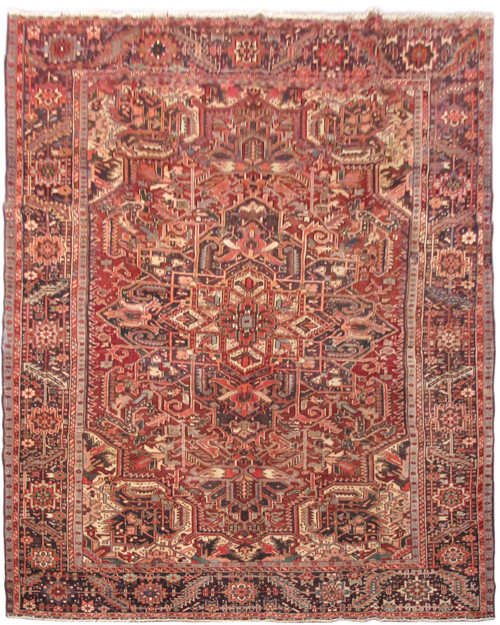
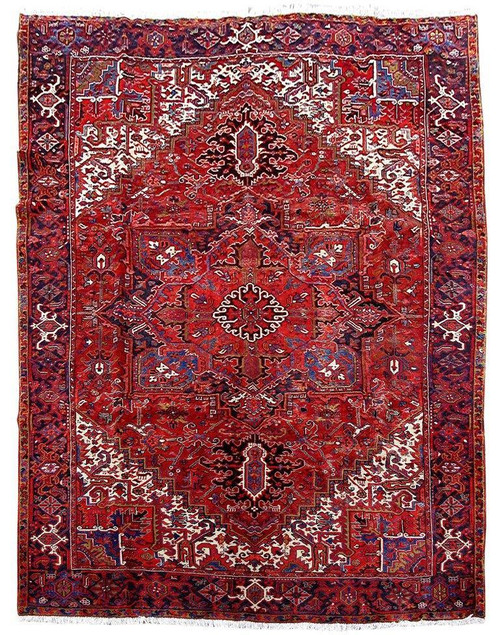
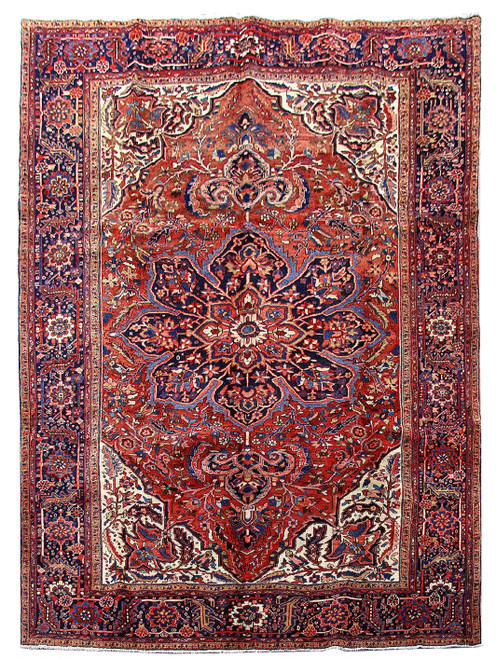
A true room-size Heriz in deep brick red, hand-knotted in wool on a cotton foundation with a full, even 3/8" pile that still stands up under the hand. At 9'9" x 13" the proportions are classic for the Heriz district, and the drawing is confident village work: one large stepped medallion, four ivory corner spandrels, and a field so densely packed with angular vines that no two square inches repeat exactly. The condition is excellent, with straight sides, tight selvages and original fringe, and it sits squarely in the most useful of all 10x13 Persian rugs for a living room or a dining table with chairs pulled out. Every rug we sell ships with a certificate of authenticity.
Design and Motifs
The center holds an 8 petal ivory rosette ringed in blue, set inside a stepped and serrated medallion outlined in pale sky blue against the dark brick ground. From its tips run cruciform pendants tipped with olive and gold hooks, and the whole medallion is framed by a diamond-shaped inner field that reaches almost corner to corner. The 4 spandrels are drawn in ivory and filled with angular palmettes, hooked brackets and small blue and rust boxes, the kind of crisp straight-line drawing that separates the best geometric Persian rugs from ordinary village goods. Scattered through the field are serrated leaves, curling rams-horn scrolls, tiny rosettes and a few birds and animal figures that the weaver added freehand. The main border runs a chain of ivory-outlined lozenges and star rosettes over a near-black indigo ground, with narrow rust and olive guard stripes on both sides.
A Field of Dark Brick, Rust and Ivory
The field is a dark brick red that shifts toward warm rust where the light catches the pile and deepens to an oxblood tone in the shaded passages, exactly the kind of variation good madder-toned wool gives across a large surface. Against it the ivory spandrels read almost white and give the rug its brightness from across a room, while the border ground drops to a black-leaning indigo that frames everything and keeps the red from spreading. Blue appears twice and does different work each time: a soft sky blue in the medallion outlines, leaf tips and scrollwork, and a saturated navy in the border lozenges and the small boxes inside the corners. Olive green runs through the leaves and pendant hooks as the quiet third color, with occasional gold, soft pink and a touch of brown in the smaller fillers. It is a warm, saturated palette that works with wood floors, leather and dark cabinetry.
Heriz Weaving East of Tabriz
Heriz is a group of villages east of Tabriz in northwest Persia, sitting below Mount Sabalan. The mineral-rich water there is credited with the famously tough, high-lanolin wool that makes these rugs the workhorses of the Persian tradition, and the weavers work from memory on large looms rather than from a full cartoon, which is why the drawing stays angular, symmetrical and slightly hand-adjusted from one side to the other. Village Heriz weaving usually sits under 200 knots per square inch, and that is not a shortfall: the heavier knot and the thick wool pile are what let a rug like this carry furniture and foot traffic for generations. The back photograph shows the knotting clearly against a ruler, with the cotton warps and wefts and the even, regular rows of a properly beaten weave. If you want to understand where a piece like this sits in time, our guide on how to date an Oriental rug walks through the same clues we use on the floor.
9'9" x 13' Persian Heriz Rug | Geometric Medallion & Ivory Spandrels | Excellent Condition
Ask about this rug
This piece is the only one of it, so the things worth knowing about it are particular to it. If you want to talk through the size, the colour in your own light, or the weave, speak to someone here first.