Watch the film
| Size in ft: | Width: 9'10" x Length: 13'2" |
| Size in Inch: | Width: 118" x Length: 158" |
| Size in meters: | Length: 4.01 x Width: 3.00 m |
| Colors: | Red, Navy Blue, Ivory, Rust, Olive Green, Sky Blue |
| Shape: | Rectangular |
| Woven: | 100% Hand-knotted | Handmade |
| Foundation: | Cotton |
| Pile: | |
| Design: | Heriz | Serrated central medallion | Stepped corner spandrels |
| Origin: | Persian Heriz | Made in Persia |
| Condition: | Excellent | Even pile throughout |
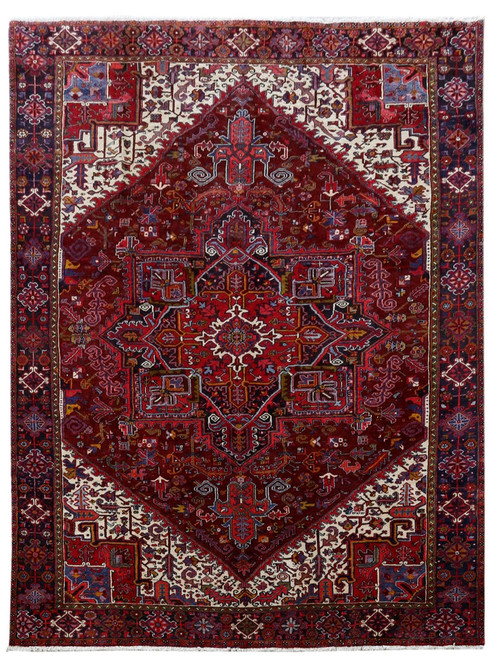
9'10" x 13'2" Persian Heriz Rug | Geometric Medallion | Ivory Spandrels | Excellent Condition
This is a full room size Heriz, hand-knotted in wool on a cotton foundation and measuring 9'10" x 13'2". It is the drawing that separates a good Heriz from an ordinary one: the serrated medallion sits dead centre, the ivory spandrels break cleanly at the stepped corners, and the field never loses its rhythm across more than 13 feet of length. The pile stands at 3/8", even from end to end, with the dry lustre that Heriz wool develops as it settles. At this footprint it belongs in the class of 10x13 Persian rugs that anchor a whole room rather than sit inside one. Every rug we ship carries a certificate of authenticity recording origin, materials and knotting.
Please Note About the Photographs:
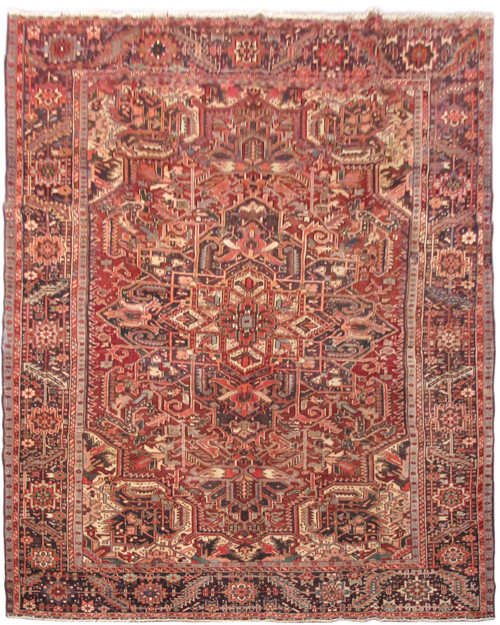
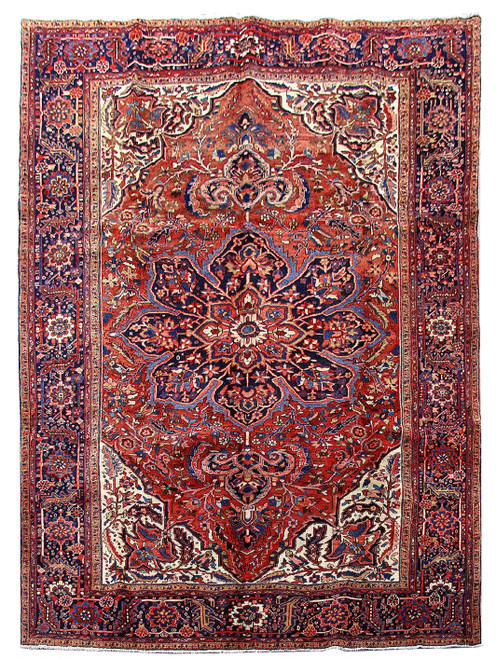
The overhead studio shot reads slightly cooler and more purple than the rug is in person. The close-up detail images and the floor photograph are the truer record of the colour: a warm madder red field with clear blue and ivory accents.
Design and Motifs
The centre carries a small ivory rosette medallion outlined in a scalloped white line, set inside a large serrated star medallion that radiates hooked leaf arms toward all 4 corners. Above and below it hang two dark indigo pendants with lobed, almost leaf-shaped silhouettes, the classic Heriz anchor points. Around them the field is packed with angular palmettes, hooked vines, small blossom heads and tiny stylised birds and comb figures, all drawn in straight lines and right angles rather than curves. The ivory corner spandrels are filled with the same vocabulary in reverse colour, which is what gives the rug its strong diagonal read from across a room. The main border runs a navy ground with alternating rosettes, diamond cartouches and angular vinework, framed by narrow reciprocal guard stripes. It is a textbook piece of drawing for collectors of geometric Persian rugs, where nothing is drawn freehand in a curve and every motif resolves on the grid.
A Madder Red Field Against Indigo and Ivory
The field is a deep madder red that shifts with the light, cooler and almost brick-toned where the pile lies away from you, warmer and brighter where it lies toward you. Against it the palette is disciplined: a near-black indigo in the pendants, the border ground and the outlines, a mid cobalt blue in the palmette interiors and the small quatrefoil fillers, and a clean ivory that does the heaviest lifting in the spandrels, the central rosette and the fine outlining that keeps every motif legible. Secondary colours appear in small quantities and matter more than their size suggests: a rust orange in the vine tips, an olive green in the leaf forms, a soft gold in the border rosettes, and occasional sky blue and pale rose flecks scattered through the field. The abrash across the red is gentle and horizontal, the natural result of dye lots changing as the weaving progressed, and it is the main reason the large open field never looks flat or printed.
Heriz Weaving East of Tabriz
Heriz is a group of villages in northwest Persia, east of Tabriz on the slopes below Mount Sabalan. The wool from those flocks is famously tough and high in lanolin, and the mineral-rich local water is credited with both the depth of the dyes and the hard, glassy handle the pile takes on over decades. Weavers there work from memory and from village cartoons rather than from a workshop master's drawing, which is why the medallion and spandrels are built from straight lines and stepped edges instead of the flowing curves of a city loom. Village Heriz work is typically knotted below 200 knots per square inch, and the trade-off is deliberate: a heavier knot on a stout cotton foundation, with a thick wool pile that takes generations of traffic. Photographed from the back, this one shows a tight, regular knot line with no slack rows or crowding, the mark of an experienced weaver holding tension steady over a loom more than 13 feet long.
9'10" x 13'2" Persian Heriz Rug | Geometric Medallion | Ivory Spandrels | Excellent Condition
Ask about this rug
This piece is the only one of it, so the things worth knowing about it are particular to it. If you want to talk through the size, the colour in your own light, or the weave, speak to someone here first.