| Size in ft: | Width: 9'4" x Length: 12' |
| Size in Inch: | Width: 112" x Length: 144" |
| Size in meters: | Length: 3.66 x Width: 2.84 m |
| Colors: | Ivory, Rust, Blue, Olive Green |
| Shape: | Rectangular |
| Woven: | Hand-Knotted |
| Pile: | Wool- Low Pile |
| Origin: | Persia |
| Design: | Serapi |
| Age: | 1930's |
| Condition: | Very Good |
9'4" x 12' Antique Persian Serapi Rug | Geometric Medallion | 1930s Heriz District Weave
Serapi is the name the trade gives to the best of the old Heriz weaving, and this 9'4" x 12' piece from the 1930s shows why the distinction stuck. The drawing is bolder and more open than a standard village rug of the period, the wool has burnished to a soft sheen rather than gone dry, and the whole surface has aged into the muted rust, ivory and indigo palette that decorators hunt for. The pile is low and even from end to end, the honest result of decades of gentle use, and the handle is supple enough that it lies flat with no cupping or ripple. At close to 9 by 12 feet it covers a full seating group, and it sits comfortably among our 9x12 Persian rugs. Every rug ships with a certificate of authenticity documenting origin, age, materials and hand-knotted construction.
Design and Motifs
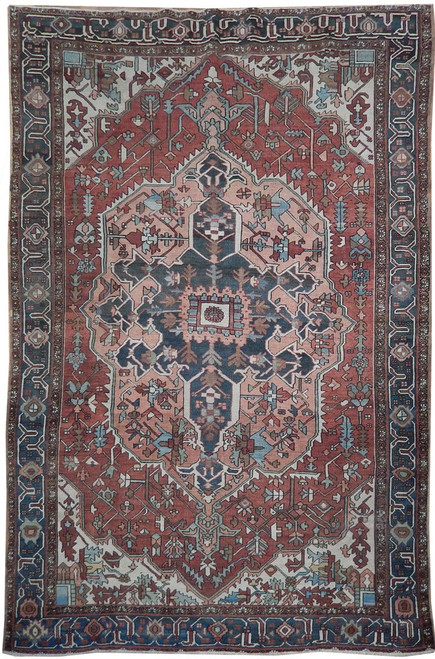
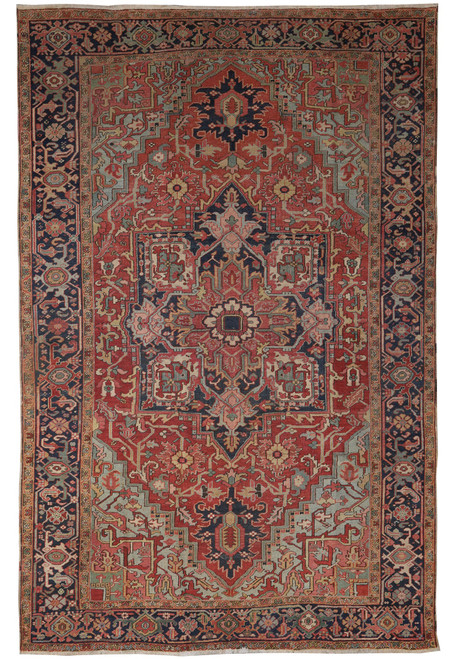
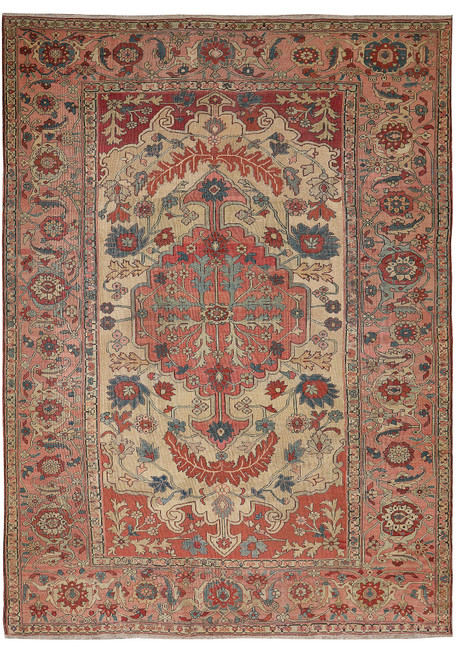
The field is built around a large stepped octagonal medallion on a deep indigo ground, with a pale ivory square cartouche at its center holding a small cluster of rosettes. Radiating out from the medallion are heavy serrated leaves and hooked palmettes, drawn in the angular Heriz manner where every curve resolves into a straight line or a step. Above and below, tall anchor pendants reach into an ivory open field scattered with 8 pointed stars, blossoms and small stylized cypress forms. All 4 corners carry substantial rust and blue spandrels with squared, layered brackets, and each is anchored by a small dark keyed square. The wide rust main border runs a procession of octagonal rosette medallions separated by upright leaf and vine devices, flanked by narrow olive and ivory guard stripes in a reciprocal vine. This is village drafting at its most confident, and it reads as clearly across a room as any of our geometric Persian rugs.
Color: Rust, Ivory, Indigo Blue and Olive Green
The dominant tone is a soft terracotta rust that shifts between salmon and dry copper depending on the light, and it fills both the spandrels and the wide main border. Against it, the medallion reads as a deep indigo that goes almost charcoal in the shadows and opens to a clear slate blue where the light catches the pile. Teal and aqua accents lift the serrated leaves and the small blossoms inside the medallion, while the open ground and the inner cartouche sit in a creamy ivory that has warmed to the color of old parchment. Olive green runs through the guard stripes and the star motifs, with occasional sage and pale celadon showing along the narrow banding, and small touches of dark brown and near black outline the rosettes and the corner squares. The overall effect is low contrast and dusty rather than bright, exactly the mellowed antique coloring that suits a room with wood floors, plaster walls and worn leather.
Origin and Weaving Quality
Serapi rugs come from the cluster of villages east of Tabriz in northwest Persia, below Mount Sabalan, where mineral-rich water and famously tough highland wool produce a fleece that resists abrasion and takes natural dye with unusual depth. Weavers there worked on a cotton foundation with a single wefted, firm structure, drawing from memory and small cartoons rather than a full workshop design, which is why the corners never quite mirror each other and the medallion sits with a slight, living asymmetry. Village work of this district is typically woven under 200 knots per square inch, so the quality question is never fineness but wool, dye and drawing, and on all 3 counts this piece is strong: the pile is dense at the base, the abrash in the rust ground is gentle and natural, and the selvedge and fringe are intact along the edges shown in the detail photos. Pieces like this are the standard reference point when dating an antique Oriental rug, and a 1930s Serapi in this state of preservation is getting harder to find each year.
9'4" x 12' Antique Persian Serapi Rug | Geometric Medallion | 1930s Heriz District Weave
Ask about this rug
This piece is the only one of it, so the things worth knowing about it are particular to it. If you want to talk through the size, the colour in your own light, or the weave, speak to someone here first.