| Size in ft: | Width: 10' x Length: 13'2" |
| Size in Inch: | Width: 120" x Length: 158" |
| Size in meters: | Length: 4.01 x Width: 3.05 m |
| Colors: | Salmon, Navy Blue, Ivory, Gold, Soft Blue, Sage Green |
| Shape: | Rectangular |
| Woven: | 100% Hand-knotted | Handmade |
| Foundation: | Cotton |
| Pile: | |
| Age: | Antique |
| Signature: | Signed | 2 woven cartouches on the long sides |
| Design: | Serapi | Star medallion with pendants | Floral palmette border |
| Origin: | Persian Serapi | Made in Persia |
| Condition: | Excellent | Even antique patina throughout |
10' x 13'2" Persian Serapi Rug | Salmon Field, Navy Star Medallion | Antique, Signed Cartouches
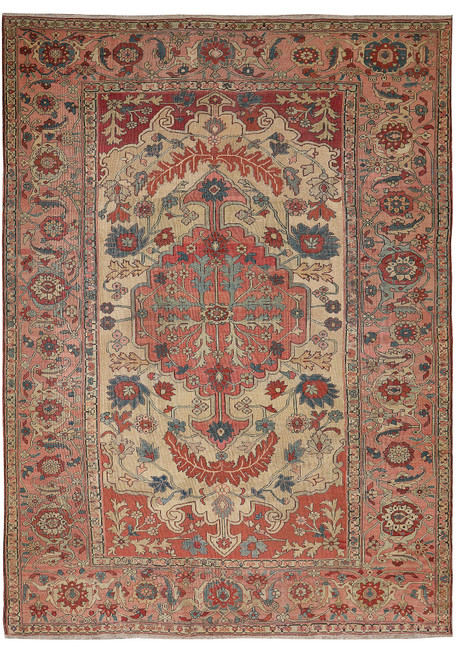
This piece arrived out of an old estate holding with its original paper dealer tag still tied to the selvage, stamped 25822 and written up by hand as 10x13'2, which is exactly what the tape reads today. It is a hand-knotted wool pile on a cotton foundation, a salmon field under a deep indigo star medallion, and it carries the low, even, slightly glassy pile that only decades of honest use produce. Two small woven cartouches sit at the midpoints of the long sides, so this is a signed weaving rather than an anonymous village piece. At this footprint it sits comfortably in the same bracket as our other 10x13 Persian rugs, floating a full seating group or a 10 chair table. A certificate of authenticity ships with the rug.
Design and Motifs
The center is an 8 lobed indigo star medallion built around a small salmon rosette core, ringed by a wheel of fine radiating stems and tiny hooked ornaments. Serrated leaf forms in gold and cream push out to the 4 quarters, and long navy pendants crowned with sage palmettes reach north and south toward the ends. Around all of that the salmon field is drawn with curling vine, cloudband forms, split leaves and small rosettes rather than the blocky angular filler you find on ordinary village work, and the ivory spandrels repeat the same scrolling vocabulary in a lighter key. The main border is a wide indigo band of alternating rose palmettes and leafy boteh forms, flanked inside and out by salmon minor stripes carrying a reciprocal chain of little rosette medallions, then closed by a narrow guard and the original flat selvage. Corner resolution is clean, which on a rug this size is the tell of a cartoon worked from a proper design rather than improvised.
A Salmon Field Under Indigo and Ivory
The field color is the reason to own this one. It reads as a soft salmon, a coral red mellowed by age into something closer to terracotta rose, and it moves across the width with gentle abrash that lightens toward the ends where the light catches the pile. Against it the medallion and the main border run a near black indigo navy that gives the whole rug its backbone. Between those two poles sit the antique tones: wheat and cream ivory in the spandrels and border ground, a warm old gold in the serrated leaves, sage and moss green in the palmette hearts, and a powdery soft blue that turns up in the small flowerheads and border rosettes. The close-up photographs show a few flecks of brick red and camel in the smaller ornaments. It is a warm, faded, lived-in palette that sits easily with walnut, oak, brass and cream plaster, and it will not fight an existing room the way a bright modern red would.
Serapi Weaving from Northwest Persia
Serapi is the name the trade gave to the best antique output of the weaving villages east of Tabriz, in the hill country below Mount Sabalan in northwest Persia. The wool from those flocks is famously tough and the mineral-rich water of the district sets dye with a depth that holds for a century, which is why rugs from this group survive on floors where softer weaves do not. What makes this example unusual within the group is the drawing: the vine is curved, the medallion outline is scalloped rather than stepped, and the border palmettes are modeled with several tones, all of which takes a higher knot count and a workshop hand than the standard angular village version. Add the 2 signature cartouches and you are looking at a commissioned piece rather than bazaar goods. The low even pile, the oxidized dark outlines and the soft handle all point the same way if you know how to date an antique Oriental rug, and this one has aged into its best years rather than out of them.
10' x 13'2" Persian Serapi Rug | Salmon Field, Navy Star Medallion | Antique, Signed Cartouches
Ask about this rug
This piece is the only one of it, so the things worth knowing about it are particular to it. If you want to talk through the size, the colour in your own light, or the weave, speak to someone here first.